craftX Design Labs
Selling on Instagram? Why Your Business Needs a Website.
Selling products on Instagram or WhatsApp? Learn how a business website builds trust, helps customers find you on Google, simplifies orders, and supports growth
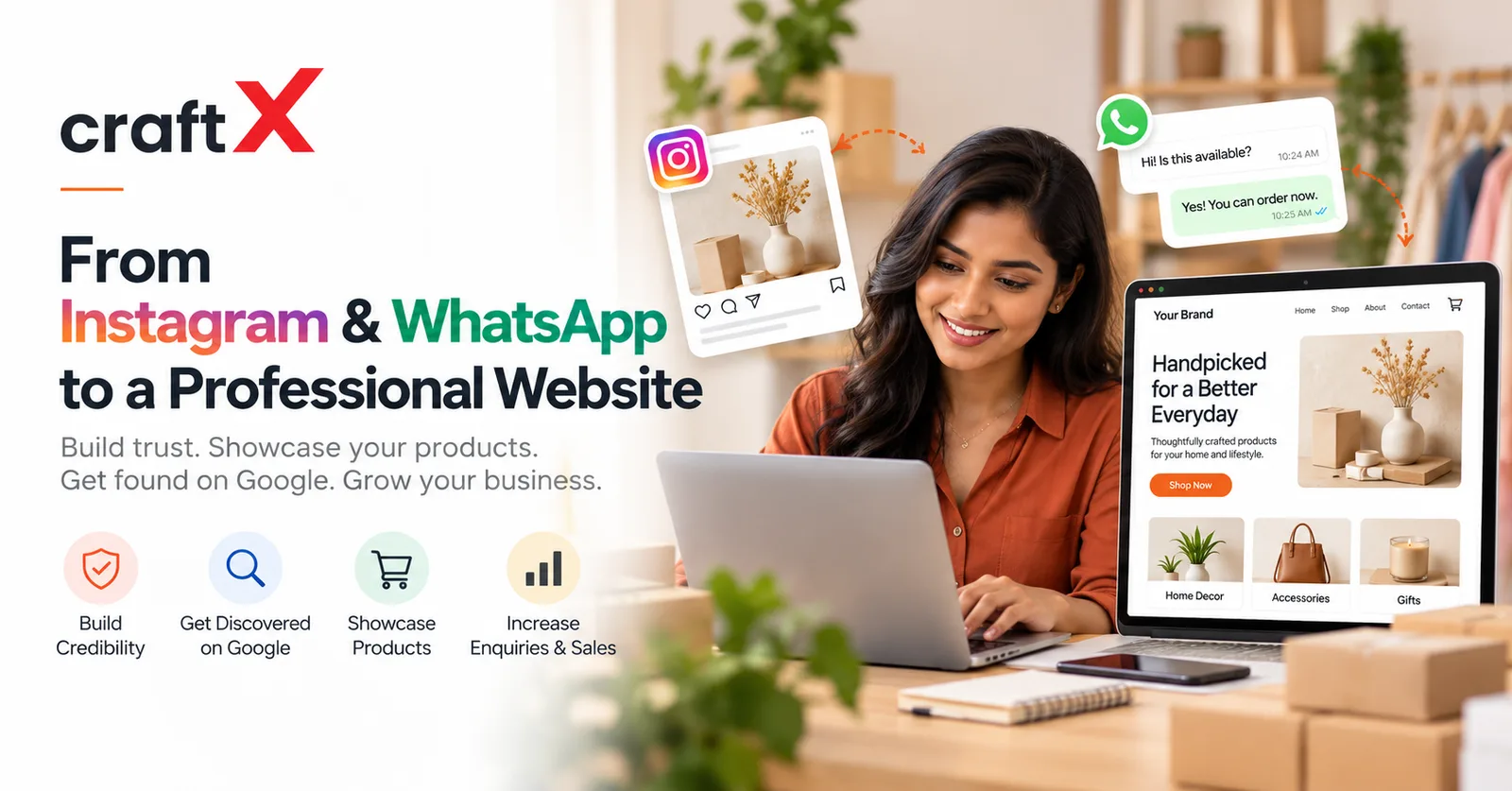
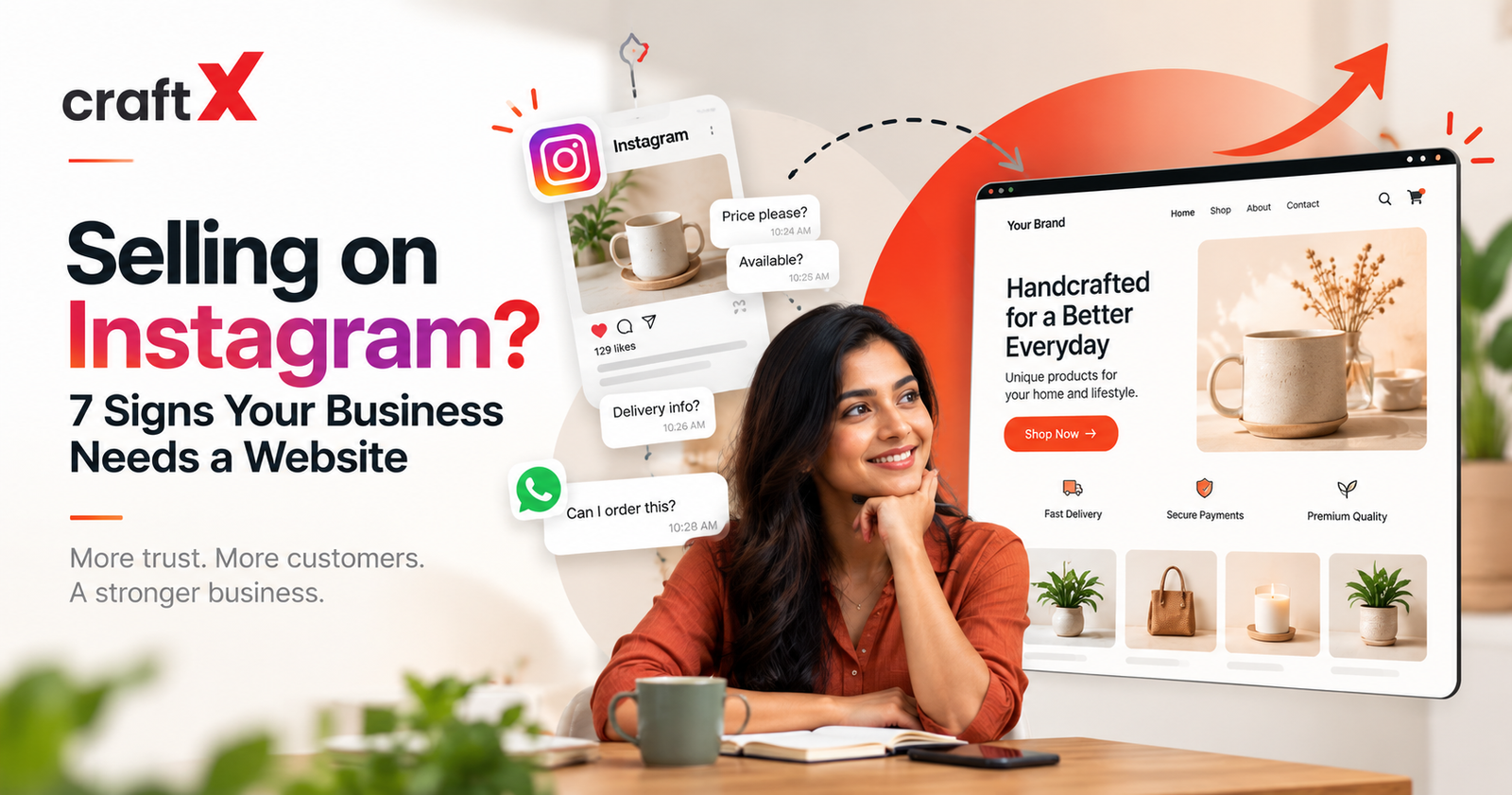
You started selling products on Instagram. Customers discovered your business through reels, sent enquiries on WhatsApp, and placed orders through direct messages. It was simple, affordable, and a great way to get started.
But as your business grows, things can become difficult.
You may be answering the same questions repeatedly, sharing product photos one by one, tracking orders manually, or struggling to turn social media followers into regular customers.
If this sounds familiar, you may be wondering: Do I really need a website if Instagram and WhatsApp are already bringing me customers?
The answer depends on your business goals. Social media is an excellent way to attract attention and connect with customers. A website gives you another important asset: a digital space that you control, where customers can explore your business, find information, browse products, and take action.
In this guide, we'll explain the benefits of having a business website, how it works alongside Instagram and WhatsApp, what it might cost, and how to decide what your business actually needs.
1. Why relying only on Instagram and WhatsApp can become difficult
Instagram and WhatsApp are valuable business tools. Many small businesses use them successfully to showcase products, answer questions, and manage customer relationships.
However, running your entire business through these platforms can create challenges as your customer base grows.
Customers have to ask for basic information
Imagine you sell handmade jewellery through Instagram.
A customer sees a necklace in your reel and sends a message asking for its price. Another asks about available colours. Someone else wants to know the delivery charges.
You may end up answering the same questions throughout the day.
With a website, you can display product prices, descriptions, images, available options, and delivery information in one place. Customers can review these details whenever they want.

Managing orders becomes time-consuming
When orders arrive through messages, you may need to copy customer details into a spreadsheet, confirm payments manually, and keep track of delivery status separately.
This can become difficult when several orders arrive at the same time.
An e-commerce website can bring product browsing, cart management, checkout, payment records, and order information into a more organised workflow.
You should still choose features based on your order volume and business needs. A small business may initially need only a product catalogue and enquiry form, rather than a complete online store.
Your business depends heavily on third-party platforms
Social media platforms control their own features, policies, account access, and distribution systems. Your reach and customer discovery can change over time.
A website gives your business a separate online presence. You can publish your own content, explain your services, organise your products, and build visibility through search engines.
This does not mean you should stop using social media. It means you should avoid depending on a single channel for every part of your business.
2. What are the benefits of having a website for your small business?
A well-planned business website can support several parts of your customer journey.
Benefit 1: Build customer trust
Before purchasing from an unfamiliar business, customers often want to know who they are buying from.
A professional website can answer important questions, including:
- What does your business sell?
- Who runs the business?
- What makes your products or services different?
- How can customers contact you?
- What are your delivery, return, or refund policies?
- Where can customers find genuine reviews or examples of your work?
For example, a home baker can use a website to display cake designs, flavour options, customisation details, ordering instructions, and delivery areas.
A customer can review this information before contacting the baker.
A website alone does not guarantee trust. Accurate information, good service, clear policies, and reliable customer support matter just as much.
Benefit 2: Help customers discover your business on Google
Social media content can help people discover your brand, but your website creates additional opportunities to appear in relevant Google search results.
Consider a person searching for:
- Custom birthday cakes in Hyderabad
- Handmade jewellery online in India
- Organic skincare products for dry skin
- Corporate gift suppliers in Vijayawada
If your website contains useful, relevant pages targeting the services or products you genuinely offer, those pages may become eligible to appear for related searches.
For example, a bakery could publish a page about custom birthday cakes in Hyderabad, explain its designs and ordering process, and provide accurate contact details.
To improve your chances of being discovered, create useful content, use descriptive page titles and headings, make your website mobile-friendly, and ensure search engines can access your pages.
Important: Having a website does not automatically put your business on Google's first page. Rankings depend on many factors, including relevance, competition, content quality, and your website's overall performance.
Benefit 3: Show all your products in one place
On Instagram, customers often have to scroll through older posts to find a particular product.
A website can organise your products into categories, making it easier for customers to browse and compare options.
For example, an apparel business could organise its store into:
- Men's clothing
- Women's clothing
- Kids' clothing
- New arrivals
- Bestsellers
- Sale products
Each product can have its own page with photographs, pricing, available sizes, colours, descriptions, and ordering options.
This makes the shopping experience more organised and reduces the need to send product details individually.
Benefit 4: Make ordering easier
A website can simplify the path from product discovery to purchase.
Depending on your setup, customers may be able to select products, add them to a cart, enter delivery details, pay online, and receive an order confirmation.
For businesses that are not ready for a full e-commerce store, a simpler website can still offer product catalogues, enquiry forms, quotation requests, or WhatsApp ordering links.
The best approach is the one that removes friction for your customers without adding unnecessary complexity to your business.
Benefit 5: Support your marketing activities
Suppose you run an Instagram advertisement for a skincare product.
You can direct customers to a product page that explains the ingredients, usage instructions, price, and available purchasing options.
You can also use your website to publish helpful articles, answer common questions, and provide information that supports customers before they buy.
With suitable analytics and conversion tracking, you can measure actions such as product views, enquiry submissions, and completed purchases.
This helps you understand what is working instead of relying only on likes, views, or follower counts.
3. Website vs Instagram vs WhatsApp: Which is better?
These platforms serve different purposes. Your business does not necessarily have to choose just one.
| Feature | Business website | ||
|---|---|---|---|
| Discover new brands | Strong for visual content and social discovery | Mainly conversations and shared links | Can attract relevant search traffic |
| Display products | Posts, reels and shop features where available | Catalogue features where available | Organised product pages and categories |
| Customer conversations | Comments and direct messages | Direct conversations and business messaging tools | Forms, chat links and contact details |
| Online ordering | Depends on available features and your workflow | Manual or assisted ordering | Can support structured checkout |
| Google search visibility | Individual public content may appear in some results | Not a substitute for a searchable website | Can provide indexable business and product pages |
| Control over presentation | Platform-defined | Platform-defined | Greater control over layout and content |
Each platform has limitations, and specific features can vary by account, country, and service provider.
The practical recommendation: Use Instagram to attract attention, WhatsApp to communicate with customers, and your website to provide complete information and support enquiries or orders.
For example, an Instagram reel can showcase a new product, the caption can direct viewers to your website, and a WhatsApp button can help customers ask questions before purchasing.
Together, these channels can create a more complete customer journey.
4. What type of website does your business need?

Not every business needs an expensive or complicated website. Start with your current requirements and build from there.
Option 1: A basic business website
Best for service providers, consultants, local businesses, salons, clinics, and companies that primarily receive enquiries.
A basic website may include:
- Home page
- About the business
- Services or product overview
- Portfolio or gallery
- Customer testimonials, where available
- Contact form and WhatsApp button
- Location and business hours, where relevant
For example, a photography studio could display wedding photography, pre-wedding shoots, baby photography, packages, previous work, and an enquiry form.
Customers can understand the studio's services before contacting the team.
Option 2: A product catalogue website
Best for businesses that sell physical products but prefer to receive orders through WhatsApp or direct enquiries.
It can include product categories, photographs, descriptions, prices, and enquiry buttons.
For example, a home decor brand could display its complete collection online. Customers browse products and click a WhatsApp link to ask about availability or place an order.
This approach can be a useful starting point if you are not ready to manage online payments and automated order processing.
Option 3: A full e-commerce website
Best for businesses that want customers to purchase products directly online.
Depending on requirements, an e-commerce store may include:
- Product categories, filters, and search
- Shopping cart and checkout
- Online payment gateway
- Delivery and shipping options
- Order confirmation and tracking
- Inventory management
- Discount codes and offers
- Sales and order reports
For example, a sweets brand selling products across India may benefit from an online store where customers can select varieties, choose quantities, pay online, and place orders without waiting for a manual response.
Start with the features you genuinely need. Additional functionality can be introduced as your business grows.
5. How much does a business website cost in India?
Website costs depend on the scope of the project, design requirements, number of pages, integrations, and ongoing support.
Instead of comparing prices alone, compare what each proposal actually includes.
| Website type | What to evaluate |
|---|---|
| Basic business website | Number of pages, custom design, contact forms, mobile responsiveness and basic SEO setup |
| Product catalogue website | Product categories, product management, enquiry flow and content updates |
| E-commerce website | Product management, checkout, payment gateway, shipping, order management and security |
| Custom business platform | User accounts, dashboards, workflow automation, integrations and reporting |
Your budget should also account for domain renewal, hosting, maintenance, premium plugins or software where required, payment gateway charges, and marketing.
Ask your developer whether these costs are included in the project quotation or billed separately.
There is no single price that fits every business. A small informational website and a store with hundreds of products, shipping integrations, and custom workflows require different amounts of work.
Before requesting a quotation, prepare a short list of your goals, required pages, products or services, integrations, and expected customer journey. This makes proposals easier to compare.
6. How to start building your business website
You do not need to understand programming to plan a useful website. Begin by understanding what your customers need and how you want them to interact with your business.
Step 1: Define your primary goal
Choose the main action you want visitors to take.
Examples include:
- Enquire about a service
- Browse products
- Purchase online
- Book an appointment
- Request a quotation
You can support several actions, but one clear primary goal makes the website easier to design.
Step 2: Identify your target customers
Think about who buys from you, what they need, and what questions they ask before making a decision.
A photography studio may need a portfolio and booking enquiries. A clothing brand may need product categories, size information, and checkout. A consultant may need service descriptions, case studies, and a contact form.
Your website should reflect your customers' buying process rather than simply follow a design trend.
Step 3: Prepare your content
Gather your business information, product photographs, service descriptions, logo, contact details, customer reviews, and policies.
Clear, original content helps visitors understand your offering. Use genuine photographs and accurate claims rather than misleading stock images or invented testimonials.
Step 4: Choose the right platform
WordPress with WooCommerce may suit businesses that need flexible content management and online selling. Other platforms or custom development may be more suitable depending on your requirements.
Compare ease of management, recurring costs, integrations, security, and future flexibility before choosing.
Step 5: Make the website mobile-friendly
Many customers will discover your business through a phone.
Make sure text is readable, buttons are easy to tap, images load efficiently, and forms are simple to complete. Test important pages on different screen sizes before launch.
Step 6: Set up basic SEO and analytics
Use descriptive page titles, relevant headings, meaningful image descriptions, and clear internal links. Ensure important pages are accessible to search engines.
Set up Google Search Console to monitor search visibility and Google Analytics or another suitable analytics tool to understand visitor behaviour.
You can also maintain a Google Business Profile if your business is eligible.
Step 7: Connect your marketing channels
Add links to your website from your Instagram profile, WhatsApp Business profile, email signature, and other relevant business channels.
Include clear calls to action so visitors know whether to enquire, browse products, or place an order.
Once your website is live, review the data and improve the pages that customers use most.
7. Common website mistakes small businesses should avoid
Building a website is only the beginning. Avoid these common mistakes:
Treating the website like an online brochure. A website should help customers take action, not just display information about your company.
Ignoring mobile users. A complicated mobile experience can make customers leave before completing an enquiry or purchase.
Publishing incomplete information. Missing prices, service details, delivery policies, or contact information can create unnecessary questions.
Expecting instant Google rankings. SEO requires useful content, technical accessibility, relevance, and time. Results are not guaranteed.
Ignoring website maintenance. Software updates, backups, security, broken links, and performance need attention after launch.
Running advertisements without a clear destination. Sending every visitor to a generic home page may be less useful than directing them to a relevant product or service page.
Building more than you need. Start with the features that solve your current problems and expand when there is a clear business reason.
8. How CraftX Design Labs can help your business
If your business is growing through Instagram and WhatsApp but managing enquiries, showcasing products, or converting visitors is becoming difficult, the next step is to identify what is missing in your current setup.
At CraftX Design Labs, we help businesses establish and improve their digital presence through:
- Business website development: Professional, mobile-friendly websites designed around your services and customer journey.
- E-commerce development: Online stores with product catalogues, payment integration, and order management based on your requirements.
- SEO and digital marketing: Search optimisation, content planning, social media campaigns, and paid advertising to help relevant customers discover your business.
- Branding and UI/UX design: Consistent brand presentation and user experiences that make your business easier to understand and use.
We believe the right solution should fit your business goals, not simply add more technology.
If you are unsure whether you need a basic website, a product catalogue, or a full e-commerce store, start with a conversation about your requirements.
Ready to build your online presence?
Visit CraftX Design Labs to explore our services, or contact our team to discuss your website and digital marketing requirements.
You can also call us on +91 77999 91816.
Let's identify what your business needs today and build a practical foundation for its next stage of growth.
Frequently Asked Questions
1. Can I sell products online without a website?
Yes. You can sell through Instagram, WhatsApp, marketplaces, or other available platforms. A website becomes useful when you want a dedicated place to showcase products, organise information, support search discovery, or manage online orders.
2. Is a website better than Instagram for a small business?
They serve different purposes. Instagram is useful for social discovery and engagement, while a website offers greater control over your business information, content, and customer journey. Many businesses benefit from using both.
3. How much does an e-commerce website cost in India?
The cost depends on the number of products, design complexity, payment and shipping integrations, inventory requirements, and ongoing support. Request a scope-based quotation rather than relying on one price for every store.
4. Will a website automatically bring customers from Google?
No. A website creates the opportunity to appear in search results, but rankings and traffic are not guaranteed. Relevant content, technical accessibility, competition, search intent, and overall website quality all matter.
5. Do I need online payments on my website?
Not necessarily. You can begin with a product catalogue, enquiry form, or WhatsApp ordering flow. Add online payments when they suit your customers and business operations.
6. Can I connect WhatsApp to my business website?
Yes. A website can include WhatsApp links or buttons that allow visitors to start a conversation with your business. You can use these to answer questions, discuss requirements, or support ordering.
7. Should I build a website before running Google or Instagram ads?
Not in every situation, but you should have a clear destination for your advertising. A suitable website or landing page can explain your offer, build confidence, and help you measure enquiries or purchases. For some campaigns, a direct messaging flow may also be appropriate.
8. How long does it take to build a business website?
The timeline depends on the scope, content readiness, design approvals, integrations, and testing. A simple website generally requires less work than a full e-commerce store or custom application. Ask for a realistic project timeline based on your requirements.
About the author
CraftX Design Labs helps businesses build websites, e-commerce stores, digital experiences, and marketing strategies. Our focus is on practical digital solutions that support real business needs.
Learn more at craftxdesignlabs.in.
- #Website
- #Website advantage
- #online store