Retail Operations
How to Manage Customer Returns and Exchanges in a Retail Shop
Learn how to manage customer returns, refunds, and product exchanges with clear policies, proper records, and practical retail procedures.
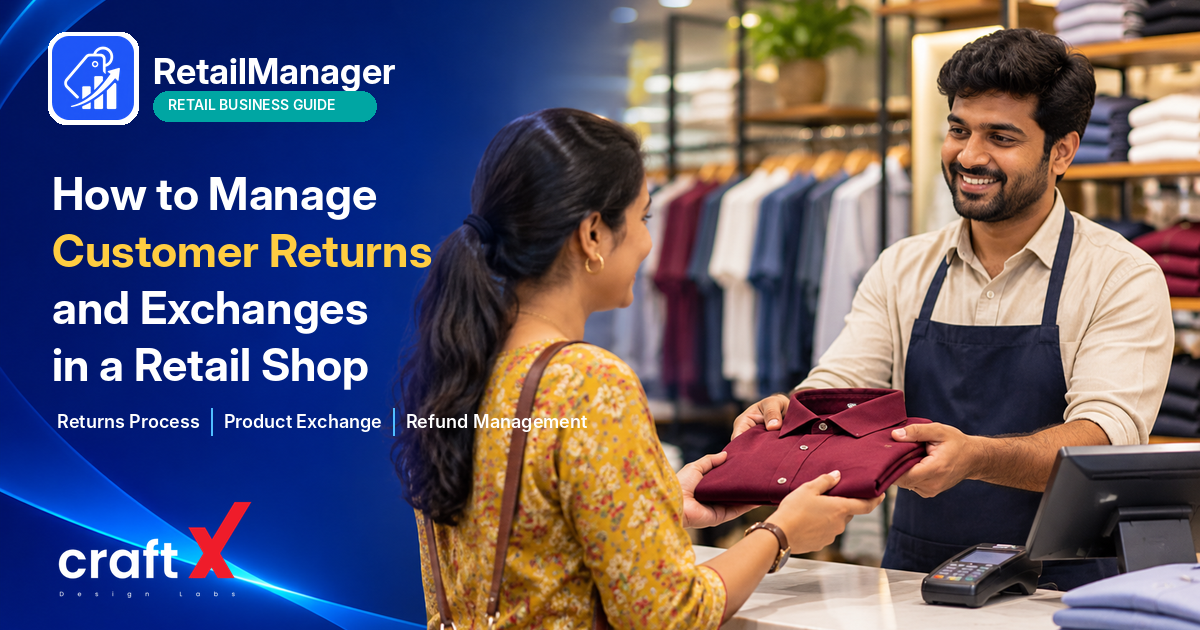
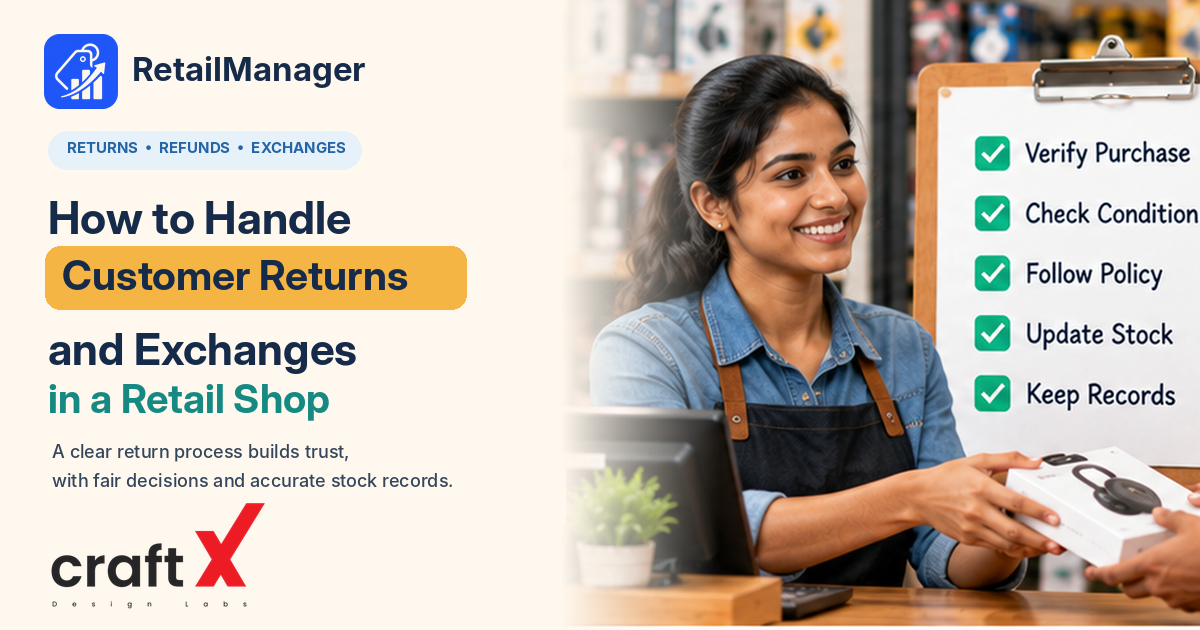
A clear retail return policy helps shop owners manage customer returns, product exchanges, and refunds without creating confusion at the billing counter. Whether you run a clothing store, electronics shop, supermarket, pharmacy, or mobile accessories business, customers may occasionally request to return a product after purchasing it.
Some products may be defective, damaged, incorrectly supplied, or unsuitable for the customer's requirements. Without a proper return process, shop owners may struggle to verify original purchases, calculate exchange differences, update stock records, and maintain accurate financial information.
For example, a customer purchases a shirt for ₹800 and later requests an exchange for another shirt priced at ₹950. The shop must verify the original transaction, inspect the returned item, calculate the price difference, and record the exchange correctly.
A consistent return management process helps retailers handle these situations professionally while maintaining customer confidence and accurate business records.
In this guide, we will explain how to create a return policy, process refunds, handle product exchanges, manage returned inventory, and reduce unnecessary returns using practical retail examples.
1. What Is a Retail Return Policy?
A retail return policy is a set of conditions that explains how a shop handles products customers request to return or exchange after purchase.
It helps customers understand the available options and gives employees a consistent process to follow.
A return policy generally covers:
- Products eligible for return or exchange.
- Applicable return periods.
- Required product condition.
- Original bill or proof of purchase.
- Refund and exchange procedures.
- Special conditions and exceptions.
- Handling of defective or damaged products.
For example, a clothing store may offer exchanges within seven days for eligible products that are unused, have their original tags, and are accompanied by the purchase bill.
An electronics shop may have a different process involving product inspection, serial number verification, and manufacturer warranty procedures.
The conditions should reflect the products you sell and the applicable consumer protection requirements.
Why should every retail shop have a return policy?
A clearly communicated policy provides several benefits.
Clear customer expectations: Customers understand the conditions before purchasing a product.
Consistent employee decisions: Employees can follow the same process instead of making different decisions for similar requests.
Better transaction records: Returns and exchanges can be linked to original purchases.
Improved inventory management: Returned items can be inspected and classified before their quantities are adjusted.
Better customer relationships: Customers are more likely to trust a business that explains its procedures clearly and handles genuine problems fairly.
A return policy is not simply about accepting or rejecting products. It is about managing the complete transaction correctly.
2. Understand Different Types of Customer Returns
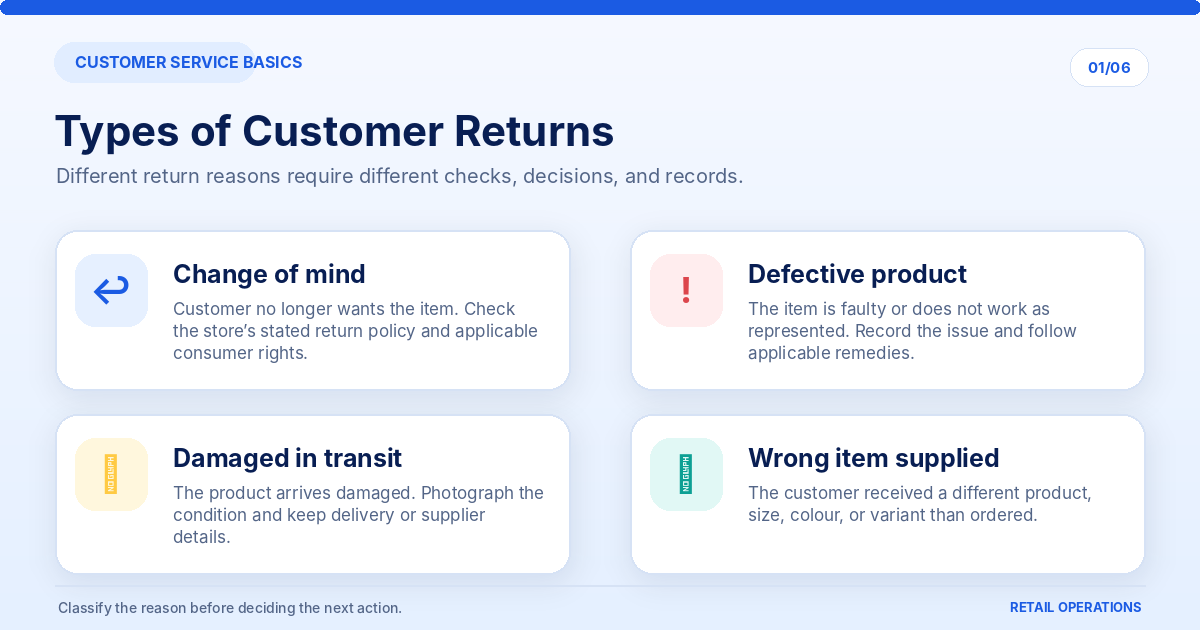
Not every customer return happens for the same reason. Identifying the reason helps you decide the appropriate next step.
Change-of-mind returns
Sometimes customers purchase a product and later decide they no longer need it.
For example, a customer buys a kitchen appliance but changes their mind before using it.
Whether such a return or exchange is accepted may depend on the shop's clearly communicated policy, purchase terms, and applicable laws.
Defective product returns
A customer may discover that a product does not work properly or has a manufacturing defect.
Examples include:
- An electronic device that does not switch on.
- A charger that does not function.
- A household appliance with a defective component.
- A product that does not perform as described.
These requests need proper inspection and appropriate resolution. A change-of-mind return restriction should not be used to avoid applicable consumer remedies for defective goods.
Damaged product returns
Products can sometimes be damaged during transportation, packaging, or handling.
For example, a customer purchases a glass container and discovers that it is cracked when opening the package.
The shop should identify when and how the damage occurred and determine the appropriate resolution.
Wrong product or variant
A customer may receive a different product, size, colour, model, or quantity from what was ordered or billed.
For example, a customer orders a blue shirt in size L but receives a black shirt in size M.
The shop should verify the original order and correct the issue.
Size and fit-related exchanges
Clothing and footwear stores regularly handle exchanges when the purchased size does not fit the customer.
A clear policy should explain the available exchange conditions, such as product condition, tags, packaging, and applicable return period.
Warranty-related requests
Some products are covered by manufacturer or seller warranties.
These requests may require warranty verification, service-centre inspection, repair, replacement, or another remedy according to the applicable warranty terms and consumer rights.
Understanding the reason for a return makes it easier to choose the correct procedure.
3. How to Create a Clear Retail Return Policy
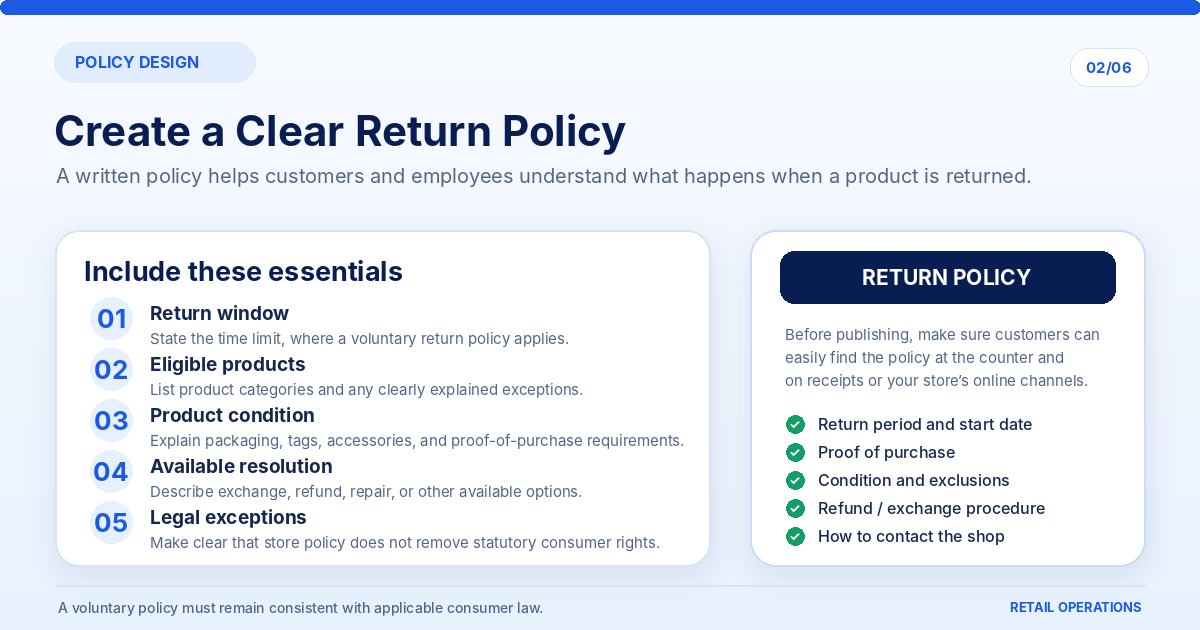
A useful return policy should be easy to understand and accessible before customers complete their purchases.
Avoid complicated conditions that employees cannot explain properly.
Consider including the following information.
1. Return eligibility
Specify which products can be returned or exchanged under your voluntary store policy.
Different product categories may require different conditions.
For example, a clothing shop may accept eligible unused garments, while opened consumables may require different handling.
Any exclusions must remain subject to applicable laws and consumer rights.
2. Return period
Clearly state the period within which eligible change-of-mind returns or exchanges can be requested.
For example:
- Seven days for eligible clothing exchanges.
- Fourteen days for selected household products.
These are illustrative store-policy periods, not universal legal limits.
The actual period should be chosen according to the product category, business model, and applicable requirements.
3. Product condition
Explain the condition expected when customers request a voluntary return or exchange.
Conditions may include:
- Original packaging where required by the policy.
- Product tags and accessories.
- Purchase documents.
- No signs of misuse or avoidable damage.
Do not apply these voluntary-return conditions to deny legitimate remedies for defective or wrongly supplied products.
4. Proof of purchase
Explain how customers can verify their original purchases.
Acceptable records may include:
- Original printed bill.
- Digital invoice.
- Transaction reference.
- Order confirmation.
- Other reliable purchase records.
5. Refund and exchange options
Clearly explain the available resolution methods.
These may include:
- Refunds where appropriate.
- Product exchanges.
- Replacement of defective products.
- Supplier or manufacturer warranty procedures.
Explain how price differences are handled during exchanges.
6. Special product conditions
Certain products may have additional restrictions because of hygiene, safety, storage, customisation, or regulatory requirements.
For example, opened personal-care products and customised merchandise may need different conditions.
Ensure these restrictions are communicated clearly and do not override legal consumer protections.
Display the policy where customers can see it
Place your return policy in visible locations, such as:
- Near the billing counter.
- Inside the store.
- On printed bills or invoices.
- On your business website.
- On product or order information where appropriate.
Employees should also know how to explain the policy.
4. Step-by-Step Process for Handling Customer Returns
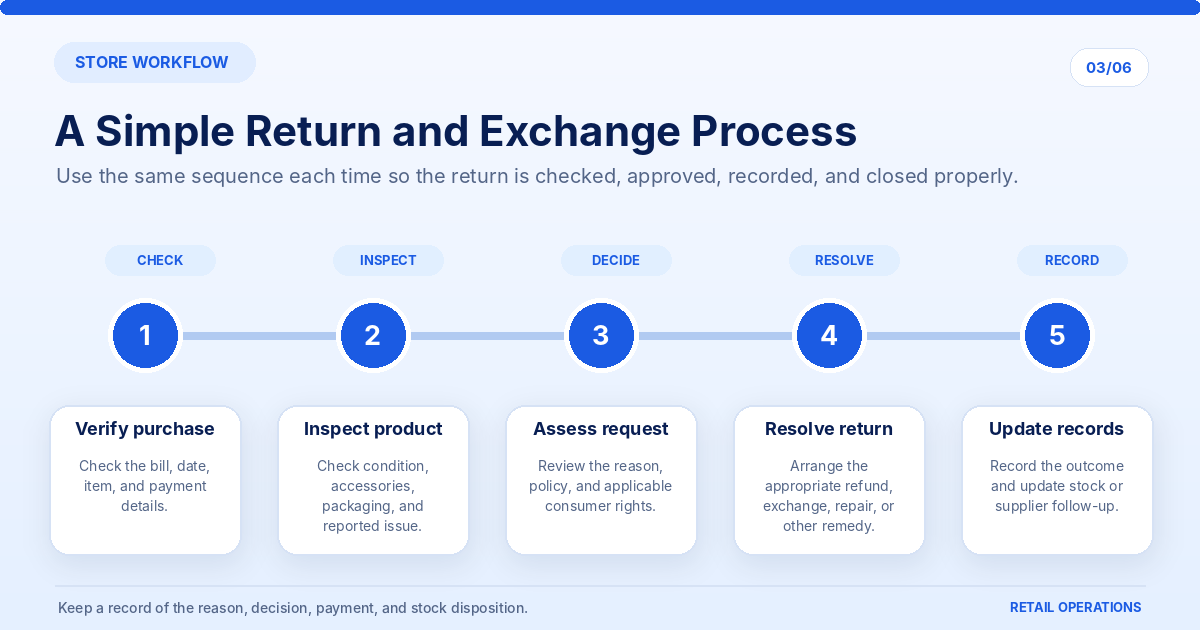
A consistent return process prevents confusion and helps employees handle requests efficiently.
Here is a practical workflow that retail shops can follow.
Step 1: Verify the original purchase
Ask the customer for the original bill, digital invoice, or another acceptable transaction reference.
Check:
- Purchase date.
- Product name.
- Quantity purchased.
- Selling price.
- Discounts applied.
- Payment details.
This helps confirm that the product was purchased from your store.
Step 2: Understand the return reason
Ask the customer why they want to return the product.
Common reasons include:
- Product defect.
- Wrong product supplied.
- Damaged packaging.
- Incorrect size or variant.
- Change of mind.
Recording the reason helps you identify recurring product or supplier problems.
Step 3: Inspect the returned product
Examine the item according to its product category and return reason.
For example, an electronic product may require checking its condition, serial number, accessories, and warranty information.
A clothing product may require checking the tags, condition, and signs of use when those conditions apply to the return.
Step 4: Determine the appropriate resolution
Review the original transaction, return reason, product condition, store policy, and applicable consumer requirements.
The possible resolutions may include:
- Refund.
- Product exchange.
- Replacement.
- Repair or warranty service.
- Supplier return for eligible products.
Employees should not make arbitrary decisions or reject genuine defect-related complaints simply because a product is outside a voluntary change-of-mind return period.
Step 5: Record the return transaction
Record the returned product against the original sale wherever possible.
Maintain the original invoice reference, product details, quantity, return reason, amount, and resolution.
Step 6: Update inventory and payment records
A returned item should not automatically be added to saleable inventory.
Inspect it first and classify it appropriately.
Also record any refund, price adjustment, or exchange transaction so that the sales and financial records remain accurate.
5. How to Process Product Exchanges Correctly
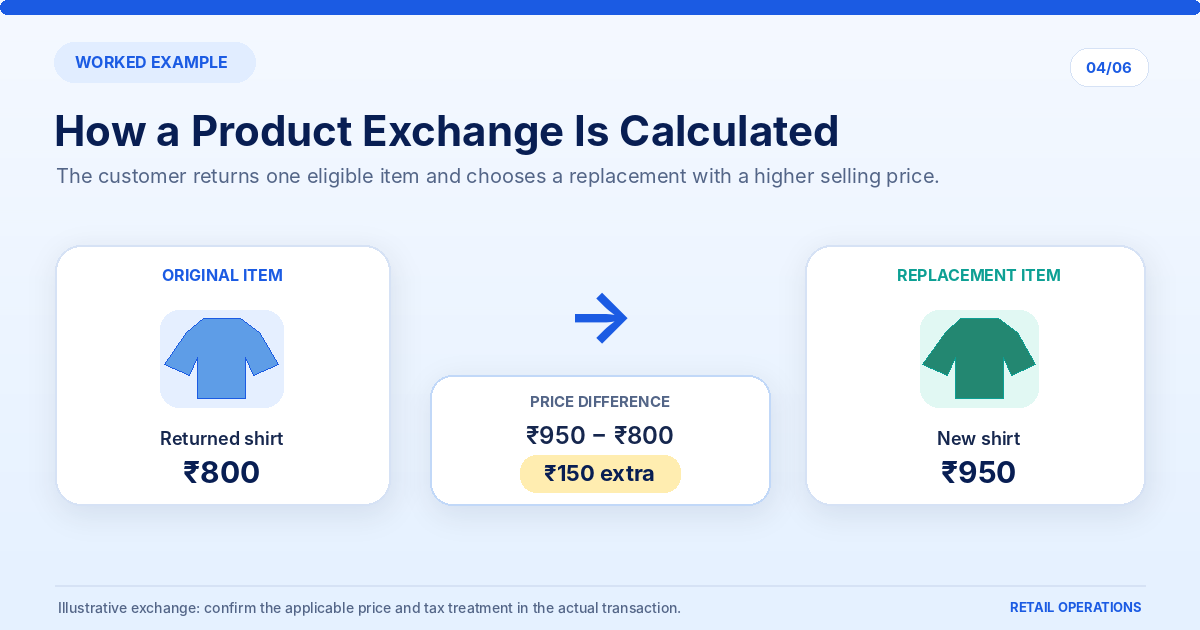
A product exchange happens when a customer returns an eligible product and receives another product instead of keeping the original item.
The new product may have the same price, a higher price, or a lower price.
Example: Customer exchanges a product with a higher price
Suppose a customer purchases a shirt for ₹800 but later chooses another shirt priced at ₹950.
The price difference is:
| Particulars | Amount |
|---|---|
| Original product price | ₹800 |
| New product price | ₹950 |
| Additional amount | ₹150 |
Calculation:
₹950 − ₹800 = ₹150.
The customer needs to pay an additional ₹150.
Example: Customer exchanges a product with a lower price
Now suppose the customer chooses another product priced at ₹700.
| Particulars | Amount |
|---|---|
| Original product price | ₹800 |
| New product price | ₹700 |
| Difference | ₹100 |
Calculation:
₹800 − ₹700 = ₹100.
The shop needs to resolve the ₹100 difference according to the applicable refund or store-credit arrangement.
Example: Customer exchanges a product with the same price
Suppose the original product costs ₹800 and the replacement product also costs ₹800.
There is no price difference.
However, the shop should still record the original return and replacement transaction so that product quantities and sales records remain accurate.
Important points during exchanges
Always verify the original purchase before processing an exchange.
Check whether the new product is eligible under the return policy.
Record the returned item separately from the replacement item.
Calculate the difference using consistent invoice values and apply the correct tax treatment where required.
Do not simply change the product name in the original sale record without maintaining an appropriate transaction history.
6. How to Handle Customer Refunds and Payment Reversals
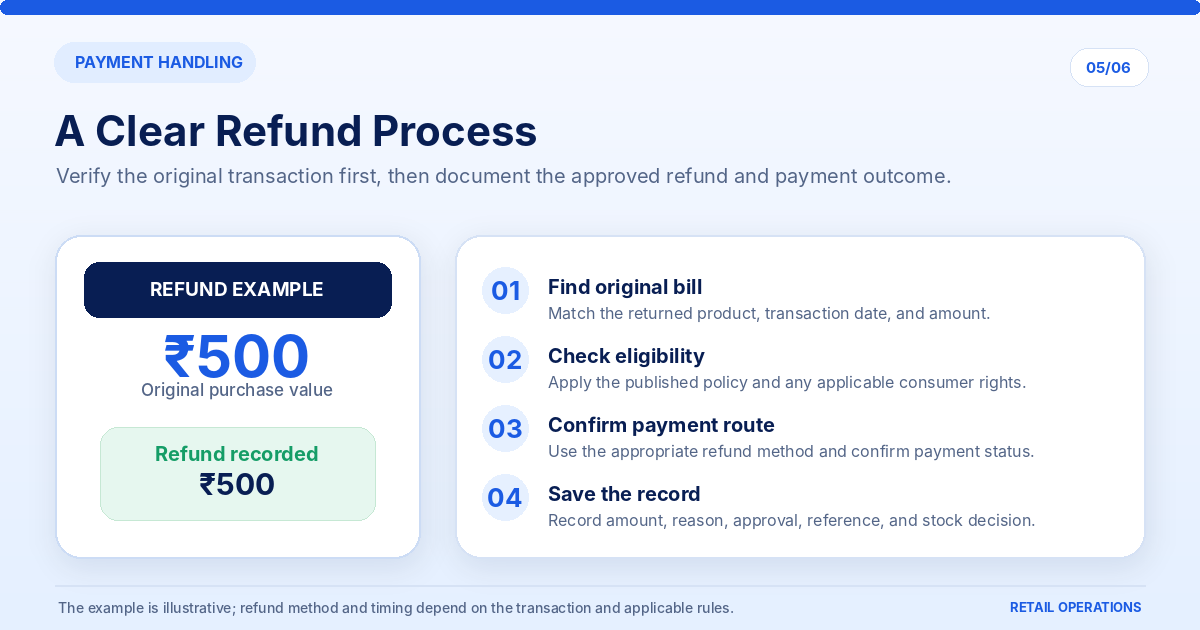
A refund is the process of returning money to a customer when an eligible purchase is reversed or an appropriate remedy requires repayment.
Refunds should be handled carefully because they affect sales records, payment records, and cash balances.
Verify the original transaction
Before processing a refund, check:
- Original invoice number.
- Purchase date.
- Product and quantity.
- Amount paid.
- Applicable discounts.
- Original payment method.
- Previous refunds or adjustments.
This helps avoid duplicate refunds or incorrect payment amounts.
Refund through the appropriate payment method
Where practical, process the refund through the original payment route, subject to the payment provider's procedures and applicable requirements.
For example:
- UPI transaction: Follow the relevant payment-provider refund procedure.
- Card payment: Process through the applicable card payment system.
- Cash purchase: Record the cash refund against the original transaction.
Processing times can differ depending on the bank, payment provider, and transaction type. Explain any expected delay to the customer.
Example: Full refund
Suppose a customer returns an eligible product worth ₹500.
| Particulars | Amount |
|---|---|
| Original sale amount | ₹500 |
| Refund amount | ₹500 |
| Net retained sale amount | ₹0 |
The refund should be recorded with its original invoice reference.
Example: Partial refund
Suppose a customer purchased multiple products and returns only one eligible item worth ₹300.
The remaining items are still part of the original purchase.
Only the applicable returned amount should be reversed, taking into account the original discounts and invoice calculation.
Maintain refund records
A refund register can contain:
| Field | Details |
|---|---|
| Refund reference | Unique transaction number |
| Original invoice | Original sale reference |
| Customer | Customer name, where available |
| Product | Returned item |
| Return reason | Reason for refund |
| Refund amount | Amount returned |
| Payment method | Cash, UPI, card, etc. |
| Date | Refund date |
| Status | Pending or completed |
This makes it easier to review refunds and investigate payment discrepancies.
7. How to Record Returned Products in Inventory
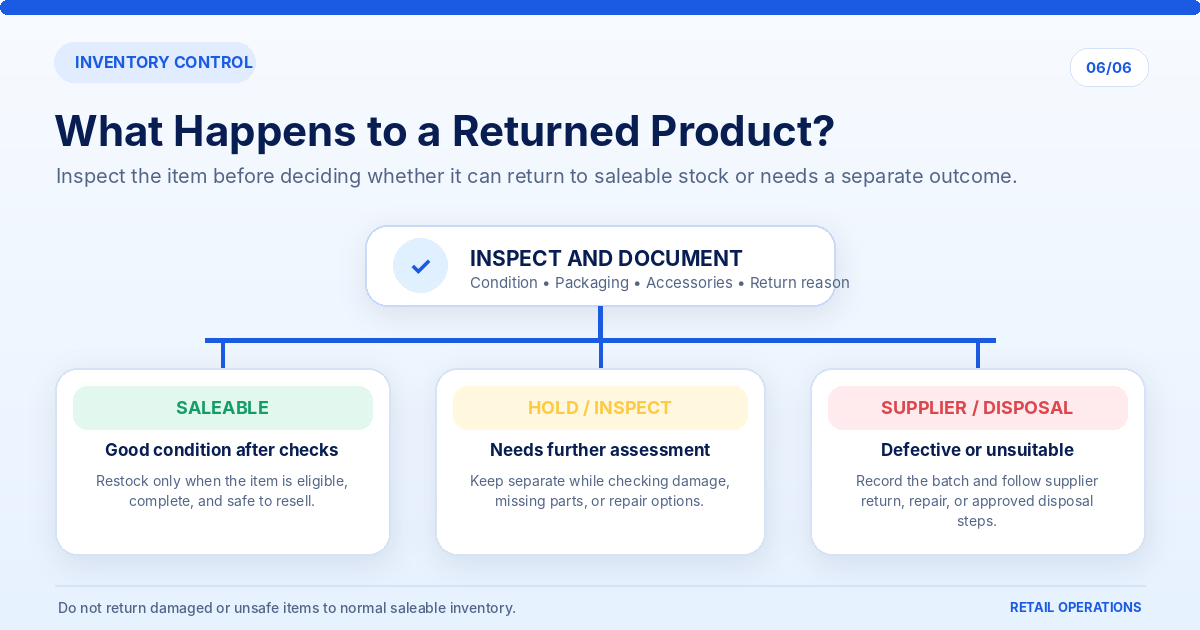
One of the most important parts of return management is deciding what happens to the returned product.
A product returned by a customer should not automatically be considered available for resale.
The item needs to be inspected and classified.
Resalable products
Products that are unused, undamaged, complete, and suitable for resale may be returned to saleable inventory after inspection.
For example, an eligible unopened household product may be suitable for restocking.
Products requiring inspection
Some returned products may require additional examination before a decision is made.
Keep them separate from ordinary saleable stock until their condition is confirmed.
Defective or damaged products
Products that are damaged or defective should be moved into a separate inspection or non-saleable inventory category.
Where appropriate, contact the supplier or manufacturer for a replacement, warranty claim, or return arrangement.
Supplier return
If the supplier accepts the returned product, maintain records of the quantity, product, reason, supplier reference, and any credit or replacement received.
Example: Returned inventory classification
Suppose a shop receives 10 returned products during a week.
| Product condition | Quantity | Action |
|---|---|---|
| Good condition | 6 | Inspect and restock |
| Requires inspection | 2 | Keep separately |
| Damaged or defective | 2 | Isolate and review |
| Total | 10 |
This example shows why a return transaction and an inventory update should be treated as related but separate activities.
The shop must know both how many items were returned and how many are actually available for sale again.
For better stock control, read our guide on how to perform physical stock verification in a retail shop.
8. How to Handle Defective, Damaged and Wrong Products
Product-related complaints need a fair and consistent procedure.
Defective products
Listen to the customer's complaint and examine the product.
Depending on the nature of the defect, the appropriate resolution may involve repair, replacement, or refund.
For warranty-covered products, verify the warranty conditions and follow the applicable service process.
Damaged products
Check whether the damage occurred before purchase, during handling, or during delivery.
Maintain photographs or other evidence where useful and document the inspection.
Do not return damaged products to normal saleable stock without establishing that they are safe and suitable for sale.
Wrong products
Compare the supplied product with the original invoice or customer order.
If the wrong product was supplied, arrange the appropriate correction and update the records.
Products that cannot be resold
Defective, damaged, incomplete, or otherwise unsuitable products should remain separated from saleable inventory.
Maintain a record of the reason and the next action.
This is especially important for electronics, appliances, fragile goods, and products with safety requirements.
9. Common Customer Return Management Mistakes
Even well-managed shops can face problems when return requests are not recorded properly.
Avoid these common mistakes.
Not verifying the original purchase: This can lead to incorrect refunds or accepting items that cannot be linked to a transaction.
No clearly communicated return policy: Customers and employees may have different expectations about eligible returns and exchanges.
Processing refunds without records: Unrecorded refunds make it difficult to reconcile cash, bank, and payment records.
Restocking every returned product: A returned item may be damaged, incomplete, or unsuitable for resale.
Ignoring the reason for returns: Repeated complaints about a particular product may indicate a supplier, quality, or product-description issue.
Changing original sales without an audit trail: Return transactions should remain traceable to the original sales record.
Making inconsistent decisions: Similar requests should be handled consistently, while still considering individual circumstances and applicable consumer rights.
Delaying genuine complaints: Customers should receive a clear explanation and timely handling of their requests.
10. Manual Return Register vs Billing Software
Small retail shops can manage returns using a manual register, spreadsheet, or billing software.
The right choice depends on the number of transactions and the complexity of the shop's operations.
Manual return register
A notebook can work for a shop handling only a small number of returns.
However, searching old entries and reconciling them with daily sales may become difficult as the number of transactions increases.
Spreadsheet
A spreadsheet offers a more organised method for recording return details.
You can maintain:
- Return reference.
- Original invoice number.
- Product name.
- Quantity.
- Return reason.
- Refund or exchange amount.
- Inventory status.
However, employees must update the sheet consistently and prevent duplicate or incorrect entries.
Billing and retail management software
A suitable retail management application can help maintain sales records and organise the information required for return management.
Before choosing a system, check whether it supports:
- Searching original invoices.
- Recording returned products.
- Linking returns to original sales.
- Processing refunds or exchanges.
- Handling price differences.
- Updating stock quantities.
- Recording return reasons.
- Maintaining transaction history.
RetailManager provides sales, product, purchase, and inventory workflows that retailers can evaluate when managing their business records. Check its current functionality before relying on it for a particular automated return or refund feature.
For more information about organising shop finances, read our guide on how to track daily expenses in a retail shop.
11. How to Reduce Unnecessary Product Returns
Managing returns is important, but preventing avoidable returns can improve customer satisfaction and reduce operational work.
Here are some practical steps.
Provide accurate product information
Explain product specifications, size, material, compatibility, quantity, and usage before the customer purchases an item.
For electronics, mention important technical requirements.
For clothing, provide accurate size information and material details.
Allow customers to check products
Where appropriate, let customers inspect the product before billing.
This is particularly useful for fragile items, accessories, clothing, and household products.
Verify products during billing
Check the product name, model, size, colour, quantity, and price before completing the transaction.
This can prevent wrong-product complaints.
Improve packaging and handling
Use suitable packaging for fragile products and inspect items before handing them to customers.
This reduces avoidable damage during handling and transportation.
Train employees
Employees should understand product specifications, store policies, warranty procedures, and how to handle customer complaints.
Analyse return reasons
Review the reasons for returned products every month.
For example, repeated returns due to incorrect sizes may indicate that product size information needs improvement.
Frequent electronics returns may indicate compatibility or quality issues.
Use these findings to improve product selection, supplier relationships, and customer communication.
12. Frequently Asked Questions
What is a retail return policy?
A retail return policy explains the conditions and procedures under which a customer can request a return, exchange, refund, or replacement after a purchase.
How many days should a retail shop allow for returns?
There is no single return period suitable for every retail product or situation. Shop owners should establish clear, reasonable conditions for voluntary change-of-mind returns while complying with applicable laws and product-specific requirements.
Can a shop refuse returns without an original bill?
A shop can establish reasonable proof-of-purchase procedures for voluntary returns. However, the absence of an original printed bill should not automatically be treated as removing statutory consumer rights. Other transaction records may help verify the purchase.
What is the difference between a refund and an exchange?
A refund returns money to the customer for an eligible transaction reversal or other appropriate remedy. An exchange replaces the returned product with another product, with any price difference handled appropriately.
Should returned products automatically be added to stock?
No. Returned products should be inspected first. Only products confirmed as suitable for resale should be added back to saleable inventory.
How should a shop record product exchanges?
Record the original sale, returned product, replacement product, price difference, and payment or refund adjustment. Keep the records linked so the original transaction remains traceable.
Can a retailer refuse to refund a defective product?
A store policy cannot override applicable consumer protections. Section 2(47)(viii) of the Consumer Protection Act, 2019 identifies certain refusals to take back defective goods and refund consideration as an unfair trade practice, with the period stated in the bill or receipt or, in its absence, thirty days. Consumer Commissions can also direct replacement or refund where the statutory requirements are met.
How can small shops manage returns without software?
Small shops can maintain a return register or spreadsheet with invoice references, product details, reasons, refund amounts, and inventory status. The important thing is to update the records consistently.
Conclusion
Managing customer returns and exchanges is an important part of running a successful retail shop.
Start by creating a clear return policy, verifying original purchases, understanding the reason for each request, and following a consistent process for refunds and exchanges.
Always inspect returned products before updating inventory, maintain accurate financial records, and review return reasons regularly.
Whether you operate a clothing store, electronics shop, supermarket, pharmacy, or general retail business, a well-organised return management process can reduce confusion, improve customer confidence, and help maintain accurate business records.
The goal is not simply to reduce the number of returns. It is to handle every genuine request fairly while keeping your shop's operations organised and transparent.
- #Retail Return Policy
- #Customer Service
- #Product Returns
- #Refund Management
- #Retail Operations
- #Customer Returns
- #Product Exchanges