Retail Operations
How to Build Customer Loyalty and Increase Repeat Purchases in a Retail Shop
Discover practical ways to build customer loyalty, reward regular buyers and encourage repeat purchases in your retail shop.
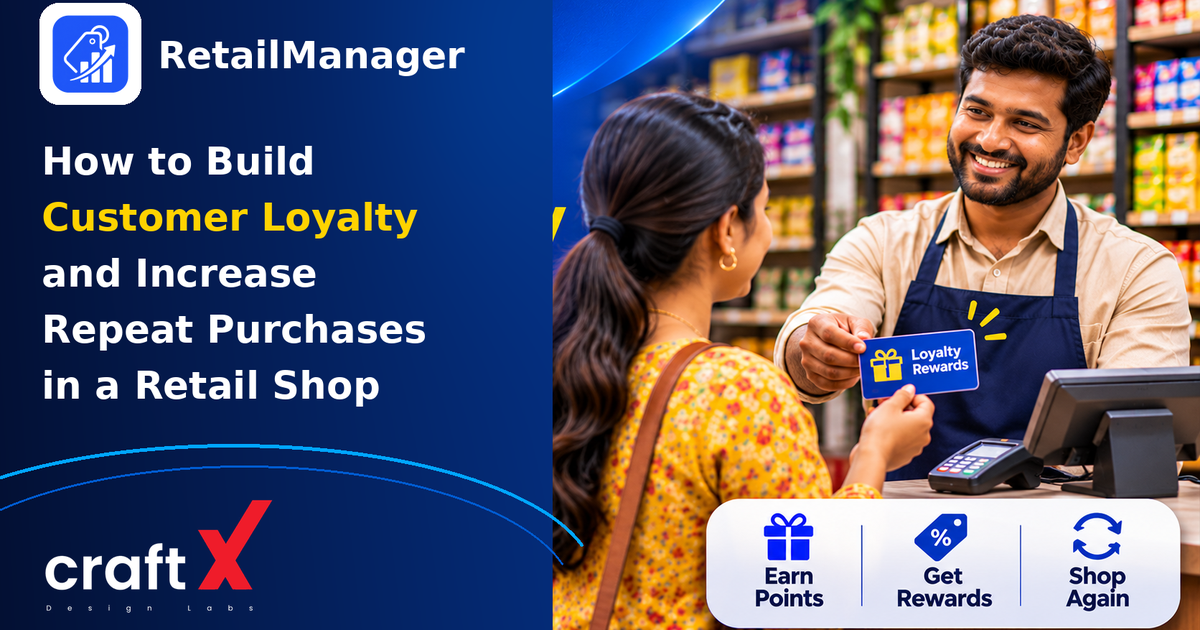
A customer loyalty program for retail stores can help turn occasional buyers into regular customers. For a small retail shop, getting a customer to return is often just as important as attracting a new one. When customers trust your shop, receive consistent value and feel appreciated, they have more reasons to shop with you again.
Think about a neighbourhood grocery store. Two shops may sell similar products at nearly the same prices. However, customers may prefer the shop where the owner remembers their preferences, offers useful rewards and makes shopping convenient. Over time, these small experiences can build a strong relationship.
Customer loyalty does not always require expensive discounts, complicated reward systems or a large marketing budget. Even a simple approach—such as tracking regular customers, offering purchase-based rewards and communicating useful offers—can make a difference.
In this guide, we will explore how retail shop owners can build customer loyalty, introduce a practical reward programme and encourage repeat purchases.
1. Why Customer Loyalty Matters for Retail Shops
Customer loyalty is the willingness of customers to continue choosing your shop instead of regularly switching to competitors.
For small retailers, repeat customers can contribute to more predictable sales and stronger customer relationships.
Here are some important benefits:
- More repeat purchases: Customers who have a positive shopping experience are more likely to return.
- Better customer relationships: Understanding customer preferences helps you serve them more effectively.
- Word-of-mouth recommendations: Satisfied regular customers may recommend your shop to friends and family.
- Lower dependence on promotions: Customers who trust your shop may continue shopping even when competitors advertise discounts.
- Better business insights: Purchase history can help you understand which products your regular customers prefer.
For example, a customer who purchases groceries worth ₹1,500 every week represents a valuable ongoing relationship. Encouraging that customer to continue shopping with you can be more useful than depending entirely on occasional walk-in customers.
2. Understand What Makes Customers Return
Before introducing a loyalty programme, understand why customers choose to shop at your store.
A reward programme alone cannot solve problems such as poor product availability, incorrect billing or inconsistent service.
Customers are more likely to return when they experience:
Consistent product availability
Customers expect their frequently purchased products to be available. If essential items are repeatedly out of stock, they may start visiting another shop.
Monitor fast-moving products and maintain appropriate stock levels.
Fair and transparent pricing
Customers appreciate clear pricing and accurate billing. Avoid unexpected charges and explain offers or discounts properly.
Convenient shopping
A quick billing process, organised shelves and helpful staff can make shopping easier, especially for customers who visit frequently.
Personal attention
Remembering a regular customer's preferences, recommending suitable products and handling complaints respectfully can help build trust.
Reliable service
Customers want confidence that they will receive proper assistance if a product is damaged, incorrect or unsuitable.
The foundation of customer loyalty is a consistently good shopping experience. Rewards should strengthen that experience, not replace it.
3. Choose the Right Customer Loyalty Programme
A loyalty programme gives customers a reason to continue purchasing from your shop. You do not need to introduce every type of reward system. Choose one that suits your products, customers and profit margins.
Here are four practical options.
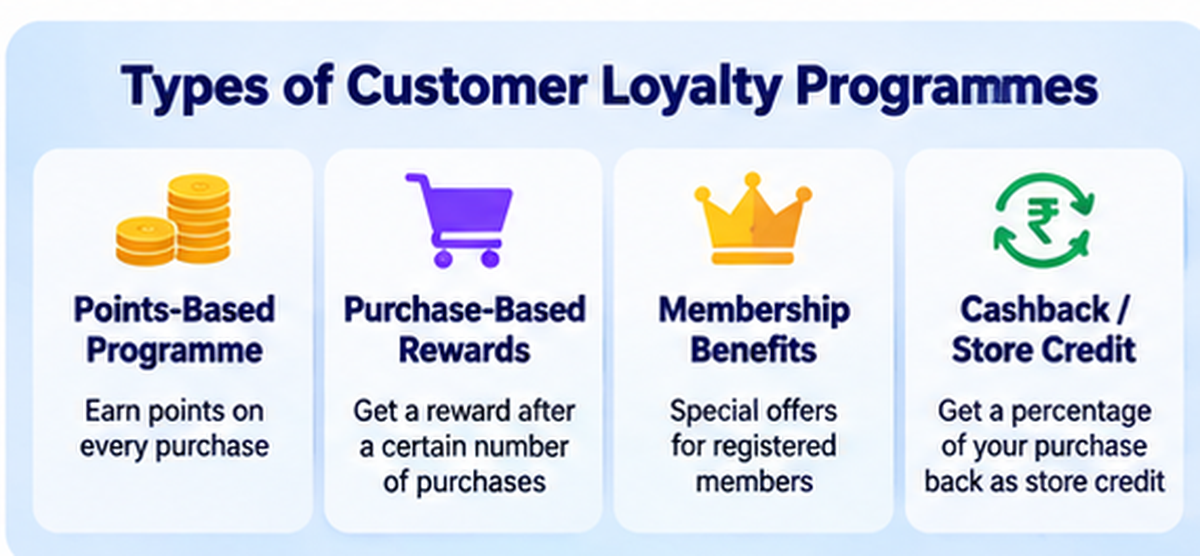
A. Points-Based Loyalty Programme
Customers earn points whenever they make a purchase. Once they collect enough points, they can redeem them for a discount or reward.
Example:
A grocery shop introduces this system:
- Every ₹100 spent earns 1 point.
- 50 points can be redeemed for a ₹50 discount.
- Points are recorded against the customer's account.
This encourages customers to accumulate points through repeat purchases.
However, calculate the reward carefully. Your reward value should be affordable and should not reduce your profit excessively.
B. Purchase-Based Rewards
Instead of points, reward customers after they complete a specific number of purchases.
Example:
A bakery offers:
- Buy 9 eligible items or complete 9 qualifying visits.
- Receive the 10th eligible item free.
This approach is easy to explain and works well for businesses with frequent purchases.
C. Membership-Based Benefits
Create a simple membership system for regular customers.
Members may receive:
- Special member-only offers.
- Early access to selected products.
- Birthday discounts.
- Exclusive seasonal promotions.
If you introduce a paid membership, make sure the benefits are clear and genuinely valuable.
D. Cashback or Store Credit
Give customers a small percentage of eligible purchases back as store credit.
Example:
A shop offers 2% store credit on eligible purchases.
If a customer spends ₹2,000, they receive ₹40 in store credit for a future purchase.
Store credit encourages another visit, but define the redemption conditions clearly. Consider minimum redemption amounts and expiry dates, and communicate them before customers participate.
4. How to Start a Customer Loyalty Programme in Your Shop
You do not need a complicated system to get started. Follow these steps to introduce a manageable programme.
Step 1: Identify Your Regular Customers
Start by identifying customers who visit frequently.
You can record basic information such as:
- Customer name.
- Mobile number, with their permission.
- Purchase date.
- Purchase amount.
- Frequently purchased products.
Collect only the information necessary for your programme. Explain why you are collecting it and how you will use it.
Step 2: Set a Simple Reward Structure
Choose a reward that customers can understand immediately.
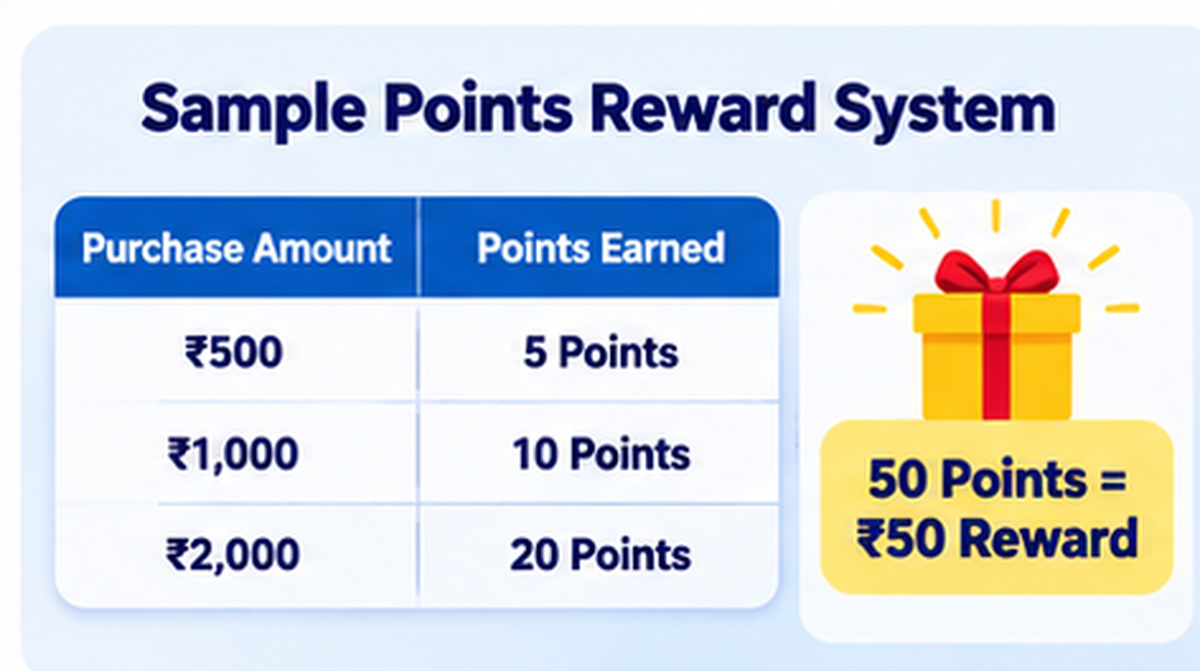
For example:
| Purchase amount | Reward |
|---|---|
| ₹500 | 5 points |
| ₹1,000 | 10 points |
| ₹2,000 | 20 points |
| 50 points | ₹50 reward |
These figures are illustrative. Before launching, calculate the actual cost of rewards against your gross margin and expected redemption rate.
Avoid offering rewards that look attractive but make your business unprofitable.
Step 3: Explain the Programme Clearly
Customers should understand how to earn and redeem rewards without asking several questions.
Display a small notice near the billing counter explaining:
- How customers can join.
- How rewards are earned.
- When rewards can be redeemed.
- Whether any products are excluded.
- Whether rewards have an expiry date.
Train staff to explain the programme in a consistent way.
Step 4: Record Every Eligible Purchase
A loyalty programme works only when purchase records are accurate.
Record the customer's eligible transaction and update their reward balance after billing.
Avoid maintaining multiple disconnected records. A single customer record helps prevent missed points, incorrect balances and disputes.
Step 5: Review the Results
After the first month, check whether customers are participating and returning.
Review:
- Number of customers enrolled.
- Number of customers making repeat purchases.
- Total rewards earned.
- Total rewards redeemed.
- Cost of rewards.
- Sales generated by participating customers.
Use these results to improve the programme instead of assuming that every discount is successful.
5. Practical Ways to Encourage Repeat Purchases
A loyalty programme is one way to encourage repeat purchases. You can also build stronger customer relationships through everyday activities.
Remember customer preferences
If a regular customer frequently buys a particular brand or product size, remembering that preference can make the shopping experience more personal.
For example, a grocery shop owner may remember the preferred rice brand of a regular customer and help them find it quickly.
Offer relevant promotions
Do not send every customer the same offer.
A customer who regularly purchases baby products may find a promotion on related products more useful than an unrelated electronics offer.
Use purchase history responsibly and avoid sending excessive promotional messages.
Introduce seasonal rewards
Indian retailers can use festivals and seasonal shopping periods to create relevant promotions.
Examples include:
- Special grocery offers during Diwali.
- School stationery bundles before the academic year.
- Summer beverage promotions.
- Seasonal clothing offers.
Keep the offer simple and make sure the discount still supports your profit goals.
Ask for customer feedback
Ask regular customers whether they are satisfied with product availability, pricing and service.
You can use a simple question:
"What can we improve to make your next visit easier?"
Pay attention to repeated feedback and act on issues that affect the shopping experience.
Keep customers informed
With customer permission, use WhatsApp or SMS to share useful updates, such as new arrivals, store timings and relevant offers.
Avoid sending too many messages. Give customers a clear way to stop receiving promotional communication.
6. How to Manage Customer Loyalty Without Increasing Workload
One challenge for small retailers is managing loyalty activities while handling daily sales, stock and billing.
A manual notebook may be sufficient for a very small shop, but it becomes difficult to maintain when the number of customers and transactions increases.
Using a manual customer register
You can begin with a simple register containing:
| Date | Customer | Bill amount | Points earned | Total points |
|---|---|---|---|---|
| 01-Nov | Customer A | ₹800 | 8 | 8 |
| 05-Nov | Customer A | ₹1,200 | 12 | 20 |
| 12-Nov | Customer A | ₹500 | 5 | 25 |
This is inexpensive, but staff must update the register after every eligible transaction.
Common problems include:
- Missing purchase entries.
- Incorrect reward calculations.
- Duplicate customer records.
- Difficulty finding previous transactions.
- Time spent calculating reward balances.
Using retail billing software
Retail billing software can make customer and transaction management easier when it supports the features your shop needs.
Depending on the software, you may be able to:
- Maintain customer records.
- Associate sales with customers.
- Review purchase history.
- Track customer balances or reward points.
- Generate sales reports.
- Identify frequently purchased products.
Before choosing software, check whether it supports the specific loyalty features you plan to offer. Not every billing application includes a built-in points or rewards system.
For a growing shop, keeping billing and customer records organised can reduce manual work and make it easier to understand purchasing patterns.
7. Common Customer Loyalty Mistakes to Avoid
A poorly planned loyalty programme can reduce profits without creating meaningful customer relationships.
Avoid these common mistakes:
1. Offering rewards that are too expensive
Large discounts may attract attention, but they can damage your margins. Calculate the cost before launching an offer.
2. Making the programme complicated
If customers need a long explanation to understand how rewards work, simplify the rules.
3. Ignoring regular customers
Do not focus only on new customer offers. Existing customers should also feel valued.
4. Maintaining inaccurate records
Incorrect reward balances can create customer dissatisfaction. Update records consistently.
5. Sending too many promotional messages
Frequent messages can annoy customers. Send relevant updates only with appropriate permission.
6. Ignoring customer complaints
A reward programme cannot compensate for poor service or unresolved problems. Address customer concerns promptly.
7. Failing to measure results
Track participation, repeat purchases and reward costs. A programme should support business performance, not simply distribute discounts.
8. How to Measure Customer Loyalty
You do not need advanced analytics to understand whether your loyalty programme is working.
Start with a few basic measurements.
Repeat Purchase Rate
This measures the percentage of customers who purchased more than once during a selected period.
Formula:
Repeat Purchase Rate = (Customers who purchased more than once ÷ Total customers) × 100
For example:
- Total customers during the month: 200.
- Customers who purchased more than once: 80.
Repeat Purchase Rate = (80 ÷ 200) × 100 = 40%.
Customer Retention Rate
This measures how many existing customers continue purchasing over a selected period.
A commonly used formula is:
Customer Retention Rate = [(Customers at the end of the period − New customers acquired during the period) ÷ Customers at the beginning of the period] × 100
For example:
- Customers at the beginning: 150.
- Customers at the end: 180.
- New customers acquired: 50.
Retention Rate = [(180 − 50) ÷ 150] × 100 = 86.7%.
Use consistent customer identification and the same measurement period when comparing results.
Average Purchase Value
This tells you how much customers spend per transaction on average.
Formula:
Average Purchase Value = Total Sales ÷ Number of Transactions
For example:
If your shop generates ₹1,50,000 from 300 transactions:
Average Purchase Value = ₹1,50,000 ÷ 300 = ₹500.
Track these measurements monthly. Compare results before and after introducing your loyalty programme to understand whether it is making a positive difference.
9. A Simple 30-Day Customer Loyalty Plan
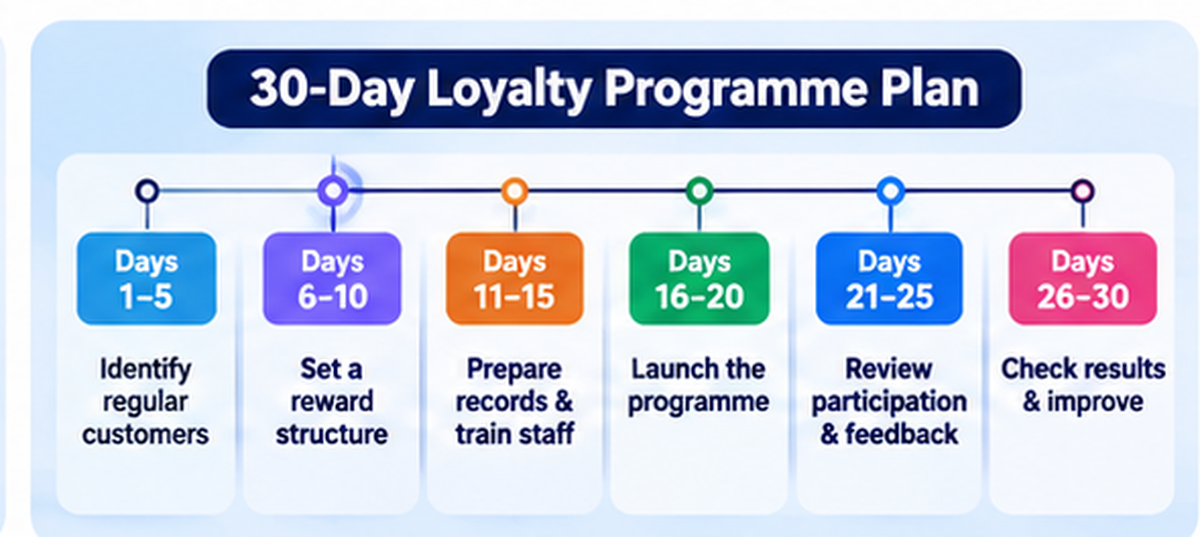
If you are introducing a loyalty programme for the first time, start small. Here is a practical 30-day plan.
| Period | Activity |
|---|---|
| Days 1–5 | Identify regular customers and understand their purchasing patterns. |
| Days 6–10 | Select a reward structure and calculate its cost. |
| Days 11–15 | Prepare customer records and explain the programme to staff. |
| Days 16–20 | Introduce the programme and invite customers to participate. |
| Days 21–25 | Review customer participation and collect feedback. |
| Days 26–30 | Check repeat purchases, reward costs and customer responses. |
At the end of 30 days, decide whether to continue, adjust or expand the programme.
Do not introduce too many reward options at once. Start with one clear benefit and improve it based on actual customer behaviour.
Learn more about managing a Kirana store and organising your daily retail operations.
Frequently Asked Questions
1. What is a customer loyalty programme in retail?
A customer loyalty programme is a system that rewards customers for continuing to purchase from a shop. Rewards may include points, discounts, cashback, store credit or special membership benefits.
2. How can a small retail shop increase repeat customers?
A small shop can encourage repeat purchases by maintaining product availability, offering consistent service, remembering customer preferences, introducing relevant rewards and keeping customers informed about useful offers.
3. Are loyalty programmes profitable for small shops?
They can be profitable when rewards are carefully planned. Retailers should calculate reward costs, consider product margins and measure whether the programme encourages additional purchases or repeat visits.
4. Can I manage a customer loyalty programme without software?
Yes. A small shop can start with a customer register or spreadsheet. However, manual tracking becomes more difficult as the number of customers and transactions grows.
5. What is the best loyalty programme for a grocery shop?
A simple points-based or purchase-based reward system can work well for grocery shops because customers often make frequent purchases. The best option depends on customer buying habits and the shop's profit margins.
6. How often should I send offers to regular customers?
There is no single ideal frequency. Send relevant updates only when there is something useful to communicate, obtain appropriate consent and respect customers who do not want promotional messages.
Conclusion
Building customer loyalty is not about offering the biggest discount. It is about giving customers consistent reasons to choose your shop again.
Start by understanding your regular customers, maintaining reliable service and introducing a simple reward system that your business can afford. Keep accurate purchase records, review customer feedback and measure repeat purchases regularly.
Whether you run a grocery store, pharmacy, clothing shop, hardware store or general retail business, strong customer relationships can become an important part of long-term growth.
Start small, reward consistently and focus on building trust with every customer who walks into your shop.
- #Customer Loyalty
- #Retail Customer Retention
- #Repeat Purchases
- #Loyalty Programs
- #Retail Marketing
- #Small Business Growth
- #Retail Management
- #Customer Relationship Management
- #Indian Retail Stores