Retail Operations
How to Handle Customer Returns and Exchanges in a Retail Shop
A practical retail return policy guide covering refunds, exchanges, customer service, and accurate stock records for small shops.
How to Handle Customer Returns and Exchanges in a Retail Shop
A clear retail return policy helps a shop handle customer requests consistently, protect business records, and maintain customer trust. Whether someone brings back a damaged product, receives the wrong item, wants a different size, or asks for a refund, shop employees should know how to manage the request.
Customer returns are part of running a retail business. They can happen in a kirana store, clothing shop, pharmacy, hardware store, electronics retailer, or mobile accessories business.
The important thing is to follow a process that treats customers fairly while keeping sales, payments, and inventory records accurate.
In this guide, we will explain how to create a retail return policy, handle refunds and exchanges, update stock records, and manage different types of return requests in a small shop.
1. Understand Why Customers Return Products
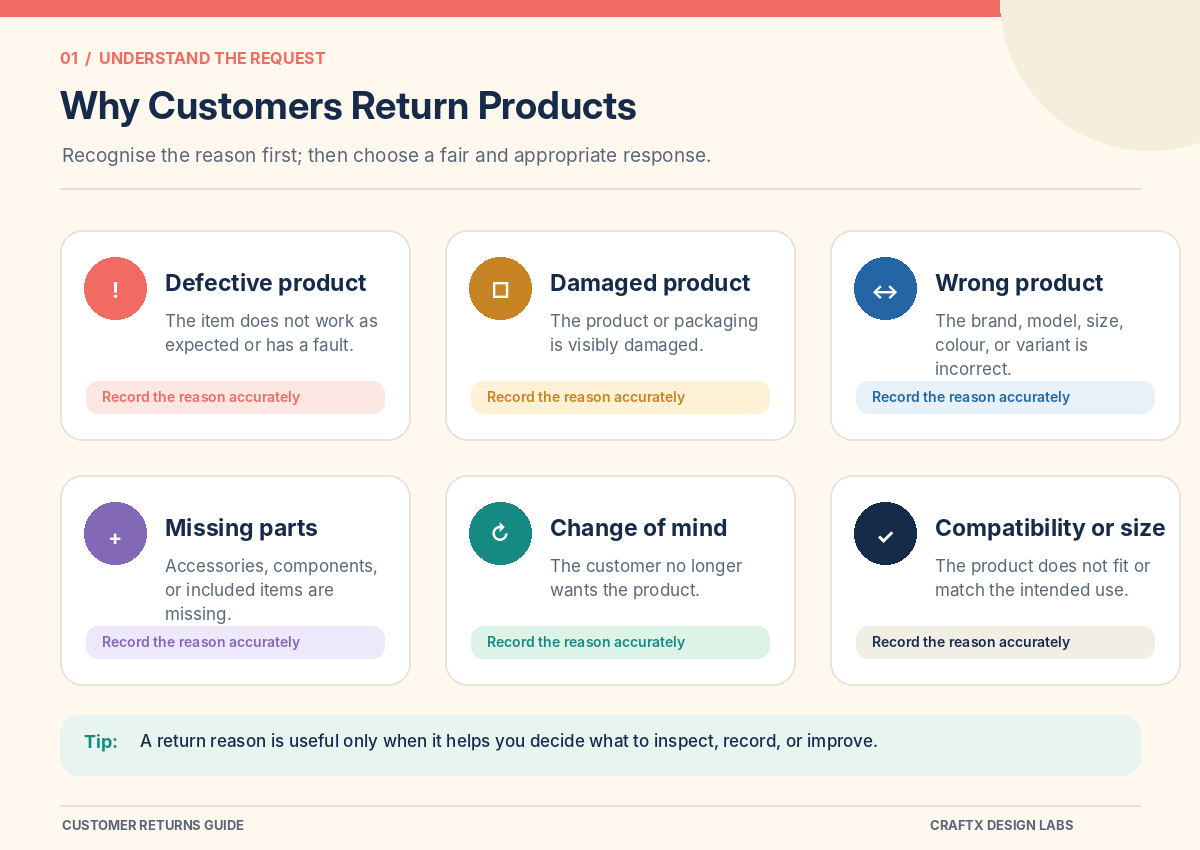
Before deciding how to handle a return, identify the reason behind it. Not every return request is the same, and the appropriate response depends on the issue, the product, applicable requirements, and the shop's disclosed policy.
Common reasons include:
Defective products: The item does not work correctly or has a fault that was present when sold.
Damaged products: The customer receives or discovers a product with broken parts, damaged packaging, or other physical damage.
Wrong product: The customer receives a different brand, model, size, colour, or variant from what was purchased or agreed.
Missing parts or accessories: The product is incomplete or does not contain the components that should have been supplied.
Change of mind: The customer no longer wants the product or has changed their preference.
Size or compatibility issues: Clothing may not fit, or a mobile accessory may not be compatible with the customer's device.
Warranty-related issues: The product develops a fault that may need to be handled through the manufacturer's or authorised service provider's warranty process.
Recording the reason accurately helps you distinguish a genuine product problem from a request covered by your voluntary change-of-mind return policy.
2. Create a Clear Retail Return Policy
A return policy explains the conditions under which your shop accepts returns, exchanges, and refund requests.
Customers should be able to understand the policy before making a purchase. Employees should also know how to apply it consistently.
A practical policy should cover the following:
- Return eligibility: Explain which products may qualify for a voluntary return or exchange.
- Return period: State the period allowed for eligible change-of-mind returns, where offered.
- Product condition: Explain any reasonable requirements concerning use, packaging, tags, accessories, and product condition.
- Proof of purchase: Explain how the original transaction can be verified, such as through a receipt, invoice, or available billing records.
- Available resolutions: Explain whether eligible requests may result in an exchange, refund, repair, or store credit.
- Refund procedure: Explain the expected process and how payment reversals or refunds are handled.
- Product-specific conditions: Clearly communicate any applicable conditions for perishable, hygiene-sensitive, customised, or other special products.
Do not use a general "No Return" notice to ignore legal obligations involving defective goods, misleading descriptions, or other consumer protections.
Important: Understand the Indian consumer protection requirements
For Indian retailers, the Consumer Protection Act, 2019 is an important reference.
Section 2(47)(viii) describes as an unfair trade practice a refusal, after selling goods, to take back defective goods or refund the consideration paid within the period specified in the bill, cash memo, or receipt, or, if no period is specified, within 30 days.
This provision specifically addresses defective goods. Do not treat the 30-day wording as a universal change-of-mind return period for every product purchased from a shop.
Section 39 also provides for remedies that a Consumer Commission may order when the relevant complaint and legal conditions are established. These include removing a defect, replacing defective goods, or returning the price paid.
You can read the Consumer Protection Act, 2019 and consult the Department of Consumer Affairs' official Act and Rules page.
If your shop also sells through a website or online marketplace, check the additional requirements applicable to e-commerce transactions. Do not automatically copy an offline shop policy into an online store without reviewing the relevant rules.
3. Follow a Consistent Process When a Customer Requests a Return
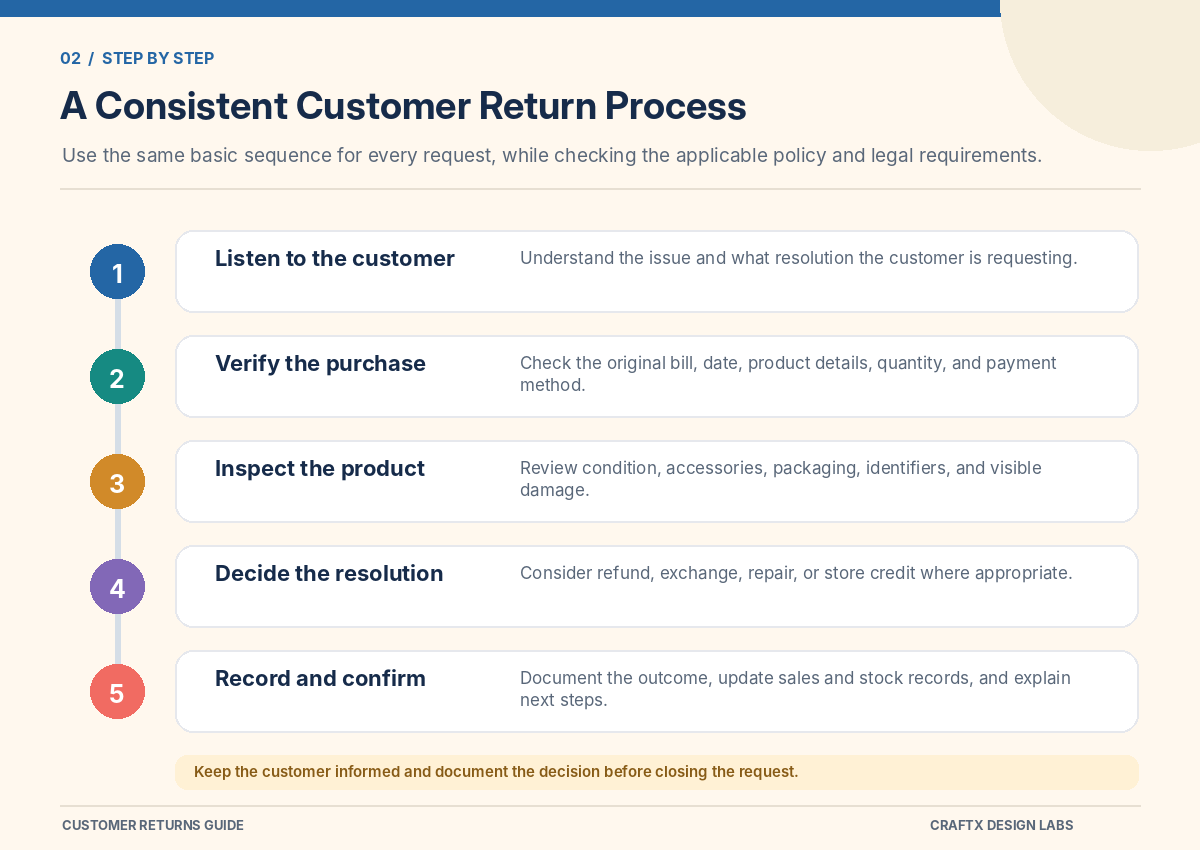
A defined process makes it easier for employees to handle return requests without confusion or unnecessary delays.
Use these steps at the billing counter or customer-service desk.
Step 1: Listen to the customer's concern
Allow the customer to explain why they want to return the product.
Ask clear questions:
- What is the issue with the product?
- When was it purchased?
- Has the product been used?
- Are any parts or accessories missing?
- Is the customer requesting a refund, replacement, or exchange?
Remain polite and avoid making assumptions before checking the transaction.
Step 2: Verify the original purchase
Check the receipt, invoice, billing record, or other available transaction information.
Confirm:
- Product name and variant
- Purchase date
- Quantity purchased
- Original selling price
- Applicable discount
- Payment method
- Original transaction reference
This helps prevent errors such as processing the same return twice or refunding an amount different from the original transaction.
Step 3: Inspect the returned product
Check the product's condition and confirm whether it matches the customer's explanation.
Depending on the product, this may include checking:
- Visible physical damage
- Serial numbers or product identifiers
- Original accessories and components
- Packaging and seals
- Product condition and signs of use
- Batch or expiry details where relevant
Follow appropriate safety procedures when handling electronic, chemical, food, medical, or other sensitive products.
Do not perform an inspection that could create additional damage or put anyone at risk.
Step 4: Decide the appropriate resolution
Review the product issue, applicable consumer protections, warranty conditions, and the shop's disclosed return policy.
Depending on the circumstances, a suitable resolution may involve a refund, replacement, repair, or exchange.
If the request involves a legal remedy for defective goods, follow the applicable requirements rather than relying only on the shop's ordinary change-of-mind policy.
Step 5: Record and confirm the outcome
Once the request has been approved and processed, provide an appropriate acknowledgement or refund record.
Explain what has been done, whether a replacement is available, or when the customer should expect the payment reversal to be completed.
4. Understand the Difference Between Refunds, Exchanges, and Store Credit
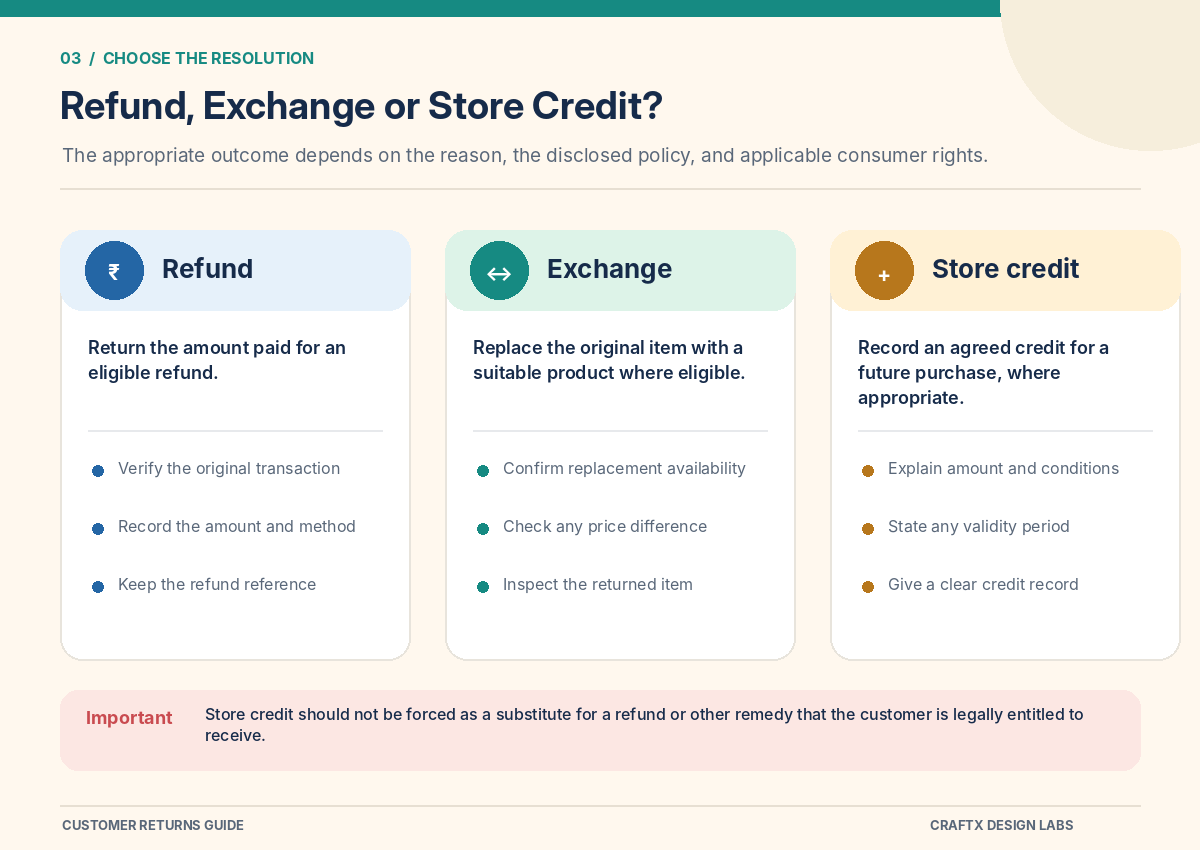
Customers may ask for different outcomes, so employees should understand how each option works.
Refund
A refund returns the amount paid for the relevant purchase, subject to the applicable legal requirements and transaction details.
For example, suppose a customer purchases a product for ₹1,200 and an eligible refund is approved for the full purchase amount.
Record the refund against the original transaction and document the payment method and refund reference.
Avoid recording the refund as a new negative sale without following your billing and accounting system's correct transaction process.
Exchange
An exchange allows the customer to receive another product instead of keeping the original item.
For example, a customer buys a mobile case for one phone model but discovers that the case is for a different model.
If an exchange is appropriate and available, check the replacement product and record the difference in price, if any.
An exchange should not be used to avoid a refund or replacement remedy that the customer is legally entitled to receive.
Store credit
Store credit allows an eligible customer to use an agreed amount toward a future purchase.
For example, a clothing shop may offer store credit under its disclosed change-of-mind policy where the customer agrees and the arrangement is legally appropriate.
Explain the amount, validity period, redemption conditions, and any applicable limitations before issuing it.
Do not force store credit as a substitute for a refund or other remedy required by law.
5. Update Stock Records After Every Return
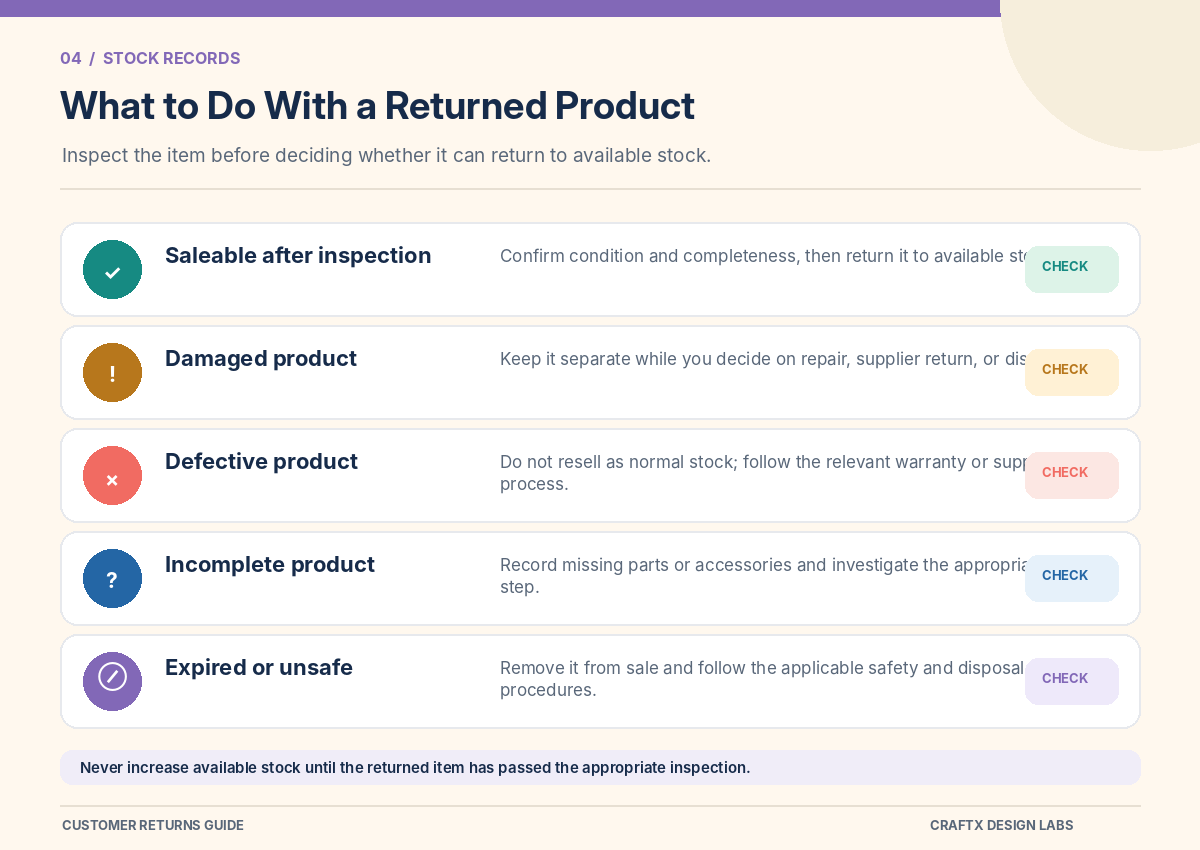
Processing the customer's request is only one part of the process. You must also decide what happens to the returned product.
A returned item should not automatically be added back to available stock.
Inspect it and assign the appropriate stock status.
Saleable products: Products that pass inspection and can safely be resold may be returned to available stock according to your store procedure.
Damaged products: Keep damaged goods separate until a decision is made about repair, supplier return, disposal, or another appropriate action.
Defective products: Follow the relevant warranty, supplier, and product-safety process. Do not put a defective product back on the shelf as normal saleable inventory.
Incomplete products: Missing accessories or components may make an item unsuitable for resale. Record the condition and investigate the available resolution.
Expired or unsafe products: Remove them from sale and follow the applicable safety, disposal, and record-keeping requirements.
For example, suppose a customer returns a product because it is defective. Your billing record may show the customer refund, but the product should not automatically increase available stock.
Record the return and its stock disposition separately.
Accurate stock movements are important for preventing both overstated inventory and unexpected stock shortages. For more guidance, read how to prevent stockouts in a retail shop.
6. Maintain a Customer Return Register
A return register helps you understand how frequently products are returned and why customers are requesting refunds or exchanges.
You can maintain it in a notebook, spreadsheet, or suitable retail-management system.
A simple register may contain:
| Field | Information to record |
|---|---|
| Return date | Date the return was processed |
| Original bill | Original invoice or transaction number |
| Product | Name, code, brand, or variant |
| Quantity | Number of units returned |
| Reason | Defective, damaged, wrong item, or other |
| Product condition | Saleable, damaged, incomplete, or under inspection |
| Resolution | Refund, exchange, repair, or agreed store credit |
| Refund amount | Amount returned, where applicable |
| Stock action | Restocked, quarantined, supplier return, or other |
| Staff member | Employee who processed the request |
For example:
| Product | Return reason | Resolution | Stock action |
|---|---|---|---|
| Mobile case | Wrong model | Exchange | Original item inspected |
| Electric accessory | Defective | Refund | Quarantined |
| Clothing item | Size preference | Eligible exchange | Returned to stock after inspection |
These are illustrative examples. Apply the relevant product conditions and your actual return procedure.
Keeping this information makes it easier to investigate repeated problems, compare suppliers, and identify products that may need better descriptions or quality checks.
7. Train Employees to Handle Returns Professionally
Customer returns can become difficult when employees do not know what they are permitted to approve.
Give staff a simple procedure that explains:
- Which return requests they can process independently
- When manager approval is required
- How to verify original transactions
- How to inspect products safely
- How to record refunds and exchanges
- How to classify returned inventory
- How to escalate disputes or unusual requests
For higher-value goods or unusual transactions, you may choose to require manager approval before issuing a refund.
However, approval procedures should not create unnecessary delays or obstruct the customer's applicable legal rights.
Train employees to remain polite even when a request cannot be approved under the shop's voluntary policy.
A helpful explanation is usually better than simply saying, "We do not accept returns."
8. Use Return Data to Identify Repeated Problems
A return register becomes more useful when you review it regularly.
Look for patterns such as:
- A particular product being returned frequently
- Repeated complaints about the same supplier
- Customers receiving incorrect product variants
- Missing components or packaging problems
- Product descriptions that create confusion
- Frequent size or compatibility issues
You can calculate a simple product return rate using:
Return Rate (%) = Units Returned ÷ Units Sold × 100
For example, if a product has 100 units sold and eight units returned during a comparable reporting period:
Return Rate = 8 ÷ 100 × 100 = 8%
This is an illustrative unit-based measure. Use consistent reporting periods and compare like-for-like products. A high return rate should prompt investigation, not an automatic conclusion that the product is faulty.
If customers repeatedly return a particular product because of compatibility issues, improve the product information or help customers check compatibility before purchasing.
If products are frequently damaged, review packaging, storage, and supplier handling.
If staff repeatedly bill the wrong variants, review the product selection and billing process.
Use the findings to improve your operations and prevent unnecessary returns.
For ways to improve the customer experience and encourage repeat business, see how to increase retail sales in a small shop.
9. Adapt Return Handling to Your Product Category
The same return process may not be suitable for every retail business.
Grocery stores: Pay attention to product condition, packaging, storage, expiry dates, and food-safety requirements. Returned perishable goods should not automatically be placed back on sale.
Pharmacies: Follow the applicable pharmacy, storage, and product-safety requirements. Returned medicines should not be returned to saleable stock without following the rules and professional procedures applicable to the product.
Clothing shops: Check product condition, tags, size, and the terms of any voluntary exchange policy. Keep the conditions clear for sale items and other eligible categories.
Electronics retailers: Record serial numbers, accessories, packaging, and warranty details where applicable. Some technical issues may require assessment by an authorised service centre.
Mobile accessories shops: Check product model compatibility, packaging, and the condition of returned accessories. Confirm the original item before approving a product exchange.
Hardware shops: Check the product's condition, completeness, and whether it has been installed, modified, or used in a way that affects its resale or return eligibility.
For every category, make sure the policy is consistent with applicable laws, product safety requirements, manufacturer warranties, and any specific contractual obligations.
10. Use Digital Records to Make Return Management Easier
When a shop processes only a few returns, a paper register may be sufficient.
As transactions increase, finding original bills, recording refunds, and updating stock manually can become more difficult.
A suitable billing or retail-management system may help you:
- Search for original sales transactions
- Maintain product and quantity records
- Review sales history
- Record supported refund or return transactions
- Track stock adjustments
- Review relevant reports
Before choosing a system, confirm that it supports the return workflow you need. Some applications may support refunds but not a complete exchange process or product-condition tracking.
RetailManager provides product, sales, and reporting workflows that retailers can evaluate as part of their record-keeping process. Check its current capabilities before relying on it for a specific return-management feature.
You can also read our guide on the daily retail shop checklist for a practical routine covering transactions, stock, and closing checks.
Frequently Asked Questions
Should a retail shop accept every product return?
Not every change-of-mind request has to be treated in the same way. A shop should clearly communicate its voluntary return policy and follow applicable legal requirements for defective goods, incorrect representations, warranties, and other consumer protections.
Can a shop refuse a refund for a defective product?
A shop should not rely on a general no-return policy to disregard the legal protections applicable to defective goods. The Consumer Protection Act, 2019 addresses certain refusals to take back defective goods and refund the consideration paid. The correct resolution depends on the facts and applicable legal requirements.
Is an original receipt necessary for every return?
A receipt is useful because it helps verify the original transaction, amount, and purchase date. Shops may also be able to check their billing records or other valid purchase information. The process should be clearly explained in the shop's policy and must not be used to defeat applicable consumer rights.
Should returned products be added back to available stock?
Only after inspection. Restock products that are confirmed to be saleable and handled according to your procedure. Damaged, defective, incomplete, expired, or unsafe products should be recorded separately.
How can a small shop reduce customer returns?
Provide accurate product information, confirm variants and compatibility, inspect goods before handover where appropriate, explain product limitations, and keep packaging and handling practices consistent.
Where can consumers seek help with a retail complaint in India?
The Department of Consumer Affairs operates the National Consumer Helpline, which provides consumer-rights information and channels for registering grievances.
Conclusion
A clear retail return policy and consistent return-handling process can help a shop manage customer requests more confidently while protecting its sales and inventory records.
Start by understanding why customers return products, communicating your policy clearly, verifying original transactions, and choosing an appropriate resolution. Record each return correctly and inspect products before updating available stock.
Review return reasons regularly to identify recurring product, supplier, packaging, or service problems.
Whether you run a kirana store, pharmacy, clothing shop, hardware store, electronics business, or mobile accessories shop, a fair and organised returns process can help you protect customer trust and maintain more accurate business records.
- #Customer Returns
- #Refunds & Exchanges
- #Retail Operations
- #Customer Service
- #Inventory Records