Sales & Marketing
How to Increase Retail Sales: 10 Small Shop Tips
Increase retail sales with practical tips for product displays, customer service, repeat visits, local marketing, and sales tracking.
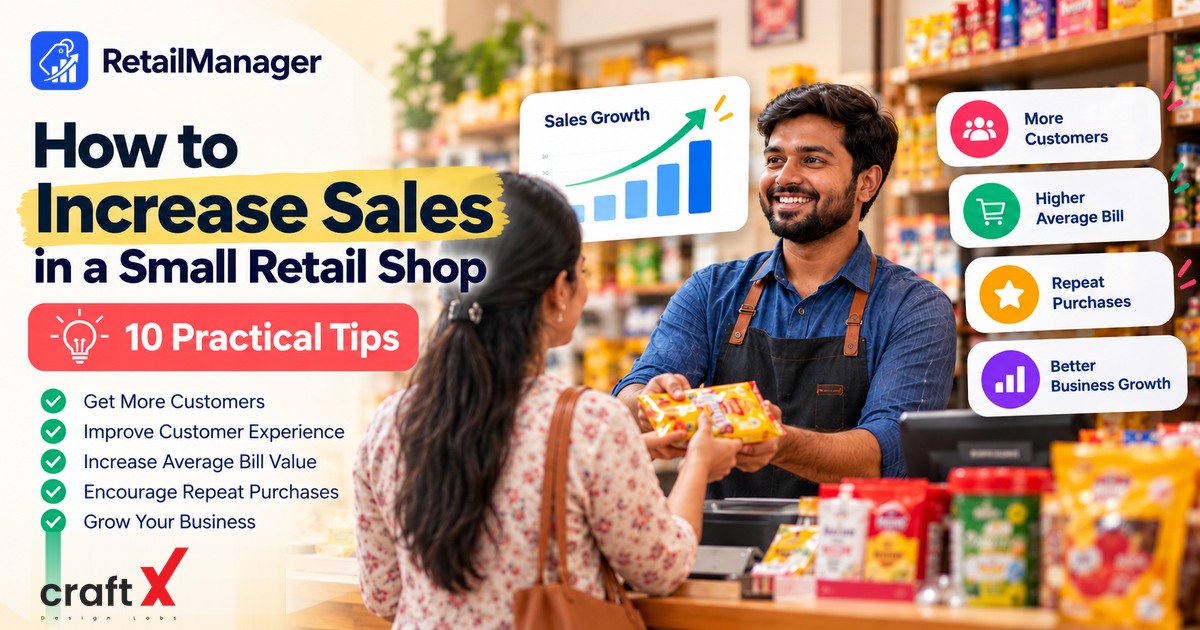
How to Increase Sales in a Small Retail Shop: 10 Practical Tips
If you want to learn how to increase retail sales in a small shop, start by understanding what your customers need and improving their shopping experience. You do not always need a large advertising budget or heavy discounts; small, consistent improvements can help you attract customers and encourage repeat visits.
Whether you operate a kirana store, pharmacy, hardware shop, fertilizer business, clothing store, or mobile accessories shop, increasing sales starts with understanding your customers and improving the way your business operates.
You do not always need a large advertising budget or heavy discounts to grow your business. Small, consistent improvements in product presentation, customer service, local visibility, and sales tracking can help you identify opportunities to sell more effectively.
In this guide, we will explore ten practical ways to increase retail sales in a small shop.
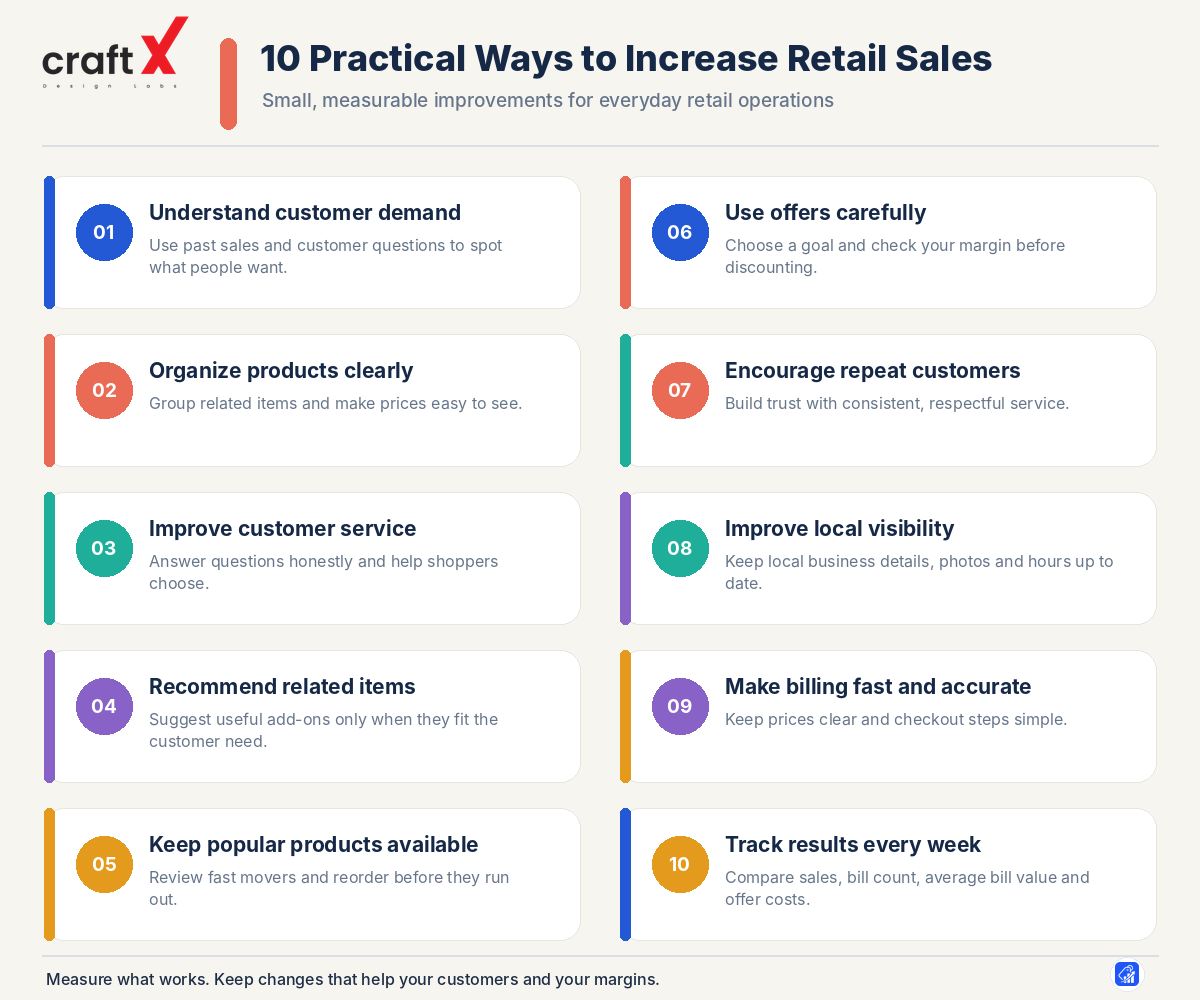
1. Understand What Your Customers Actually Buy
Before trying to increase sales, understand which products your customers purchase most often and which products generate fewer sales.
Your assumptions may not always match actual customer demand. A product that looks popular may contribute little to revenue, while another product may sell consistently without attracting much attention.
Start by reviewing your sales records and identifying:
- Products that sell frequently
- Products that generate the most sales value
- Products that contribute useful profit margins
- Products customers regularly ask for but you do not stock
- Products that remain unsold for long periods
For example, a grocery shop may discover that certain household essentials sell consistently throughout the week, while some premium products sell mainly during festivals. A mobile accessories shop may find that customers frequently purchase charging cables and screen protectors together.
Use these observations to make better stocking, display, and promotional decisions.
Review your sales regularly rather than relying only on memory. Our guide on how to calculate daily sales and profit in a retail shop explains how to understand sales figures and business performance.
2. Make Your Products Easy to Find
Customers should be able to locate products without unnecessary effort. A confusing shop layout can make shopping frustrating, especially when customers are in a hurry.
Arrange products into clear, logical categories.
For example:
- A grocery shop can group snacks, beverages, household essentials, and personal care products.
- A hardware shop can separate plumbing supplies, electrical accessories, tools, and fasteners.
- A pharmacy can organise products according to the applicable storage, safety, and regulatory requirements.
- A mobile accessories shop can group chargers, cables, cases, screen protectors, and other accessories.
Use clear labels wherever they help customers understand where products are located.
Keep frequently purchased products accessible and ensure that prices are visible when appropriate. Make sure promotional displays do not block walkways or make essential products difficult to reach.
A well-organised shop can also help staff locate items faster, reducing delays during busy hours.
3. Improve Customer Service
Customer service can influence whether people feel comfortable buying from your shop and whether they choose to return.
Customers often appreciate simple things: a polite greeting, accurate product information, transparent pricing, and help finding the right item.
Try these practices:
- Greet customers naturally without pressuring them to buy.
- Ask a useful question to understand what they need.
- Explain relevant product differences clearly.
- Be honest about quality, limitations, availability, and pricing.
- Give customers time to compare options.
- Handle complaints calmly and explain the available solution.
For example, if a customer visits a hardware shop looking for a particular tool, ask what task they need it for before recommending a product. This can help you suggest an appropriate option rather than simply selling the most expensive item.
Similarly, a mobile accessories retailer can help a customer check charger compatibility rather than guessing based on appearance.
The goal is not to push every customer toward a purchase. It is to help customers make suitable decisions and build confidence in your business.
4. Recommend Related Products When They Are Useful
Customers sometimes purchase additional products because they make the main purchase more useful or convenient.
This is commonly called cross-selling. For example:
- A customer buying a phone may also need a compatible case or screen protector.
- Someone purchasing paint may need brushes, rollers, or masking tape.
- A customer buying flour may also need ingredients commonly used with it.
- A person purchasing a school bag may ask for matching stationery.
The key is relevance. Recommend related products when they meet a genuine need, rather than adding items to every bill simply to increase its value.
You can also create sensible product bundles. A bundle might combine related items at a clearly explained price, provided the offer still makes financial sense for your shop.
Monitor which recommendations customers actually accept. If a combination rarely sells, change the offer or stop promoting it.
Important: Do not confuse a larger bill with a more profitable sale. Consider product costs, discounts, and other relevant expenses before deciding which combinations to promote.
5. Keep Popular Products Available
A customer who visits your shop for a specific product may buy it elsewhere if it is unavailable. Repeated stockouts can lead to missed sales and inconvenience for regular customers.
Review your sales history to identify fast-moving products and products that customers expect you to carry regularly.
Then establish a simple replenishment routine:
- Check the stock of important products regularly.
- Identify products approaching their reorder levels.
- Consider supplier delivery time when planning purchases.
- Review pending supplier orders before placing new ones.
- Monitor products with seasonal or changing demand.
For instance, a fertilizer shop may experience higher demand for particular products during specific agricultural periods. A grocery shop may need to replenish everyday essentials more frequently than slow-moving specialty products.
Your purchasing decisions should reflect actual demand, supplier lead times, and the cash available to your business.
Read our practical guide on how to prevent stockouts in a retail shop for more details on stock tracking and reorder levels.
6. Smart Retail Discount Strategies: Use Offers Carefully
Discounts can attract attention, but frequent discounting can reduce your profit and encourage customers to wait for the next offer.
Before creating a promotion, decide what you want it to achieve.
Possible objectives include introducing a new product, clearing suitable slow-moving inventory, increasing sales during a quieter period, or encouraging customers to purchase related items.
Consider these approaches:
Product bundles: Combine related products at an attractive overall price while protecting your margins.
Limited-period offers: Promote a genuine offer with clear start and end dates.
Quantity-based offers: Offer a benefit for purchasing a larger quantity when doing so is appropriate for the product and customer.
Seasonal promotions: Prepare for relevant festivals, school seasons, local events, or predictable demand changes.
Clearance offers: Reduce prices on appropriate products that need to be sold, taking account of product condition, expiry dates, and other applicable requirements.
Before launching a promotion, calculate the likely effect on revenue and profit. Do not assume an offer is successful merely because the number of bills increases.
Compare results with a similar period when practical, and record what worked.
7. Encourage Existing Customers to Return
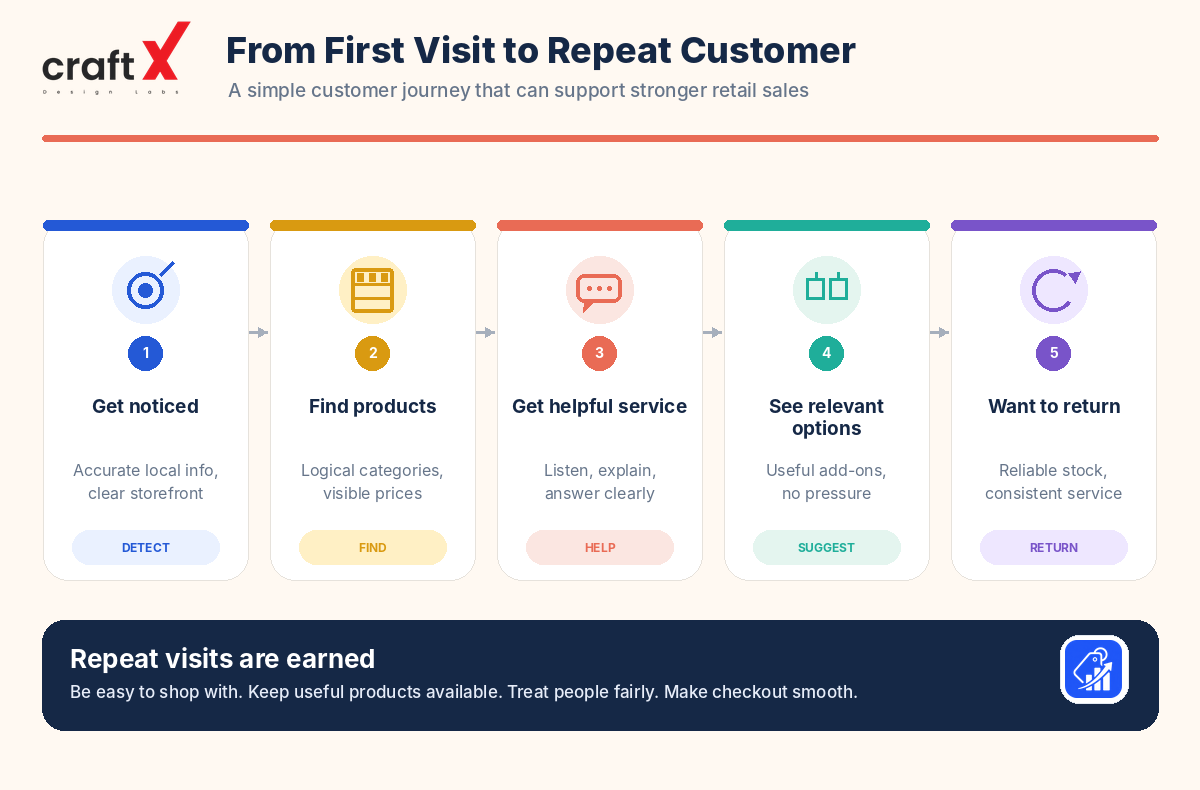
Attracting new customers is useful, but retaining existing customers can also support steady business.
Think about what would make someone choose your shop again. It might be reliable product availability, convenient opening hours, fair pricing, helpful advice, quick billing, or a dependable way to resolve issues.
Here are some practical approaches:
- Remember regular customers' preferences where appropriate.
- Provide consistent service and clear prices.
- Inform interested customers when requested products become available.
- Introduce a simple loyalty programme if it suits your business.
- Ask for feedback and act on recurring complaints.
- Make returns and exchanges clear according to your stated policy and applicable rules.
For example, a mobile accessories shop may keep a record of customers who ask to be notified when a particular accessory arrives. Contact them only when the product becomes available and in accordance with their preferences.
Do not collect or use customer contact details for marketing without appropriate permission. Keep messages relevant, respect requests to stop receiving them, and avoid sending repeated promotional messages.
Trust is built over time through consistent experiences, not through discounts alone.
8. Improve Your Local Online Visibility
Many people use online searches and maps to find nearby shops, check opening hours, or obtain contact information before visiting.
Even a shop that primarily serves walk-in customers can benefit from having accurate local business information online.
Consider these steps:
Maintain your business profile: If eligible, create or update your Google Business Profile with the correct shop name, address, hours, phone number, and relevant business category.
Add genuine photographs: Show the shopfront, interior, products, or other useful details that accurately represent your business.
Keep information updated: Correct holiday timings, temporary closures, and contact details when they change.
Request genuine reviews: Invite customers to share honest feedback without offering rewards for positive reviews. Respond professionally to feedback, including criticism.
Use local social channels: Share new arrivals, relevant offers, useful product information, and changes to opening hours where your customers are likely to see them.
Use WhatsApp appropriately: If customers have opted in to receive updates, share relevant announcements occasionally rather than overwhelming them with promotions.
For example, a local hardware retailer could post information about newly available tools, while a clothing store might show a new seasonal collection.
Keep your messages accurate, useful, and relevant to the products you actually stock.
9. Make Billing Fast and Accurate
A good shopping experience can be undermined by long queues, pricing mistakes, or confusion at checkout.
Review your billing process and look for common delays.
Check whether staff can find products quickly, whether prices are recorded consistently, and whether payment methods work reliably. Train employees to handle billing, discounts, returns, and other routine transactions correctly.
When the shop is busy, a clear process can help reduce waiting time and prevent avoidable errors.
Suitable billing software may also help you record sales, maintain product information, and review transaction reports. However, the available features vary between applications, so choose a system that fits your actual workflow.
If you are evaluating digital tools, read our guide on how to choose billing software for small shops in India.
Technology should make everyday work easier rather than introduce unnecessary complexity. Keep a backup process for situations such as network problems or device failure, and ensure employees know how to use the system.
10. Track Sales Performance and Test Small Improvements
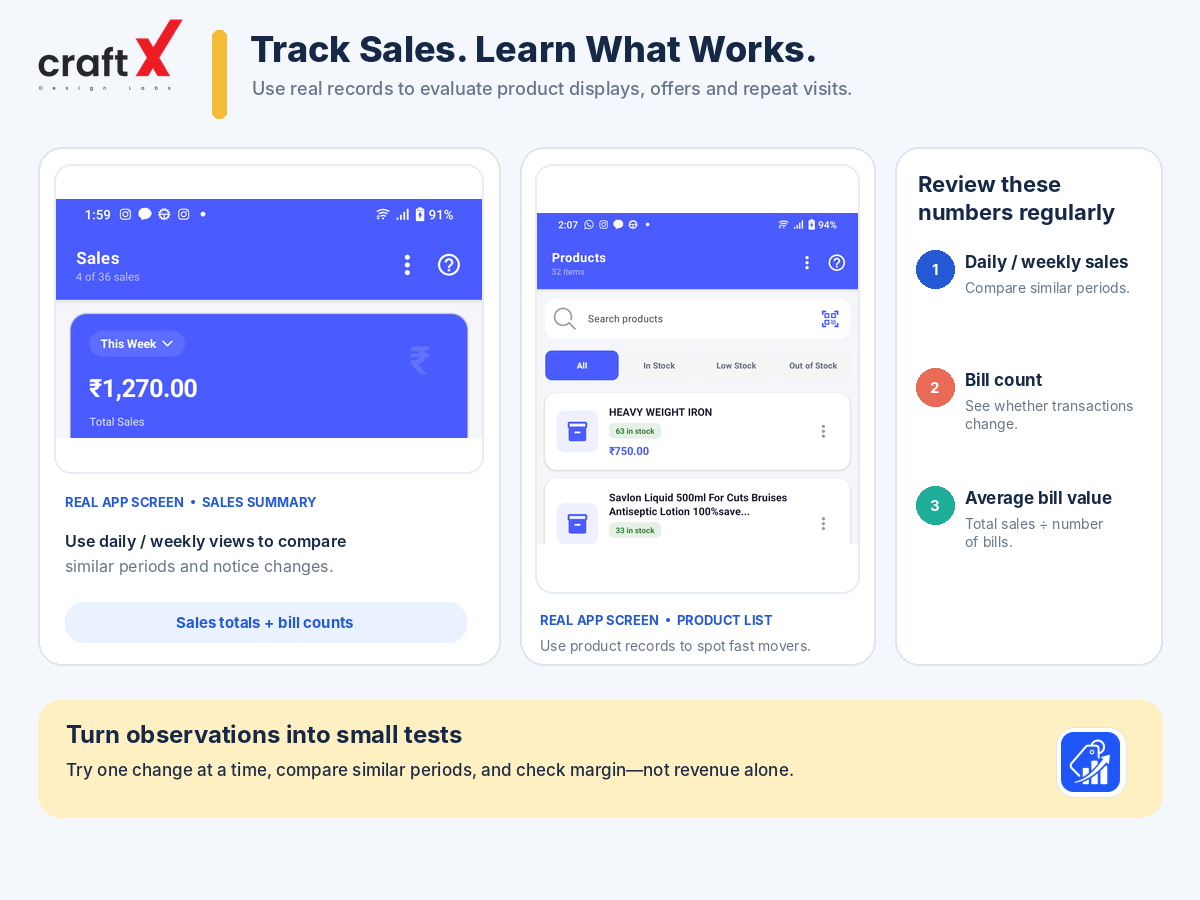
You cannot easily determine whether a change is working if you do not measure the results.
You do not need a complicated reporting system to begin. Start with a few useful measures.
Daily sales: The total value of sales recorded during the day.
Number of bills: The number of completed transactions.
Average bill value: Total sales divided by the number of bills.
Product performance: Which products and categories are selling well or slowly.
Repeat customers: Where records and customer consent permit, observe whether customers return.
Promotion results: Compare the sales and relevant costs associated with an offer.
For example, suppose a shop records ₹24,000 in sales across 80 bills on one day.
Average bill value = ₹24,000 ÷ 80 = ₹300.
The shop owner could test a relevant product bundle or improve how related items are displayed, then compare the results with a reasonably comparable period.
This does not guarantee that average bill value will increase. Other factors, such as customer demand, seasonality, and the type of products sold, may affect the outcome.
Change one or two things at a time where possible. Record what you changed and review the results before investing more money in the same idea.
Remember that revenue alone does not tell the whole story. Review product costs, discounts, expenses, and cash flow before judging whether your business is becoming healthier.
A Simple 30-Day Plan to Improve Retail Sales
You can begin with manageable changes rather than trying to implement every idea immediately.
Week 1 — Understand your sales: Review recent sales records, identify fast-moving products, and note the questions or requests customers make most often.
Week 2 — Improve the shop experience: Reorganise a confusing product section, make relevant prices easier to see, and review the billing process.
Week 3 — Encourage repeat purchases: Improve customer service, plan a relevant promotion, and update your local business information.
Week 4 — Review the results: Compare sales, bill counts, average bill value, and promotion costs with a comparable period. Keep the changes that appear useful and reconsider those that do not.
Adapt this plan to your product category, available time, and budget. A small grocery shop and a specialist hardware retailer may need different approaches.
Conclusion
Increasing sales in a small retail shop does not depend on one trick. It involves understanding what customers need, making products easy to find, providing helpful service, maintaining stock availability, and giving customers good reasons to return.
Start by reviewing your actual sales records, then make small improvements to product presentation, related-product recommendations, local visibility, and billing. Measure the results and pay attention to profitability rather than focusing only on revenue.
Whether you run a kirana store, pharmacy, hardware shop, fertilizer business, clothing store, or mobile accessories shop, consistent improvements can help you make better business decisions and create a more useful shopping experience.
Want to organise your shop's daily operations? Explore RetailManager on Google Play to review its current features and see whether they suit your business requirements.
- #Retail Sales
- #Customer Retention
- #Retail Marketing
- #Small Business Tips
- #Sales Growth