Sales & Profit
How to Price Products in a Retail Shop: Markup, Margin & Profit
Learn retail product pricing with simple cost, markup, and margin formulas, worked ₹ examples, discount tips, and India's MRP rules.
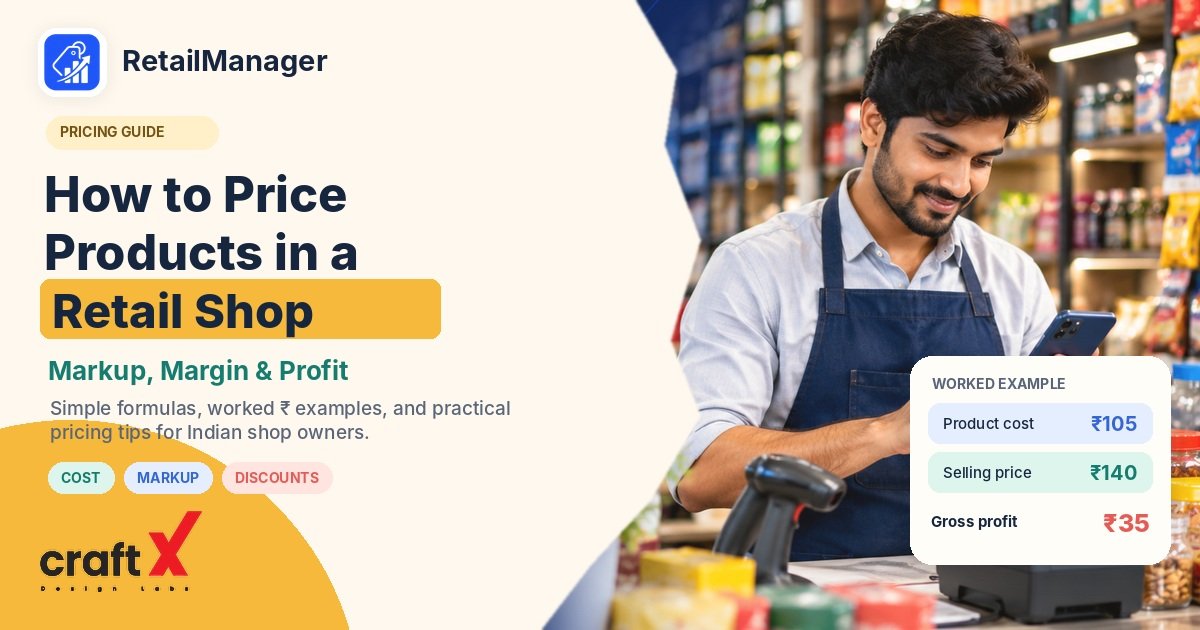
How to Price Products in a Retail Shop: Markup, Margin & Profit
Retail product pricing is one of the most important decisions a shop owner makes. Set the price too low, and you may sell many products without earning enough to cover your expenses. Set it too high, and customers may choose a competitor offering better value.
Whether you run a kirana store, pharmacy, hardware shop, fertilizer business, clothing store, or mobile accessories shop, understanding product cost, markup, and profit margin can help you make better pricing decisions.
You do not need complicated accounting software to understand the basics. With a few simple formulas and accurate purchase records, you can calculate selling prices, evaluate discounts, and understand how much gross profit you earn on each product.
In this guide, we will explain how to price products in a retail shop using practical examples in Indian rupees.
1. Calculate the True Cost of Each Product
Before deciding your selling price, understand what the product actually costs your business.
The supplier's price is an important starting point, but you may also incur costs to transport goods to your shop or handle them before they are ready for sale.
Depending on your business, consider:
- Purchase price paid to the supplier
- Transport or delivery charges attributable to the purchase
- Loading, unloading, or handling costs where applicable
- Other direct acquisition costs that reasonably apply to the product
For a simple example, suppose a retailer purchases a product for ₹100 per unit and allocates ₹5 per unit for transport and handling.
| Cost component | Amount per unit |
|---|---|
| Supplier purchase price | ₹100 |
| Allocated transport and handling | ₹5 |
| Illustrative product cost | ₹105 |
The product cost for this example is ₹105 per unit.
This is an illustrative calculation, not a universal accounting treatment. Depending on your GST registration and eligibility for input tax credit, tax may need to be treated separately. Avoid counting recoverable taxes as costs or adding the same expense twice.
You should also consider your shop's operating expenses, such as rent, salaries, electricity, payment charges, and other overheads, when evaluating whether your overall pricing is sustainable.
To improve your purchasing records, read our guide on how to manage supplier purchases and purchase orders in a retail shop.
2. Understand the Difference Between Markup and Margin
Markup and profit margin are related, but they are not the same. Confusing them can lead to selling prices that are lower than you intended.
What is markup?
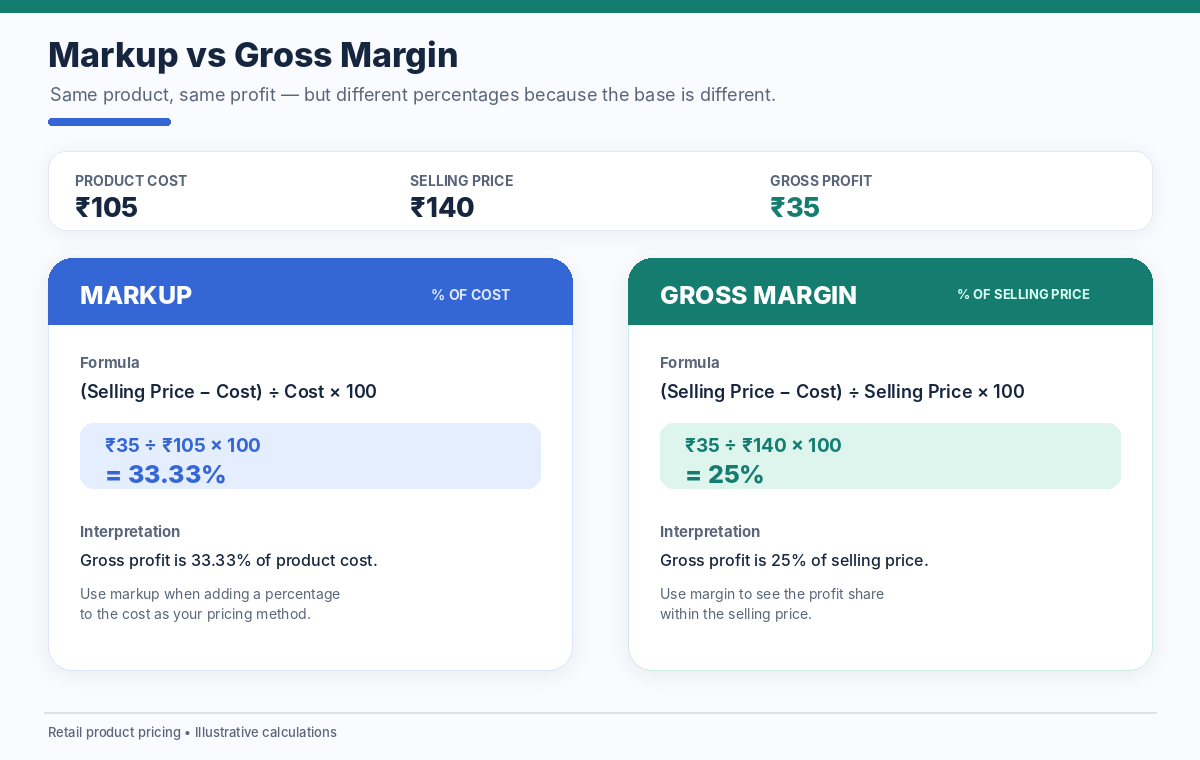
Markup measures the difference between the selling price and product cost as a percentage of cost.
Markup formula:
Markup (%) = (Selling Price − Product Cost) ÷ Product Cost × 100
Suppose a product costs ₹105 and you sell it for ₹140.
- Selling price: ₹140
- Product cost: ₹105
- Gross profit before other expenses and applicable tax effects: ₹35
Markup = ₹35 ÷ ₹105 × 100 = 33.33%
Your markup is approximately 33.33%.
What is gross profit margin?
Gross profit margin measures gross profit as a percentage of the selling price.
Gross margin formula:
Gross Margin (%) = (Selling Price − Product Cost) ÷ Selling Price × 100
Using the same figures:
Gross Margin = ₹35 ÷ ₹140 × 100 = 25%
Your gross profit margin is 25%.
Markup vs margin: A simple comparison
| Measure | Calculation | Result |
|---|---|---|
| Product cost | — | ₹105 |
| Selling price | — | ₹140 |
| Gross profit | ₹140 − ₹105 | ₹35 |
| Markup | ₹35 ÷ ₹105 × 100 | 33.33% |
| Gross margin | ₹35 ÷ ₹140 × 100 | 25% |
The important point is that a 25% markup does not produce a 25% gross margin.
When setting prices, be clear about which percentage you are targeting. Also remember that gross profit is not the same as final net profit: operating expenses still need to be accounted for.
3. How to Calculate a Selling Price From a Target Margin
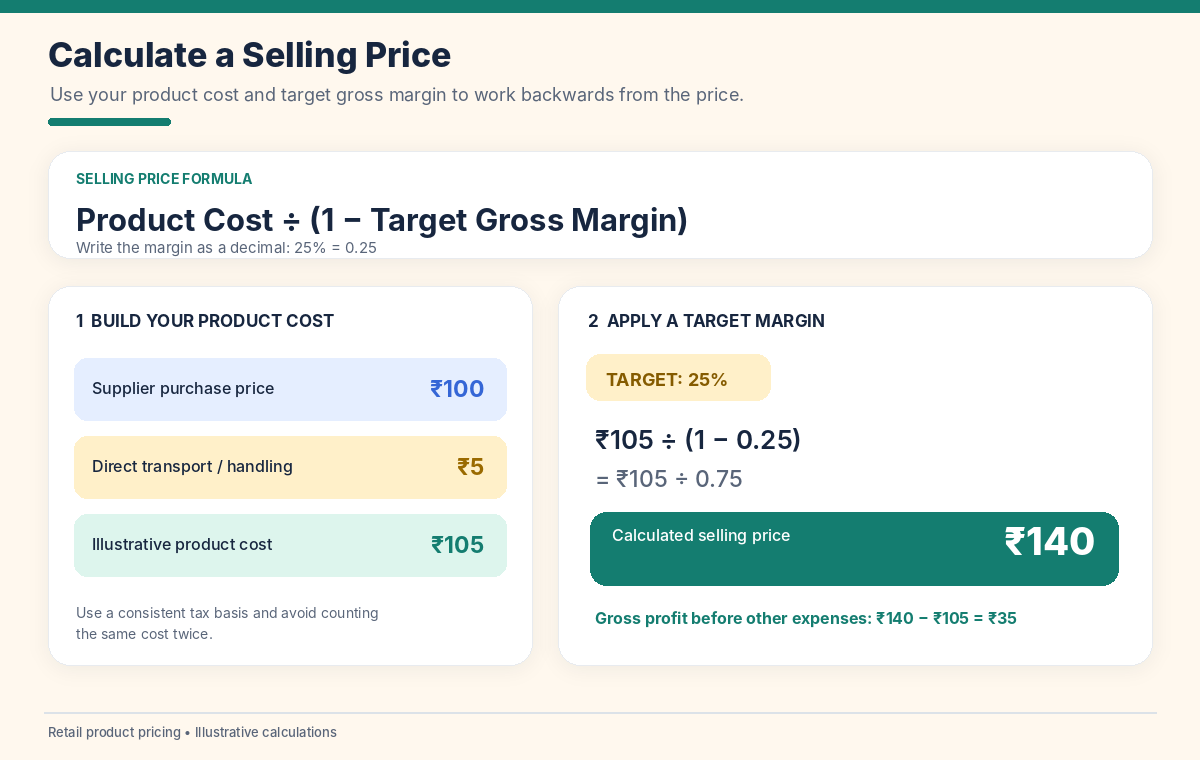
Once you know your product cost, you can calculate the selling price required to achieve a target gross margin.
Use this formula:
Selling Price = Product Cost ÷ (1 − Target Margin)
Express the target margin as a decimal in the formula.
For example, your product cost is ₹105 and your target gross margin is 25%.
Selling Price = ₹105 ÷ (1 − 0.25)
Selling Price = ₹105 ÷ 0.75
Selling Price = ₹140
At a selling price of ₹140, the gross profit is ₹35, which represents 25% of the selling price.
Here are a few examples using the same ₹105 product cost:
| Target gross margin | Calculated selling price |
|---|---|
| 20% | ₹131.25 |
| 25% | ₹140.00 |
| 30% | ₹150.00 |
These figures are mathematical examples, not recommended margins for every product category. Your actual pricing needs to account for the market, product demand, applicable taxes, and business expenses.
If your shop uses GST invoicing, keep cost and selling-price calculations on a consistent tax basis and confirm the treatment relevant to your business with your accountant.
4. Make Sure Your Prices Help Cover Shop Expenses
A product can appear profitable while the shop as a whole struggles to cover its expenses.
Suppose you purchase a product for ₹105 and sell it for ₹140. The difference is ₹35 before other expenses and applicable tax effects.
That ₹35 is not necessarily the amount you take home as net profit.
Your shop still needs to pay for costs such as:
- Rent and maintenance
- Employee salaries
- Electricity and internet
- Payment-processing charges where applicable
- Packaging and other operating supplies
- Business expenses not already included in the product cost
For this reason, avoid setting prices by adding an arbitrary percentage to supplier cost without reviewing the economics of your business.
Look at your overall sales, product costs, and operating expenses together. Our guide on how to calculate daily sales and profit in a retail shop explains how to separate sales revenue, gross profit, and expenses.
The objective is to create a pricing approach that supports both customer demand and the financial needs of your shop.
5. Compare Market Prices Without Blindly Copying Competitors
Competitor pricing can help you understand the market, but it should not be your only pricing method.
Before changing a price, consider:
Product quality: Are you selling the same brand, model, size, specification, and quantity?
Customer expectations: Do customers prioritise the lowest price, product quality, convenience, availability, or after-sales service?
Local competition: What are nearby retailers charging for genuinely comparable products?
Your costs: Can you offer a similar price while covering your own purchase and operating costs?
Business objectives: Are you trying to maintain a regular price, introduce a product, clear suitable stock, or encourage purchases of related products?
For example, a mobile accessories shop may sell a branded charger and a generic charger at different prices because their specifications, quality, and customer expectations differ.
A hardware shop might also offer different products at different price points to suit different customer requirements.
Rather than automatically matching the lowest competitor price, decide what makes sense for your product, customers, and costs.
6. Understand MRP and Pricing Rules in India
Pricing decisions in India must account for the requirements that apply to the products you sell.
For pre-packaged commodities covered by the applicable Legal Metrology (Packaged Commodities) Rules, the declared retail sale price or maximum retail price (MRP) is an important limit. The Government of India's Department of Consumer Affairs states that covered packaged commodities cannot be sold above their declared retail sale price.
You can consult the official Department of Consumer Affairs FAQ on Legal Metrology for the relevant rules and details.
Before changing prices, check whether the product is covered by those rules and whether any category-specific requirements or exemptions apply. Other products and transactions may be governed by different requirements.
For covered packaged goods, do not assume that a higher selling price is permitted simply because your purchase cost has increased. Review your supplier costs and purchasing arrangements instead.
Keep price labels, displayed offers, and bills accurate and consistent. If you are unsure about a product's applicable requirements, consult the relevant authority or a qualified professional.
7. Calculate the Real Impact of Discounts
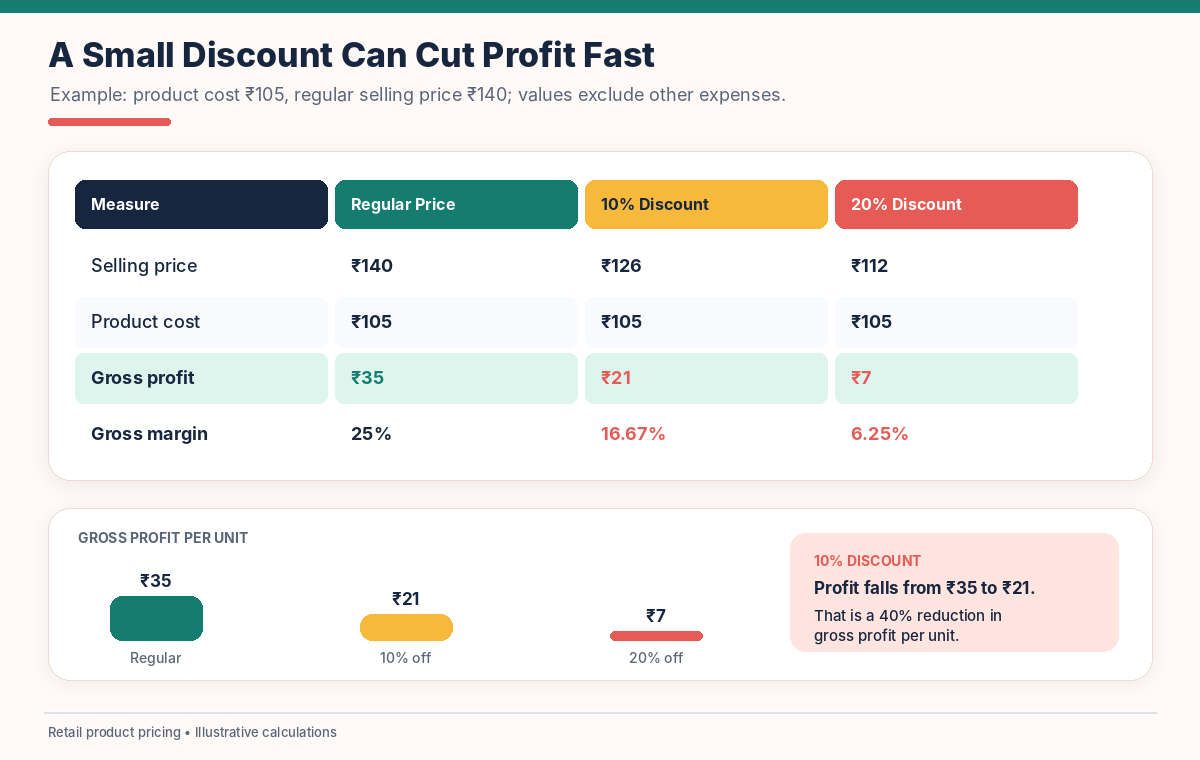
Discounts may encourage customers to buy, but they can also reduce gross profit much faster than expected.
Consider the product used in our earlier example:
- Product cost: ₹105
- Regular selling price: ₹140
- Gross profit before other expenses and applicable tax effects: ₹35
Now suppose you offer a 10% discount.
Discount = ₹140 × 10% = ₹14
Discounted selling price = ₹140 − ₹14 = ₹126
Gross profit after the discount = ₹126 − ₹105 = ₹21
| Measure | Regular price | After 10% discount |
|---|---|---|
| Selling price | ₹140 | ₹126 |
| Product cost | ₹105 | ₹105 |
| Gross profit | ₹35 | ₹21 |
| Gross margin | 25% | 16.67% |
The selling price has fallen by 10%, but gross profit per unit has fallen from ₹35 to ₹21—a reduction of 40%.
This is why you should calculate the effect of a discount before offering it.
Consider the promotion's purpose, the number of additional units you expect to sell, and the costs involved. A discount may make sense for certain business objectives, but increasing sales volume does not automatically mean increasing profit.
For more ideas on promotions and attracting customers, read how to increase retail sales in a small shop.
8. Choose the Right Pricing Approach for Each Product
Different products may need different pricing approaches. Choose a method that fits your business goals, customer expectations, and legal requirements.
Cost-based pricing
Start with the product cost and calculate a price that supports your target gross margin.
This approach gives you a clear starting point, but it does not replace market research or an assessment of operating expenses.
Competitor-aware pricing
Compare prices for genuinely comparable products in your market. Use the information as one input rather than automatically copying another seller.
Value-based pricing
Consider what customers value about the product, such as quality, convenience, reliability, compatibility, or service. The price still needs to make commercial sense and comply with applicable rules.
Bundle pricing
Offer a set of related products at a clearly communicated combined price. Check that the bundle remains financially worthwhile and that its terms are transparent.
For example, a mobile accessories retailer might offer a compatible case and screen protector together. A hardware shop could bundle related tools or accessories when customers are likely to need them together.
Clearance pricing
A controlled price reduction can help move suitable slow-selling stock. Before proceeding, consider the product's condition, remaining shelf life where relevant, current demand, and the financial impact of the discount.
You do not need one pricing method for every product in your shop. Use the approach that fits each product category and your business goals.
9. Review Prices When Costs or Market Conditions Change
A price that worked a few months ago may not remain suitable if supplier prices, transport costs, demand, or competition change.
Review your pricing when:
- A supplier changes the agreed purchase price.
- Transport or other direct acquisition costs increase.
- A product consistently sells more slowly than expected.
- A promotion is reducing profit more than anticipated.
- A competitor changes the price of a comparable product.
- Your sales records show that a product or category needs attention.
When changing prices, update your records and any displayed prices or promotional information as needed. Ensure that prices in your billing system match what customers are charged.
Use a regular review schedule rather than changing prices every time you hear about a competitor's offer. The appropriate frequency depends on your products and how quickly the market changes.
10. Keep a Simple Product Pricing Record
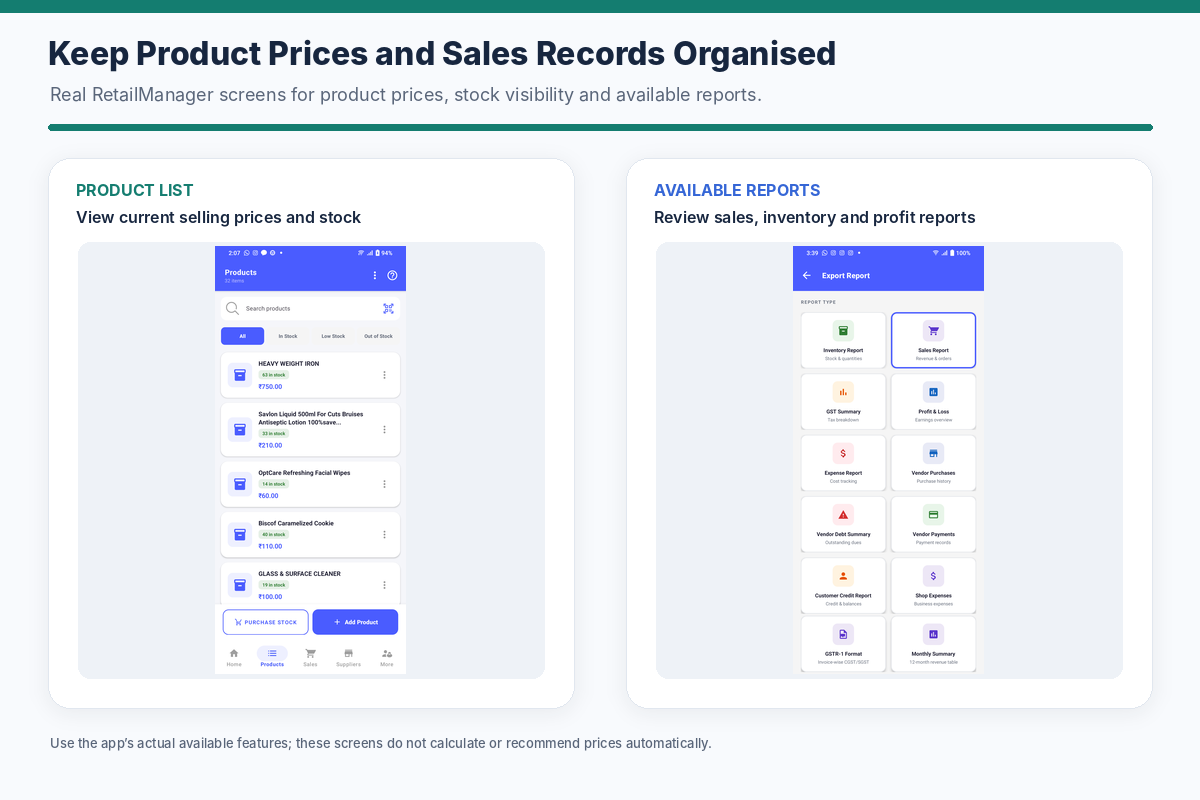
A pricing record makes it easier to explain why you set a particular price and to review it later.
For each important product, consider recording:
- Product name, code, brand, or variant
- Supplier and latest purchase price
- Relevant direct acquisition costs
- Calculated product cost
- Current selling price
- Markup and gross margin, using clearly defined calculations
- Applicable MRP or other pricing constraints
- Date of the latest price review
You can maintain this information in a spreadsheet, a notebook, or a suitable retail-management system.
If you use billing software, check whether it lets you maintain product prices and view useful sales reports. The available functions vary, so choose a system based on your requirements rather than assuming every application supports automatic margin calculations.
Our guide on how to choose billing software for small shops in India covers the features and questions worth evaluating.
Frequently Asked Questions
What is a good profit margin for a retail shop?
There is no single margin that suits every retail business. A suitable target depends on the product category, purchase costs, operating expenses, competition, customer demand, and business objectives. Compare the margins of your own products and make sure the overall business can cover its expenses.
What is the difference between markup and profit margin?
Markup measures the difference between selling price and product cost as a percentage of cost. Gross profit margin measures that same difference as a percentage of selling price. Because the denominators differ, the percentages are not the same.
How do I calculate a selling price for a 25% margin?
For a simplified calculation, divide the product cost by 0.75. If the product cost is ₹105, the selling price is ₹105 ÷ 0.75 = ₹140, giving a gross margin of 25% before other expenses and applicable tax effects.
Can I sell a packaged product above its MRP in India?
For pre-packaged commodities covered by the applicable Legal Metrology rules, the declared retail sale price is a limit that retailers must respect. Check the relevant government guidance and any product-specific rules or exemptions before making a pricing decision.
Conclusion
Retail product pricing becomes easier when you understand the cost of each product, the difference between markup and margin, and the effect of discounts on gross profit.
Start with accurate purchase records, calculate your product cost carefully, and decide whether your target is based on markup or gross margin. Compare your prices with the market, account for shop expenses, follow the pricing requirements that apply to your products, and review prices when business conditions change.
Whether you operate a grocery store, pharmacy, hardware shop, fertilizer business, clothing store, or mobile accessories shop, a consistent pricing process can help you make more informed decisions.
Want to organise your shop's daily operations? Explore RetailManager on Google Play and review its current features to see whether they meet your business requirements.
- #Retail Product Pricing
- #Markup vs Margin
- #Retail Profit
- #Pricing Strategy
- #Small Business Tips