Retail Management
How to Calculate Daily Sales and Profit in a Retail Shop
Learn how to calculate daily retail sales, gross profit, and shop expenses using simple formulas and a worked ₹ example for small retailers.

Every day, a retail shop makes sales, receives payments, purchases products, and pays expenses. But knowing how much money came into the shop is not the same as knowing how much profit the business earned.
A shop might record ₹15,000 in sales in a day and still make less profit than expected because of product costs, discounts, rent, staff expenses, and other operating costs.
If you want to understand how your business is performing, learning how to calculate retail shop profit is an important first step.
In this guide, we'll explain how to calculate daily sales, understand the cost of products sold, work out gross profit, and estimate the amount remaining after shop expenses. We'll use a simple Indian retail example that you can adapt to your own business.
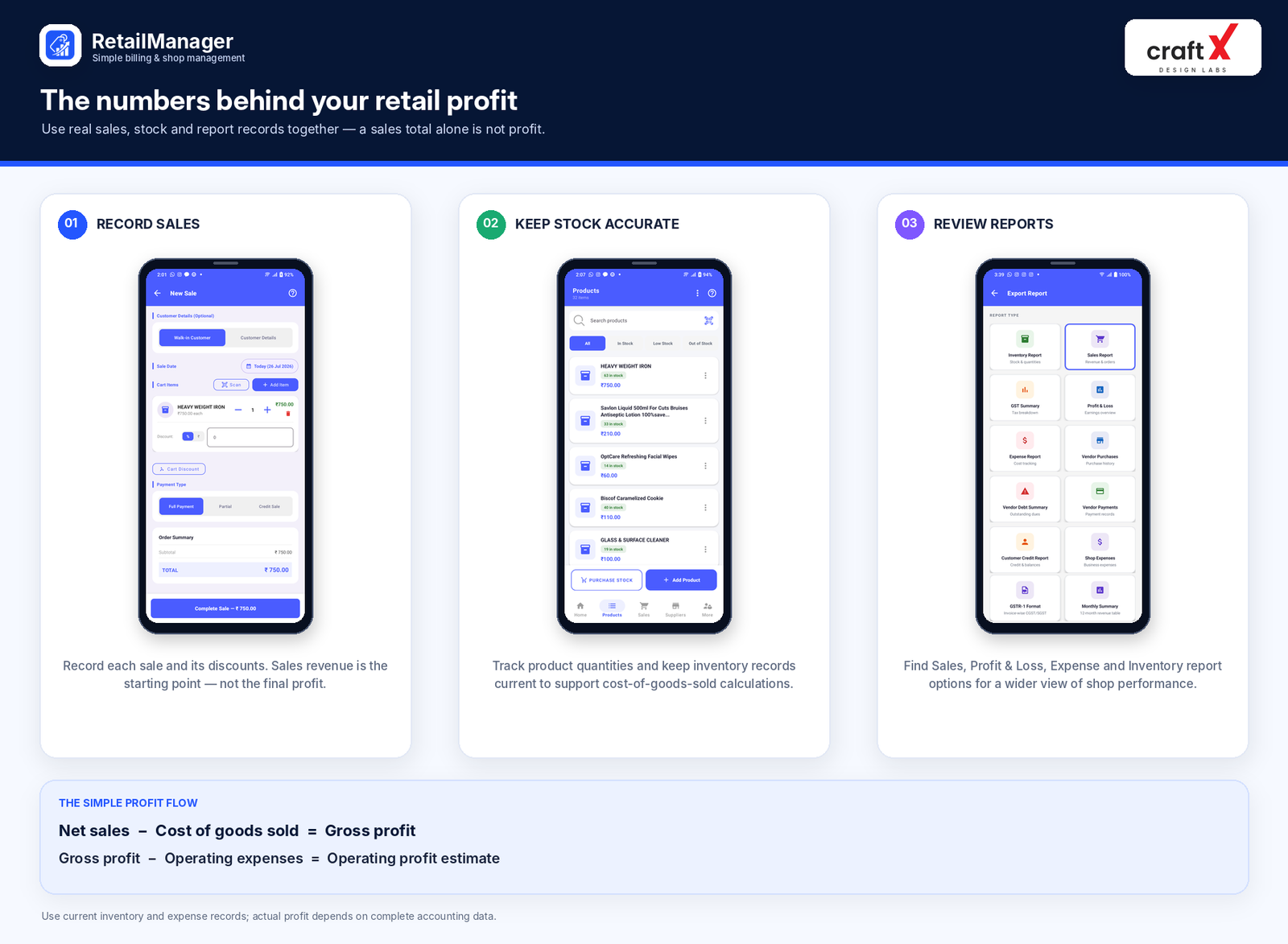
1. Understand the Difference Between Sales and Profit
Sales and profit are two different numbers.
Sales represent the value of goods sold during a period, after accounting for applicable discounts and returns.
Profit is what remains after deducting the relevant costs and expenses from that revenue.
For example, imagine a shop records ₹20,000 in sales before discounts and returns during a day. That does not mean the shop earned ₹20,000 in profit.
The shop also needs to account for the cost of the products sold and its operating expenses.
Here's the difference:
- Sales revenue: The amount earned from selling products.
- Cost of goods sold: The cost of the products that were actually sold.
- Gross profit: Sales revenue minus the cost of goods sold.
- Operating profit estimate: Gross profit minus the operating expenses attributable to the period.
Understanding these terms helps you interpret your daily sales reports correctly.
2. Calculate Your Daily Sales
The first step is to determine the value of the sales completed during the day.
A simple method is to add the finalized sales bills for that day and account for discounts, returns, and cancellations.
Net sales = Gross sales − Discounts − Sales returns
For example:
| Sales calculation | Amount |
|---|---|
| Total sales before discounts and returns | ₹20,000 |
| Less: Discounts and returns | ₹500 |
| Net sales | ₹19,500 |
The shop's net sales for this example are ₹19,500.
For a fair comparison, use a consistent basis for your records. Where GST applies, distinguish the tax collected from the shop's own sales revenue and follow the appropriate accounting treatment.
Also remember that sales and collections are not always the same. If you sell products on credit, the sale may be recorded today even though the customer pays later. Payments received today may also include amounts owed from earlier days.
For this reason, track sales separately from cash, UPI, bank collections, and outstanding customer balances.
3. Calculate the Cost of Products Sold
Before calculating profit, you need to estimate how much the products you sold actually cost your business.
This is called the cost of goods sold, or COGS.
For a simple inventory calculation:
Cost of goods sold = Opening inventory cost + Net purchases − Closing inventory cost
All three figures should be measured consistently at cost, with appropriate adjustments for purchase returns, damaged goods, and other relevant stock movements.
Consider this example:
| Inventory calculation | Amount |
|---|---|
| Opening inventory at cost | ₹45,000 |
| Net purchases during the period | ₹12,000 |
| Closing inventory at cost | ₹43,800 |
| Cost of goods sold | ₹13,200 |
The calculation is:
₹45,000 + ₹12,000 − ₹43,800 = ₹13,200
This means the cost assigned to the products sold during the period is ₹13,200.
The important point is that you should not automatically treat every purchase made today as the cost of today's sales. Some purchased goods may remain unsold in your inventory.
Keeping stock records accurate is therefore essential when calculating profit.
4. Calculate Your Gross Profit
Gross profit shows how much remains from sales revenue after accounting for the cost of the products sold.
The formula is:
Gross profit = Net sales − Cost of goods sold
Using our example:
| Gross profit calculation | Amount |
|---|---|
| Net sales | ₹19,500 |
| Less: Cost of goods sold | ₹13,200 |
| Gross profit | ₹6,300 |
The shop generated ₹6,300 in gross profit on ₹19,500 in net sales.
However, this is not necessarily the final profit. The shop may still need to pay rent, wages, electricity, transport, packaging, payment-processing fees, and other operating expenses.
Gross profit tells you how much remains to cover those costs.
5. Account for Your Shop Expenses
To estimate how much profit your shop earned, deduct the relevant operating expenses from gross profit.
Common retail operating expenses include:
- Shop rent
- Staff wages
- Electricity and internet
- Transport and delivery
- Packaging materials
- Payment-processing charges
- Other business operating costs
Some expenses occur daily, while others are billed monthly or annually. For daily performance estimates, allocate recurring expenses consistently across the period they relate to instead of charging an entire monthly bill to one day.
Let's continue our example:
| Expense | Amount allocated to the day |
|---|---|
| Rent and utilities | ₹450 |
| Staff wages | ₹500 |
| Transport and packaging | ₹200 |
| Other operating expenses | ₹100 |
| Total operating expenses | ₹1,250 |
Now calculate the estimated operating profit:
Estimated operating profit = Gross profit − Operating expenses
₹6,300 − ₹1,250 = ₹5,050
The shop's estimated operating profit for this example is ₹5,050 before other applicable costs, finance charges, taxes, and accounting adjustments.
This is a simplified illustration. Your actual profit depends on complete and accurate records for your business.
6. Calculate Your Profit Margin
Knowing the amount of profit is useful, but profit margin helps you understand how much profit your shop earns relative to its sales.
The gross profit margin formula is:
Gross profit margin = (Gross profit ÷ Net sales) × 100
Using our example:
(₹6,300 ÷ ₹19,500) × 100 = 32.3%
This means the shop retains approximately ₹32.30 in gross profit for every ₹100 of net sales, before operating expenses.
You can also calculate the estimated operating profit margin:
Operating profit margin = (Operating profit ÷ Net sales) × 100
(₹5,050 ÷ ₹19,500) × 100 = 25.9%
These margins answer different questions. Gross profit margin measures the amount left after the cost of products sold. The operating profit estimate also deducts the operating expenses included in your calculation.
When comparing margins over time, use consistent expense categories and accounting methods. Otherwise, changes in the calculation itself may distort your comparison.
7. Review Daily Results Without Jumping to Conclusions
One day's numbers do not always tell the whole story.
A retailer might earn less on a particular day because of lower demand, a higher share of discounted products, a change in product mix, or an unusual expense.
Reviewing daily results alongside weekly and monthly performance can help you identify more meaningful patterns.
Here are some useful questions to ask:
- Are sales increasing or decreasing?
- Which products contribute the most to gross profit?
- Are discounts reducing margins more than expected?
- Are stock purchases and inventory records accurate?
- Are operating expenses increasing?
- How much money remains outstanding from credit sales?
- Are supplier payments and customer collections being recorded correctly?
For example, a shop may increase its total sales but experience a lower gross profit margin because more low-margin products were sold. Looking at both sales and profit helps reveal what the sales total alone cannot show.
Also remember that a daily profit estimate may be less reliable when closing inventory values, damaged stock, or outstanding transactions have not been updated.
8. Use Retail Management Software to Make Tracking Easier
Calculating sales and profit manually can become difficult when a shop handles many products, daily transactions, purchases, credit sales, and expenses.
Retail management software can help organize the records needed for better reporting.
RetailManager brings together workflows for product management, billing and sales, purchases, customer balances, vendor payments, expenses, and business reporting. Its available reporting features depend on the app version and subscription plan.
For more useful results, keep product cost prices updated, record sales and expenses consistently, and review stock discrepancies. A report is only as reliable as the data recorded in the system.
You can explore RetailManager on Google Play.
Frequently Asked Questions
How do I calculate daily profit in a retail shop?
Start with net sales, subtract the cost of goods sold to calculate gross profit, and then subtract the operating expenses attributable to the day. The result is an operating profit estimate before any other applicable costs and adjustments.
What is the difference between gross profit and net profit?
Gross profit is sales revenue minus the cost of goods sold. Net profit accounts for the other applicable expenses, costs, and taxes according to the business's accounting treatment. The simplified operating profit calculation in this guide should not be confused with final net profit.
Should I count today's stock purchases as today's expenses?
Not automatically. Unsold products generally remain part of inventory. The cost of products sold should be calculated using appropriate inventory records rather than treating every purchase as an expense immediately.
Are daily sales and daily cash collections the same?
No. Sales may include credit transactions, while today's collections can include payments for earlier sales. Track sales, collections, and outstanding balances separately.
How often should I calculate retail shop profit?
You can review daily performance for operational awareness, but weekly and monthly reviews often give a more useful picture of profitability. Use accurate inventory and expense records and apply the same calculation method consistently.
Final Thoughts
Calculating retail shop profit starts with understanding your sales, the cost of the products sold, and your operating expenses.
Begin by recording daily sales accurately. Keep your inventory and purchase records updated, track expenses consistently, and separate customer collections from sales revenue.
Once these figures are organized, you can understand your gross profit, estimate operating profit, and monitor profit margins over time.
The goal is not simply to sell more products. It is to understand how much your business earns from those sales and make better decisions about pricing, purchasing, expenses, and stock.
If you're looking for more practical advice, read our guide on how to manage a small retail shop, covering billing, inventory, sales, and payments.
- #Retail Profit
- #Sales Tracking
- #Expense Management
- #Small Business
- #Retail Management
- #Inventory management