Finance & Business Management
How to Calculate the Break-Even Point for a Retail Shop
Learn how to calculate your retail shop's break-even point, understand contribution margin, and set realistic monthly sales targets
For a retail shop, the break-even point is the sales level at which total revenue equals total fixed and variable costs. Understanding this figure helps shop owners calculate how much they need to sell each month to cover their business expenses without making an operating profit or loss.
For example, if your shop spends ₹60,000 every month on rent, salaries, utilities, and other fixed expenses, you need to generate enough contribution from product sales to cover those costs before the business starts earning an operating profit.
Whether you run a kirana store, pharmacy, hardware shop, clothing store, fertilizer business, or mobile accessories shop, understanding the break-even point can help you set realistic sales targets and make better pricing and spending decisions.
In this guide, we will explain break-even analysis using simple Indian rupee examples, including fixed costs, variable costs, contribution margin, monthly sales targets, and target profit.
1. What Is the Break-Even Point?
The break-even point is the level of sales at which your total revenue equals your total costs.
At this point:
- Your business has covered its fixed expenses.
- Your variable costs have been covered.
- Your operating profit is zero.
- Your business has neither made an operating profit nor incurred an operating loss.
Suppose your shop generates ₹2,00,000 in monthly sales. After accounting for the variable costs of the products sold, ₹60,000 remains to cover fixed expenses.
If your fixed expenses are also ₹60,000, your shop has reached its break-even point.
If sales increase while the cost structure and product mix remain consistent, the additional contribution can generate operating profit.
If sales fall below the break-even level, the business may not generate enough contribution to cover its fixed expenses.
This calculation helps you understand the minimum sales level your shop needs to aim for.
2. Understand Fixed Costs and Variable Costs
Before calculating the break-even point, separate your business costs into fixed and variable categories.
This distinction is important because both types of costs behave differently as sales change.
What are fixed costs?
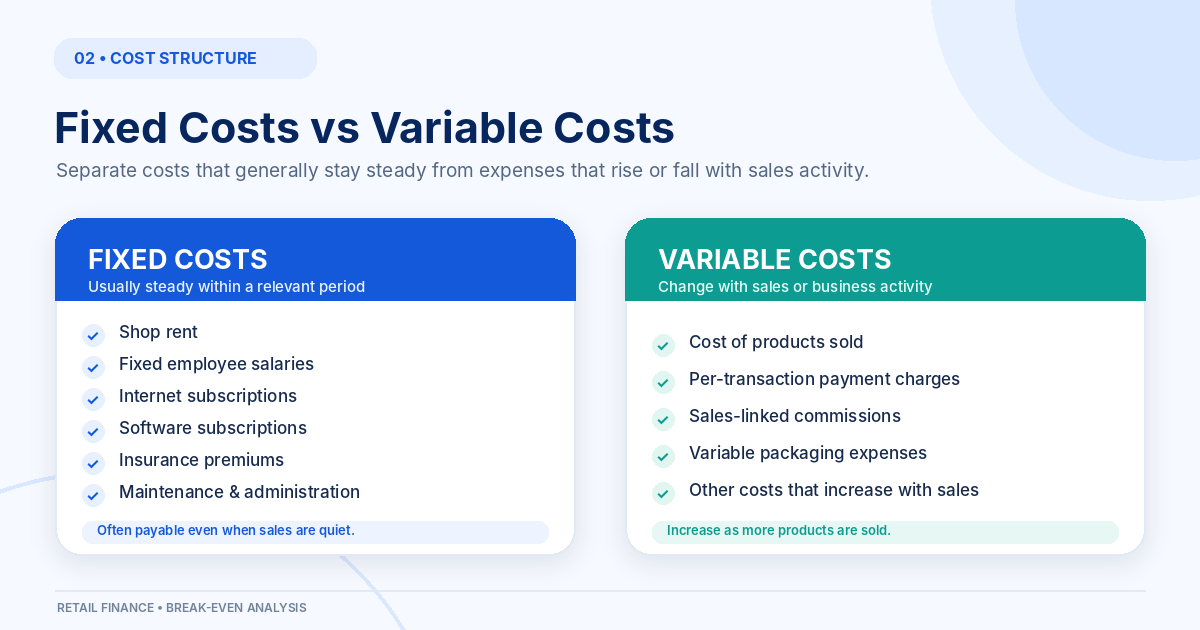
Fixed costs are expenses that generally remain unchanged within a particular operating range, regardless of how many products you sell during the period.
Examples include:
- Shop rent
- Fixed employee salaries
- Internet subscriptions
- Software subscriptions
- Insurance premiums
- Certain maintenance and administrative expenses
For example, if your shop pays ₹20,000 in monthly rent, that amount generally remains payable whether you sell 100 products or 1,000 products during the month.
Some expenses may change over time or when your business expands, but they can still be treated as fixed within a relevant planning period.
What are variable costs?
Variable costs change with the quantity of products sold or the level of business activity.
For a retail shop, these may include:
- Cost of products sold
- Per-transaction payment charges
- Sales-linked commissions
- Variable packaging expenses
- Other costs that increase with sales volume
For example, if you sell more products, the cost associated with those products also increases.
The purchase value of goods still sitting in your shop should not automatically be treated as the cost of goods sold for the same period. Use the cost attributable to the products actually sold.
Example: Monthly fixed expenses
Suppose your shop has these monthly costs:
| Fixed expense | Monthly amount |
|---|---|
| Shop rent | ₹20,000 |
| Employee salaries | ₹25,000 |
| Internet and software | ₹3,000 |
| Fixed utility and maintenance costs | ₹5,000 |
| Other fixed administrative expenses | ₹7,000 |
| Total fixed costs | ₹60,000 |
Your estimated monthly fixed costs are ₹60,000.
Use your actual bills, salary commitments, and recurring business expenses when preparing this calculation.
Some expenses, such as electricity, may contain both fixed and variable elements. Separate or reasonably estimate those components so that you do not count the same expense twice.
3. Understand Contribution Margin Before Calculating Break-Even
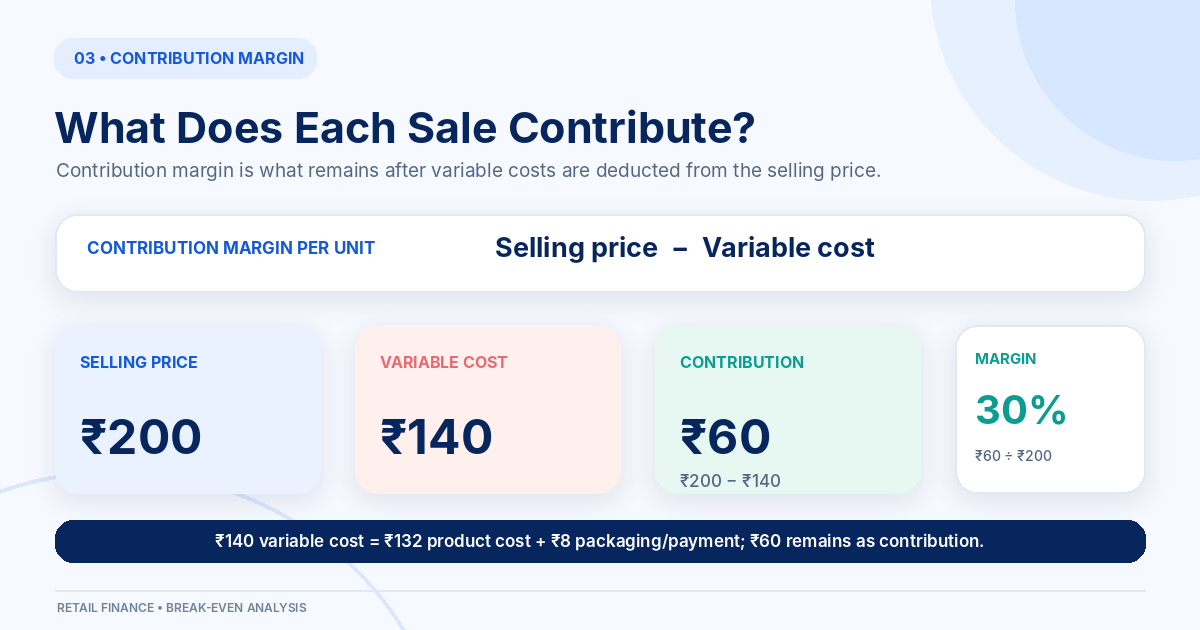
Contribution margin is the amount remaining from a product's selling price after deducting its variable costs.
This amount contributes towards covering fixed costs. Once fixed costs are covered, additional contribution generates operating profit, assuming the other costs and sales mix remain consistent.
Contribution Margin per Unit = Selling Price per Unit − Variable Cost per Unit
Consider this example:
A retail shop sells a product for ₹200.
The variable costs are:
| Cost component | Amount per unit |
|---|---|
| Product cost | ₹132 |
| Variable packaging and payment costs | ₹8 |
| Total variable cost | ₹140 |
| Selling price | ₹200 |
| Contribution margin | ₹60 |
Calculation:
₹200 − ₹140 = ₹60.
The contribution margin is ₹60 per unit.
This means every unit sold contributes ₹60 towards covering the shop's fixed expenses and, after those expenses are covered, towards operating profit.
Calculate the contribution margin ratio
The contribution margin ratio expresses the contribution margin as a percentage of selling price.
Contribution Margin Ratio = Contribution Margin ÷ Selling Price × 100
Using the same example:
₹60 ÷ ₹200 × 100 = 30%
Your contribution margin ratio is 30%.
In other words, for every ₹100 of sales, ₹30 is available to cover fixed costs and contribute towards operating profit, assuming the same cost structure.
4. Calculate the Break-Even Point in Units
For a shop selling a single product, you can calculate how many units need to be sold to cover fixed expenses.
The formula is:
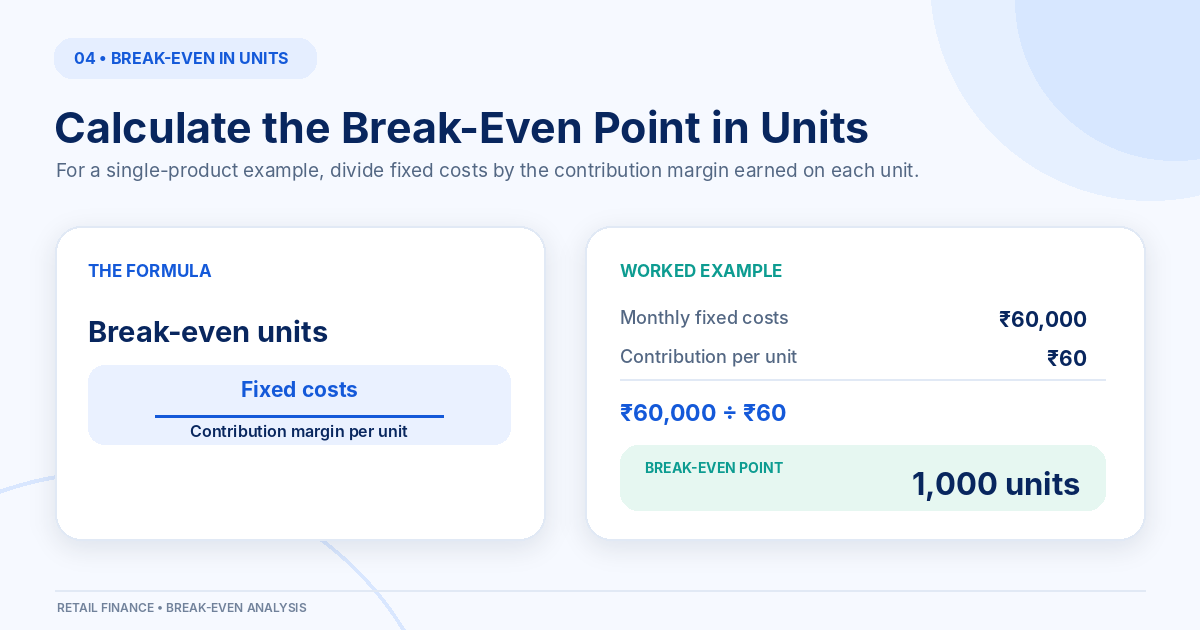
Break-Even Units = Total Fixed Costs ÷ Contribution Margin per Unit
Using our example:
- Monthly fixed costs = ₹60,000
- Selling price per unit = ₹200
- Variable cost per unit = ₹140
- Contribution margin per unit = ₹60
Break-Even Units = ₹60,000 ÷ ₹60
Break-Even Units = 1,000 units
Your shop needs to sell 1,000 units during the month to cover the fixed costs and variable costs included in this calculation.
Verify the result
| Particulars | Amount |
|---|---|
| Units sold | 1,000 |
| Sales revenue | ₹2,00,000 |
| Variable costs | ₹1,40,000 |
| Contribution margin | ₹60,000 |
| Fixed costs | ₹60,000 |
| Operating profit at break-even | ₹0 |
The shop covers all the costs included in the example but has not yet generated an operating profit.
This is the basic idea behind break-even analysis.
5. Calculate the Break-Even Point in Sales Value
Retail shops usually sell several products rather than only one product.
For that reason, it is useful to calculate break-even as total sales revenue.
The formula is:
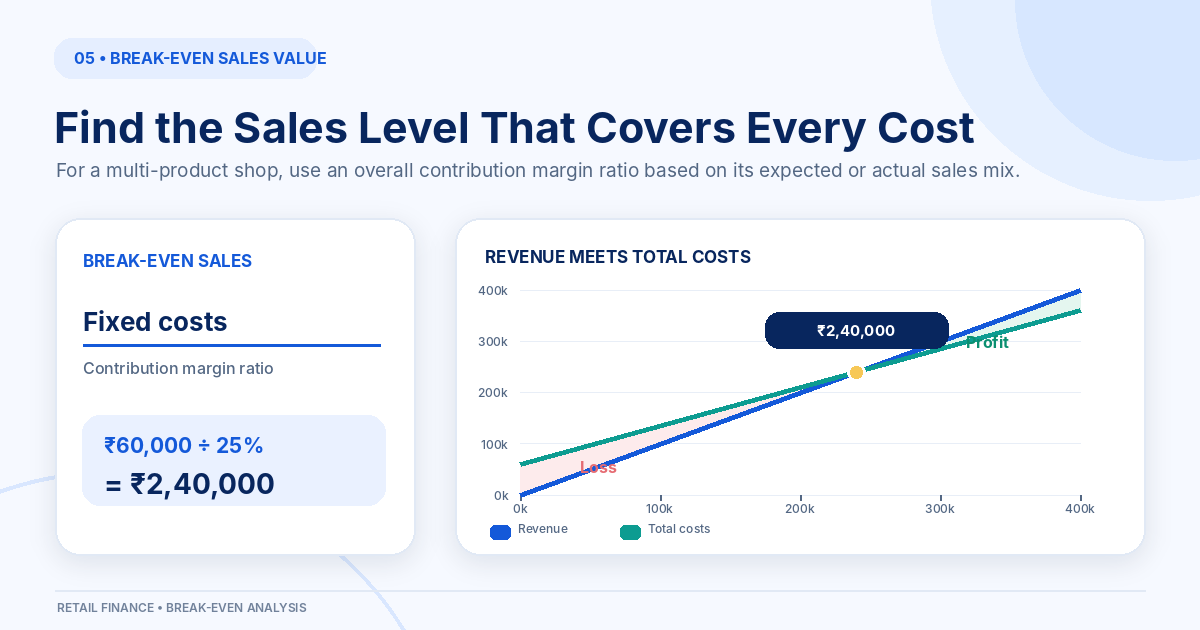
Break-Even Sales = Fixed Costs ÷ Contribution Margin Ratio
Suppose your shop has:
- Monthly fixed costs = ₹60,000
- Average contribution margin ratio = 25%
Break-Even Sales = ₹60,000 ÷ 0.25
Break-Even Sales = ₹2,40,000
Your shop needs to generate approximately ₹2,40,000 in monthly sales to cover the costs included in this calculation.
What does this mean?
For every ₹100 of sales:
- ₹75 covers variable costs.
- ₹25 contributes towards fixed expenses and profit.
At ₹2,40,000 in monthly sales, the contribution is:
₹2,40,000 × 25% = ₹60,000.
This exactly covers the ₹60,000 in fixed costs.
The operating profit at this level is zero.
The 25% contribution margin ratio is an illustrative assumption. Your actual ratio depends on your product range, selling prices, product costs, and sales mix.
6. Understand Break-Even Analysis for a Shop Selling Multiple Products
Most retail businesses sell products with different costs and contribution margins.
For example:
A grocery store may sell everyday essentials with relatively small contributions per item, while some household products may provide a different contribution.
A clothing shop may have different margins for shirts, trousers, accessories, and seasonal collections.
Because of these differences, you should not assume that every product contributes the same percentage of its selling price.
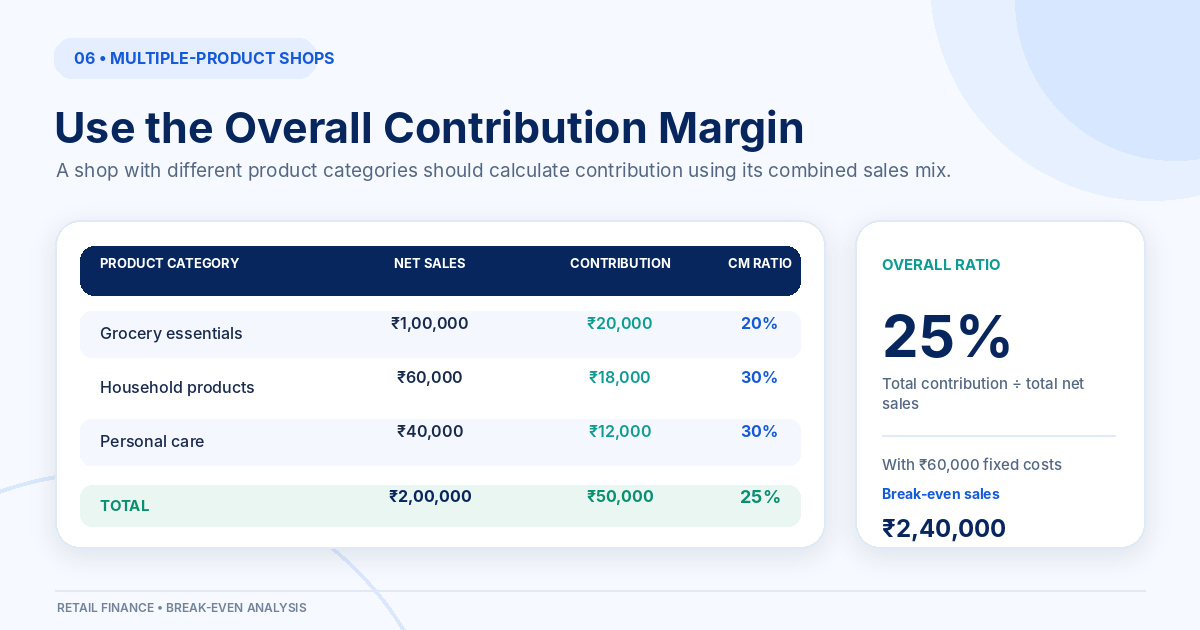
For a multi-product shop, use the overall contribution margin ratio based on the expected or actual sales mix.
Overall Contribution Margin Ratio = Total Contribution Margin ÷ Total Net Sales
Consider this illustrative example:
| Product category | Net sales | Contribution margin |
|---|---|---|
| Grocery essentials | ₹1,00,000 | ₹20,000 |
| Household products | ₹60,000 | ₹18,000 |
| Personal care products | ₹40,000 | ₹12,000 |
| Total | ₹2,00,000 | ₹50,000 |
Overall contribution margin ratio:
₹50,000 ÷ ₹2,00,000 × 100 = 25%
If monthly fixed costs are ₹60,000:
Break-Even Sales = ₹60,000 ÷ 0.25
Break-Even Sales = ₹2,40,000
This is more useful than applying the contribution margin of one product to the entire shop.
Remember that the result depends on the sales mix remaining reasonably similar. If customers begin purchasing more low-contribution products and fewer high-contribution products, the overall contribution margin ratio may change.
For reliable comparisons, calculate these figures using consistent cost and sales values. If your business is registered under GST, make sure sales and relevant costs are treated consistently with the applicable GST and input tax credit treatment. Your accountant can help establish the correct figures for your records.
7. Convert Your Monthly Break-Even Sales Into a Daily Target
Knowing your monthly break-even figure is useful, but a daily sales target can make it easier to manage everyday business activity.
Suppose:
- Monthly break-even sales = ₹2,40,000
- Operating days in the month = 26
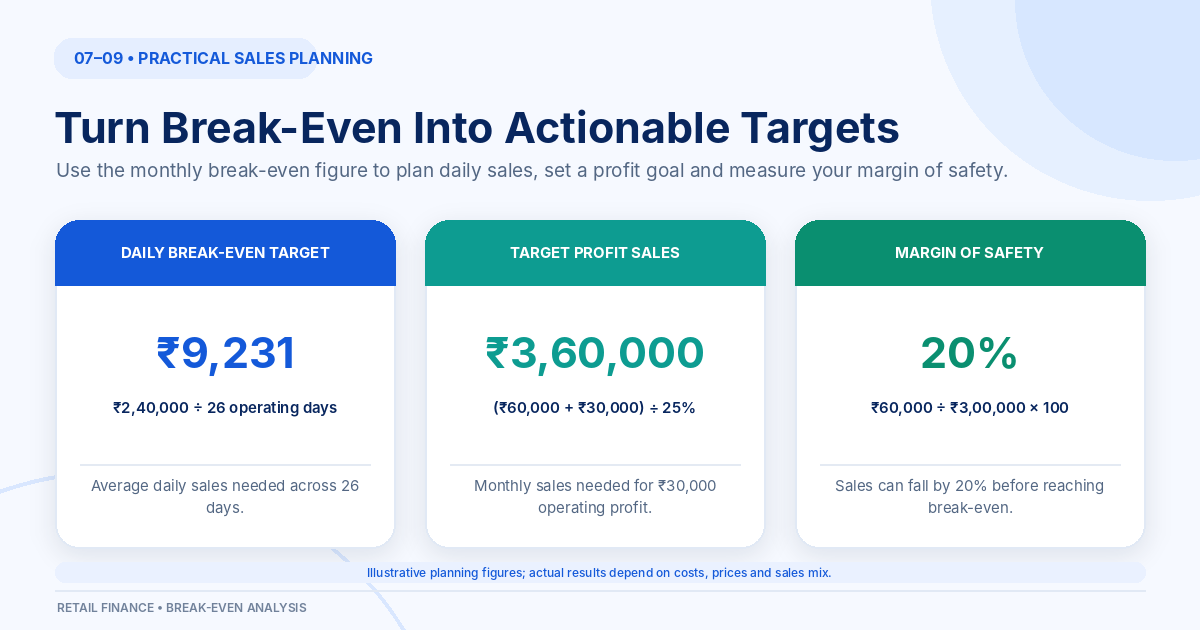
Daily Break-Even Sales = ₹2,40,000 ÷ 26
Daily Break-Even Sales ≈ ₹9,231
This means the shop needs average daily sales of approximately ₹9,231 across 26 operating days to reach the calculated monthly break-even level.
This is an average planning target, not a requirement that every day must produce exactly the same sales.
Some days may be busy, while others may be quieter. Weekends, festivals, local events, and customer traffic can influence daily performance.
Compare your actual sales with the daily average while continuing to monitor the complete monthly result.
You can also set separate targets for weekdays, weekends, and seasonal periods when your sales patterns justify doing so.
8. Calculate the Sales Needed to Reach a Target Profit
Break-even analysis does not have to stop at covering expenses.
Once you understand your break-even sales, you can also calculate the sales required to achieve a particular operating profit.
The formula is:
Target Sales = (Fixed Costs + Desired Operating Profit) ÷ Contribution Margin Ratio
Suppose your monthly figures are:
- Fixed costs = ₹60,000
- Desired operating profit = ₹30,000
- Contribution margin ratio = 25%
Target Sales = (₹60,000 + ₹30,000) ÷ 0.25
Target Sales = ₹90,000 ÷ 0.25
Target Sales = ₹3,60,000
Your shop needs to generate approximately ₹3,60,000 in monthly sales to cover the fixed costs and achieve the target operating profit of ₹30,000, assuming the contribution margin ratio remains 25%.
Compare this result with your break-even sales of ₹2,40,000.
The difference is the additional sales needed to reach the desired profit under the same assumptions.
This calculation helps you set sales targets based on your actual cost structure rather than choosing an arbitrary monthly sales figure.
9. Understand the Margin of Safety
The margin of safety tells you how much actual sales can fall before the business reaches its break-even point.
A larger margin of safety generally means the business has more room for a decline in sales before it starts making an operating loss.
The formula is:
Margin of Safety = Actual Sales − Break-Even Sales
You can also express it as a percentage:
Margin of Safety (%) = Margin of Safety ÷ Actual Sales × 100
Consider this example:
- Actual monthly sales = ₹3,00,000
- Break-even sales = ₹2,40,000
Margin of Safety = ₹3,00,000 − ₹2,40,000
Margin of Safety = ₹60,000
Margin of Safety Percentage:
₹60,000 ÷ ₹3,00,000 × 100 = 20%
This means sales could decline by approximately 20% from the current level before reaching the calculated break-even point, assuming costs and product mix remain consistent.
A lower margin of safety means the business has less room to absorb a decline in sales.
Use this measure alongside cash flow and payment commitments rather than relying on it alone.
10. How Can You Improve Your Break-Even Position?
If your break-even sales figure seems too high for your shop's current performance, identify which part of the calculation needs attention.
You have several possible options.
Review fixed expenses
Check recurring business expenses and identify unnecessary costs.
For example, you may find subscriptions, services, or operating expenses that are no longer useful.
Do not reduce necessary maintenance, safety, employee-related, or legal compliance expenses simply to improve the calculation.
Review product pricing
Some products may have very small contribution margins.
Review the purchase cost, selling price, discounts, and market conditions before changing prices.
Our guide on retail product pricing, markup, margin, and profit explains how to calculate selling prices more carefully.
Improve the product mix
Review which products contribute more towards covering fixed costs.
You may be able to improve the product mix by making relevant high-contribution products easier for customers to discover.
Do not remove essential low-margin products without considering their importance to the overall customer offering.
Reduce unnecessary discounts
Discounts reduce the contribution generated by each sale.
Before announcing a promotion, calculate the effect on contribution margin and the additional sales required to compensate for the reduction.
Reduce inventory losses
Damaged, expired, and unsold products can affect business performance and working capital.
Improve storage, purchasing, and stock verification practices to reduce avoidable losses.
Increase sales through better operations
Improve customer service, product availability, product visibility, and local marketing.
For further suggestions, read how to increase retail sales in a small shop.
The objective is to improve the overall financial performance of your shop rather than simply increase sales at any cost.
11. Common Mistakes When Calculating the Break-Even Point
Break-even analysis is useful only when the figures are prepared correctly.
Avoid these mistakes.
Using total purchases instead of variable costs of goods sold: Purchases made during a month may include products that remain in inventory. Use the cost attributable to products sold for the relevant period.
Ignoring variable selling expenses: Payment fees, packaging, and sales-linked commissions can affect contribution margin.
Using the wrong sales figure: Use consistent net sales values and account for discounts, returns, and applicable tax treatment.
Treating every expense as fixed: Some expenses vary with sales activity, while others contain both fixed and variable elements.
Using one product's margin for the entire shop: Multi-product retailers should use a representative overall or weighted contribution margin ratio.
Mixing different time periods: Monthly fixed costs must be compared with monthly contribution, not annual figures.
Assuming break-even means the business is financially healthy: A shop may cover its accounting costs while still experiencing cash-flow problems due to credit sales, inventory purchases, loan repayments, or payment timing.
Treating the result as a guaranteed forecast: Break-even analysis is based on assumptions. Actual costs, prices, demand, and product mix can change.
Review your inputs regularly and update the calculation whenever major business costs or selling prices change.
12. Use Business Records to Review Your Break-Even Position
A shop owner can calculate the break-even point using a spreadsheet if accurate figures are available.
You will need:
- Net sales
- Cost of goods sold
- Other variable selling costs
- Monthly fixed expenses
- Contribution margin ratio
- Current sales performance
A suitable billing or retail-management system may help organise sales, expense, purchase, and product records.
However, the availability of reports varies between applications. Do not assume that every billing application automatically calculates a break-even point.
RetailManager provides product, sales, purchase, expense, and reporting workflows that retailers can evaluate when maintaining their business records. Check its current capabilities before relying on it for a specific break-even calculator or automated financial analysis feature.
You can also refer to our guide on how to calculate daily sales and profit in a retail shop and how to track daily expenses in a retail shop.
Frequently Asked Questions
What is the break-even point in a retail shop?
It is the level of sales at which the shop's total revenue equals its total fixed and variable costs for a selected period. At this point, operating profit is zero.
How do I calculate the break-even point?
Divide total fixed costs by the contribution margin ratio to calculate break-even sales.
Break-Even Sales = Fixed Costs ÷ Contribution Margin Ratio.
For break-even units, divide fixed costs by the contribution margin per unit.
What is contribution margin?
Contribution margin is the amount remaining after deducting variable costs from sales. It contributes towards paying fixed expenses and generating operating profit.
Can a shop calculate break-even without accounting software?
Yes. You can use a spreadsheet or calculator if you have accurate information about fixed costs, variable costs, and sales. Software can make it easier to maintain the supporting records.
Is a higher break-even point good or bad?
A higher break-even point means your shop needs more sales to cover its costs under the calculation assumptions. Whether it is reasonable depends on your business size, market, margins, and expected demand.
Does break-even analysis include GST?
The calculation should use a consistent accounting basis. GST collected on taxable sales should not simply be treated as ordinary business revenue. The appropriate treatment of sales, purchase costs, and eligible input tax credit depends on your tax status and transactions. Consult your accountant when preparing figures for financial planning.
Is break-even the same as cash flow?
No. Break-even analysis compares revenue, variable costs, and fixed costs to identify the sales level at which operating profit is zero. Cash flow tracks when money is actually received and paid. A business can reach break-even on an accounting basis and still face a temporary cash shortage.
Conclusion
The break-even point helps retail shop owners understand the minimum sales required to cover their business costs.
Start by identifying fixed and variable expenses, calculating the contribution margin, and using the correct formula for your product range. Convert the result into a monthly and daily sales target, then compare actual sales with the calculated requirement.
As your shop grows, review pricing, product mix, operating expenses, and inventory costs to understand how changes affect your break-even position.
Whether you operate a kirana store, pharmacy, hardware shop, clothing business, fertilizer shop, or mobile accessories store, break-even analysis can help you set more realistic sales targets and make better financial decisions.
- #Break-Even Analysis
- #Retail Profit
- #Contribution Margin
- #Business Costs
- #Retail Finance