Finance & Business Management
Cash Flow Management for Small Retail Shops in India
A practical guide to cash flow management for retail shops, with a weekly forecast, collection planning, stock control, and payment scheduling.

Cash Flow Management for Small Retail Shops in India
Cash flow management is an important part of running a retail shop. You may sell products every day and record a reasonable profit, but still struggle to pay suppliers, rent, employee salaries, or other business expenses on time.
This happens because profit and available cash are not the same thing. Some customers may purchase products on credit, money may remain tied up in unsold inventory, and several business payments may become due before you receive your next collections.
Whether you run a kirana store, pharmacy, hardware shop, clothing store, fertilizer business, or mobile accessories shop, managing cash flow helps you understand how much money is available and what payments are coming up.
In this guide, we will explain how to manage cash flow in a retail shop, prepare a simple forecast, organise collections and payments, and avoid common cash shortages.
1. Understand What Cash Flow Means
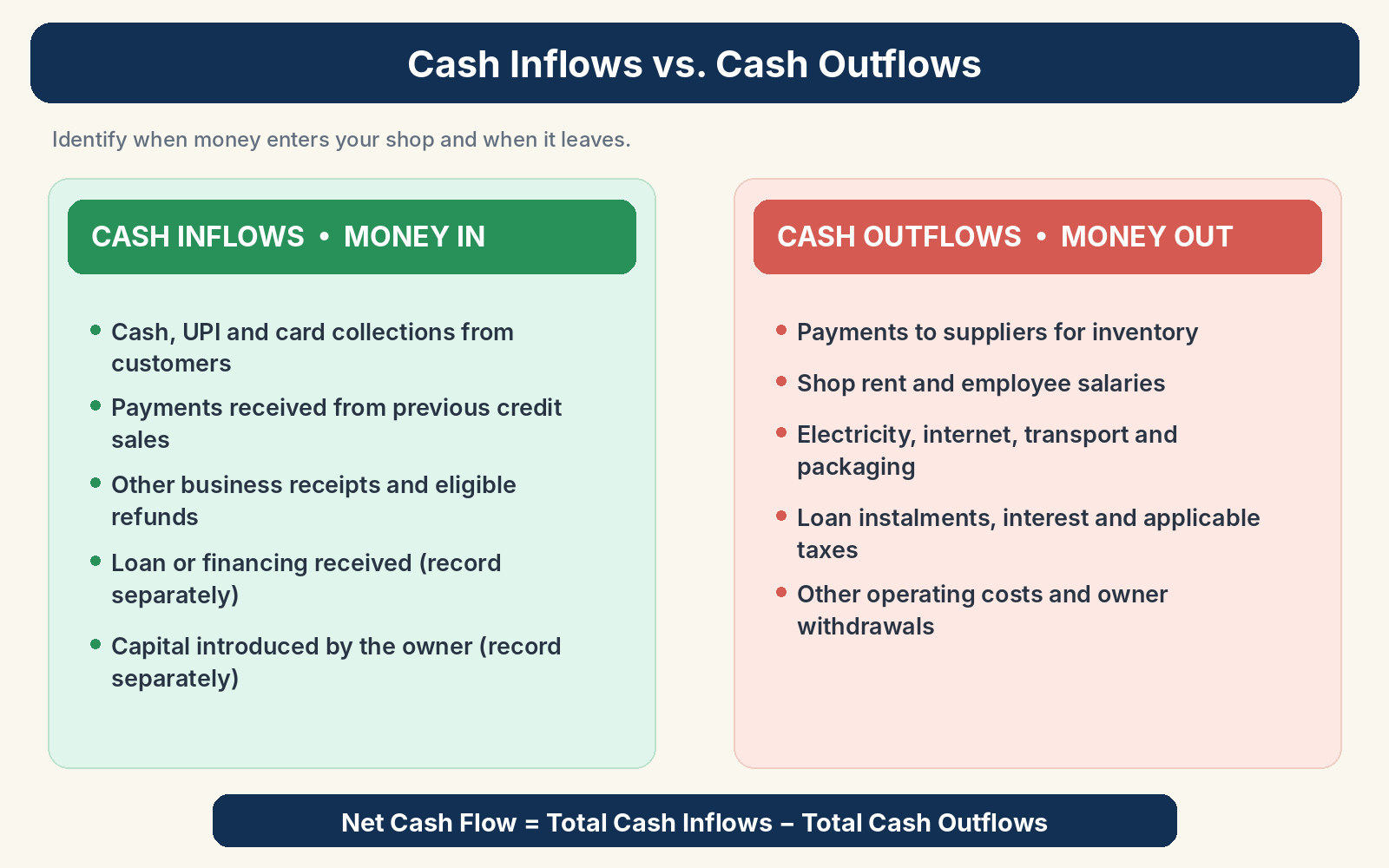
Cash flow refers to the money moving into and out of your business during a particular period.
Cash inflows are amounts received by the business, such as:
- Cash, UPI, and card collections from customers
- Payments received from customers who previously purchased on credit
- Other business receipts
- Eligible loan or financing amounts received
- Capital introduced by the owner
Cash outflows are amounts paid by the business, such as:
- Payments to suppliers
- Shop rent
- Employee salaries and wages
- Electricity and internet bills
- Transport and delivery expenses
- Packaging and operating costs
- Loan instalments and applicable interest
- Taxes and other business obligations
- Owner withdrawals
The difference between total inflows and total outflows gives the net cash flow for the period.
Net Cash Flow = Total Cash Inflows − Total Cash Outflows
A positive result means more cash entered the business than left it during that period. A negative result means the business paid out more cash than it received.
However, a single positive or negative period does not necessarily tell you whether the business is financially healthy. You should also consider the opening cash balance, upcoming payments, outstanding collections, and expected stock purchases.
2. Understand the Difference Between Profit and Cash Flow
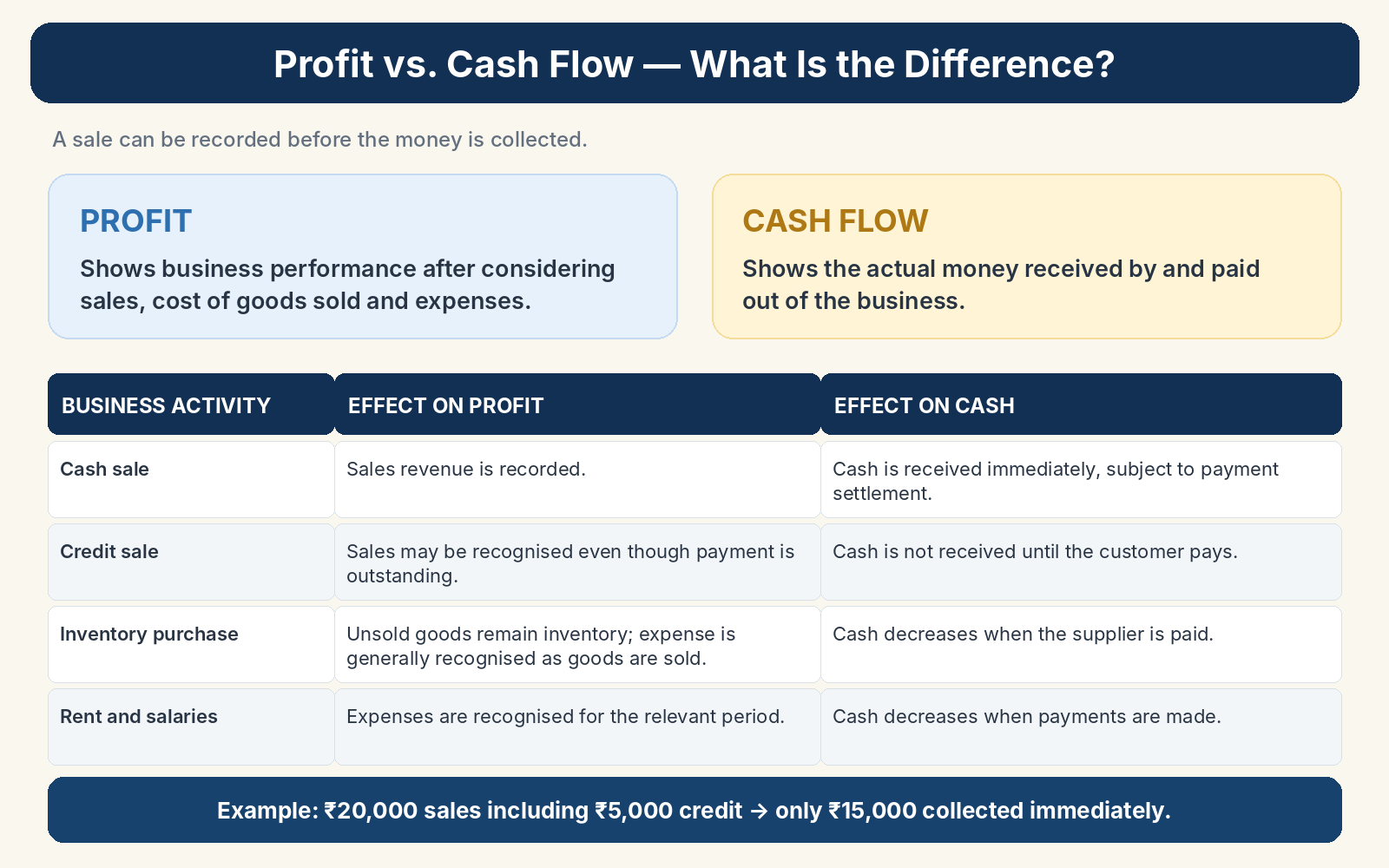
One of the most common mistakes in retail is assuming that profitable sales automatically mean more money is available in the bank.
Consider this example.
A shop sells products worth ₹20,000 during a particular day.
Out of this amount:
- ₹15,000 is collected through cash and digital payments.
- ₹5,000 is sold on customer credit.
The shop has recorded ₹20,000 in sales, but it has collected only ₹15,000 so far.
The remaining ₹5,000 is still outstanding from customers.
Now consider inventory purchases. The shop may pay ₹10,000 to a supplier today, but some of the purchased goods may remain unsold for several days or weeks.
The payment reduces available cash immediately, but the full purchase amount does not automatically become the cost of products sold for that day.
This is why cash flow and profit need to be monitored separately.
| Business activity | Effect on cash | Effect on profit |
|---|---|---|
| Cash sale | Cash increases | Sales revenue recorded |
| Credit sale | Cash not received immediately | Sales revenue generally recorded |
| Inventory purchase | Cash decreases when paid | Unsold goods remain inventory |
| Supplier payment for earlier purchase | Cash decreases | Does not automatically create a new product expense |
| Rent payment | Cash decreases | Rent expense recognised for the relevant period |
| Loan principal repayment | Cash decreases | Not normally treated as an operating expense |
The exact accounting treatment depends on the transaction and applicable accounting rules.
Our guide on how to calculate daily sales and profit in a retail shop explains the differences between sales revenue, cost of goods sold, gross profit, and operating expenses.
3. Identify Where Your Shop's Cash Comes From and Where It Goes
Before improving cash flow, understand the major sources of money entering and leaving your business.
Start by reviewing your business transactions and grouping them into simple categories.
Cash inflows
Daily customer collections: Cash, UPI, card payments, and other collections received from current sales.
Customer dues: Payments received from customers who purchased products earlier on credit.
Other business receipts: Supplier refunds, eligible business reimbursements, or other genuine receipts.
Financing and owner funds: Money introduced by the owner or received through approved business financing. Record these separately from sales collections.
Cash outflows
Inventory purchases: Money paid to suppliers for products.
Operating expenses: Rent, salaries, electricity, internet, maintenance, transport, and other regular expenses.
Financial payments: Loan instalments, interest, and applicable bank charges.
Tax and statutory payments: Amounts payable according to your business's applicable requirements.
Owner withdrawals: Money taken from the business for personal use.
Separating these categories helps you understand which activities use the most cash.
For example, if a shop regularly runs short of money after purchasing inventory, the problem may not be low sales. It may be that too much cash is being spent on products before the previous stock has been sold.
4. Prepare a Simple Weekly Cash Flow Forecast
A cash flow forecast helps you estimate how much money your shop may have available on future dates.
You do not need complicated financial software. A spreadsheet or simple table can be enough for a small business.
Start with:
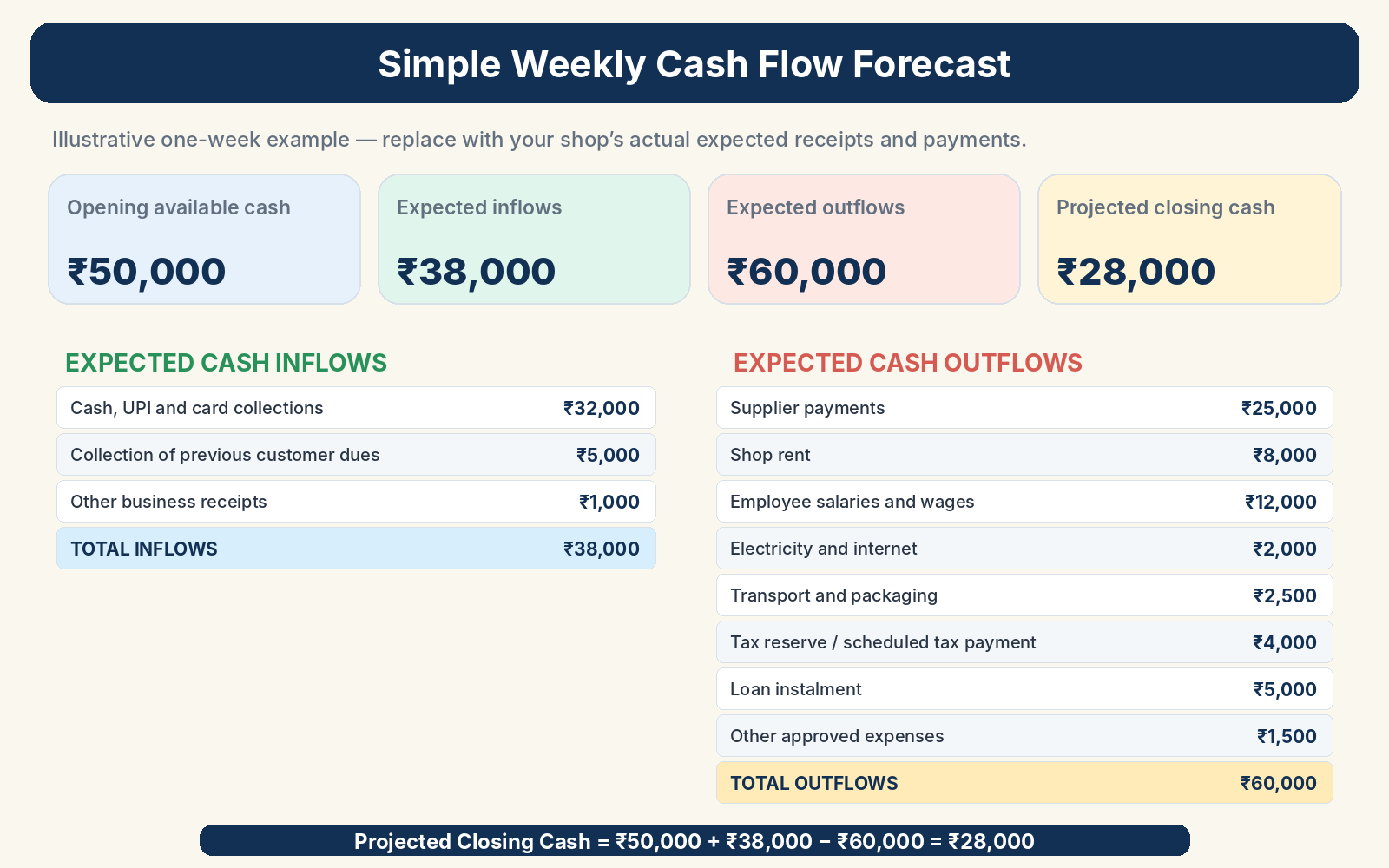
Projected Closing Cash = Opening Available Cash + Expected Inflows − Expected Outflows
Consider this illustrative one-week example.
Opening available cash
Suppose your shop has ₹50,000 available across its business cash and bank balances at the beginning of the week.
Expected cash inflows
| Expected collection | Amount |
|---|---|
| Cash, UPI, and card collections | ₹32,000 |
| Collection of previous customer dues | ₹5,000 |
| Other business receipts | ₹1,000 |
| Total expected inflows | ₹38,000 |
Expected cash outflows
| Payment | Amount |
|---|---|
| Supplier payments | ₹25,000 |
| Shop rent | ₹8,000 |
| Employee salaries and wages | ₹12,000 |
| Electricity and internet | ₹2,000 |
| Transport and packaging | ₹2,500 |
| Tax reserve or scheduled tax payment | ₹4,000 |
| Loan instalment | ₹5,000 |
| Other approved expenses | ₹1,500 |
| Total expected outflows | ₹60,000 |
Calculate the projected closing balance
Opening available cash = ₹50,000
Expected inflows = ₹38,000
Expected outflows = ₹60,000
Projected closing cash = ₹50,000 + ₹38,000 − ₹60,000
Projected closing cash = ₹28,000
This means the shop expects to have ₹28,000 remaining after the listed payments, assuming the collections and payments happen as planned.
The example is illustrative. Replace these figures with your actual bank balances, due dates, expected collections, and business obligations.
Review future weeks as well
Do not prepare a forecast only for the current week.
Create a simple four-week view so that you can see upcoming commitments.
For example:
| Week | Opening balance | Expected inflows | Expected outflows | Projected closing |
|---|---|---|---|---|
| Week 1 | ₹50,000 | ₹38,000 | ₹60,000 | ₹28,000 |
| Week 2 | ₹28,000 | ₹45,000 | ₹30,000 | ₹43,000 |
| Week 3 | ₹43,000 | ₹35,000 | ₹55,000 | ₹23,000 |
| Week 4 | ₹23,000 | ₹48,000 | ₹32,000 | ₹39,000 |
These are hypothetical planning figures, not sales forecasts or expected results.
Update the forecast every week using actual collections and payments. If a customer delays payment or a supplier changes a delivery date, revise the affected period.
5. Collect Customer Payments on Time
Customer credit can support regular business relationships, but delayed collections can create cash shortages.
For example, you may sell products worth ₹30,000 on credit during a week and need to pay suppliers before those customers settle their balances.
This creates a gap between the time the sale occurs and the time money reaches your business.
To manage this:
- Set appropriate credit limits for customers.
- Agree on payment dates before approving credit.
- Record every credit transaction.
- Review outstanding balances regularly.
- Send polite payment reminders.
- Follow up on overdue amounts.
- Avoid increasing credit without reviewing existing dues.
Do not rely entirely on memory when customers have running balances.
Our guide on how to manage credit sales and customer dues in a retail shop explains how to maintain customer records and follow a consistent collection process.
6. Plan Supplier Payments Around Your Cash Position
Supplier payments are among the major cash outflows for many retail shops.
Paying suppliers on time helps maintain business relationships, but you should also organise payment dates so that several large payments do not unexpectedly fall due together.
Maintain a supplier payment calendar containing:
- Supplier name
- Invoice or purchase reference
- Outstanding amount
- Agreed payment date
- Payment method
- Amount already paid
- Remaining balance
Before making a large purchase, check both your current stock and the payments already scheduled.
Consider discussing suitable credit periods or payment arrangements with suppliers. Any agreed terms should be documented and respected.
Avoid delaying agreed payments without communication. If a temporary cash problem arises, speak with the supplier early and discuss a realistic arrangement.
Also review whether a bulk purchase is financially sensible. A small discount may not justify locking up a large amount of cash in slow-moving inventory.
For more guidance, see how to manage supplier purchases and purchase orders in a retail shop.
7. Avoid Locking Too Much Cash in Inventory
Inventory is one of the biggest uses of working capital in many retail businesses.
When you purchase products, cash leaves your business. Until the goods are sold and the money is collected, that investment may remain tied up in inventory or customer receivables.
This is why purchasing too much stock can create cash-flow problems even when the shop has regular sales.
Consider these practices:
Buy according to demand: Use actual sales records and customer requirements when planning purchases.
Review slow-moving products: Identify products that remain unsold for long periods.
Avoid unnecessary bulk buying: Compare supplier discounts with the cost of holding additional stock.
Set suitable reorder levels: Maintain enough inventory to serve customers without purchasing excessive quantities.
Review seasonal inventory: Plan festival purchases carefully and avoid holding large quantities after demand has declined.
For example, a clothing shop may purchase a large festival collection before the season. If most of the stock remains unsold afterwards, money stays tied up in products that may require discounts to clear.
Our guides on how to identify and clear dead stock in a retail shop and how to prevent stockouts explain how to balance availability with excess inventory.
8. Monitor Business Expenses and Upcoming Payments
Small expenses may appear manageable individually, but together they can use a significant amount of cash.
Create a list of recurring payments and their expected dates.
Common examples include:
- Rent
- Employee salaries
- Electricity and water
- Internet and phone bills
- Transport and delivery
- Packaging materials
- Maintenance
- Bank and payment charges
- Loan instalments
- Applicable taxes and statutory payments
Categorise expenses into essential operating costs, optional spending, and payments with fixed due dates.
Review subscriptions, unused services, unnecessary purchases, and recurring expenses that no longer provide value.
However, do not reduce necessary safety, maintenance, legal compliance, or employee-related expenses simply to improve the short-term cash balance.
Keep expense records updated rather than waiting until the end of the month.
Read our article on how to track daily expenses in a retail shop for a practical expense-recording process.
9. Keep Business Money Separate From Personal Withdrawals
Small shop owners sometimes use the same bank account or cash balance for both business and personal spending.
This makes it difficult to understand the actual amount available for shop operations.
For example, a shop may collect ₹40,000 during a busy day. The owner may use ₹10,000 for a personal expense without recording the withdrawal.
The next day, the business may not have enough money for a planned supplier payment.
To avoid this:
- Maintain separate business and personal records.
- Record owner withdrawals clearly.
- Decide on a reasonable withdrawal schedule.
- Avoid taking money from supplier-payment or tax reserves.
- Review the business cash position before making large withdrawals.
Owner withdrawals should be tracked separately from ordinary shop operating expenses.
If the business has multiple owners or partners, document the agreed arrangements for withdrawals and capital contributions.
10. Prepare for Seasonal Sales and Unexpected Cash Requirements
Cash requirements can change throughout the year.
A shop may need to purchase additional inventory before Diwali, Pongal, Eid, Onam, Christmas, or other local selling periods.
At the same time, normal expenses such as rent and salaries continue.
Prepare early by estimating:
- Additional inventory investment
- Expected supplier payment dates
- Employee costs during busy periods
- Promotional and decoration expenses
- Expected customer collections
- Possible unsold inventory after the event
Do not assume that higher sales automatically mean more available cash.
A seasonal purchase may require payment several weeks before the products are sold.
For practical preparation ideas, read festival sales planning for retail shops in India.
You should also maintain a reasonable cash buffer for unexpected expenses, delayed customer payments, equipment repairs, or temporary drops in sales.
The appropriate buffer depends on your fixed expenses, business stability, and access to funds. Do not use one fixed number as a universal rule for every shop.
11. What Should You Do When Your Shop Faces a Cash Shortage?
A projected cash shortage should be identified before payments become overdue.
If your forecast shows that available cash may fall below upcoming requirements, investigate the cause.
Consider these steps:
Review expected collections: Check which customer payments are due and follow up on overdue balances.
Revisit planned purchases: Postpone or reduce non-essential orders where it is commercially appropriate. Do not cut essential products without considering customer demand.
Check upcoming payments: Confirm supplier due dates and communicate early if a payment arrangement needs to be discussed.
Review optional expenses: Avoid unnecessary purchases and discretionary spending during a temporary shortage.
Check available business resources: Review cash reserves and eligible financing arrangements.
Prepare a revised forecast: Update your inflows and outflows using realistic amounts and dates.
Consider working capital finance carefully
If your business has a recurring gap between paying suppliers and collecting customer payments, you may consider discussing a suitable working capital facility with a bank or regulated lender.
Possible facilities depend on the lender, business eligibility, financial records, and the purpose of the funding.
Do not take a loan simply to cover an ongoing problem without understanding why the cash shortage occurs.
Review the interest rate, processing charges, repayment schedule, security requirements, and total cost before accepting an offer.
The Reserve Bank of India explains that banks should assess genuine working capital requirements for micro and small enterprises with consideration for their business cycle and short-term credit needs. You can read the RBI's official MSME lending FAQs for additional information.
Seek advice from a qualified financial professional before selecting a financing arrangement.
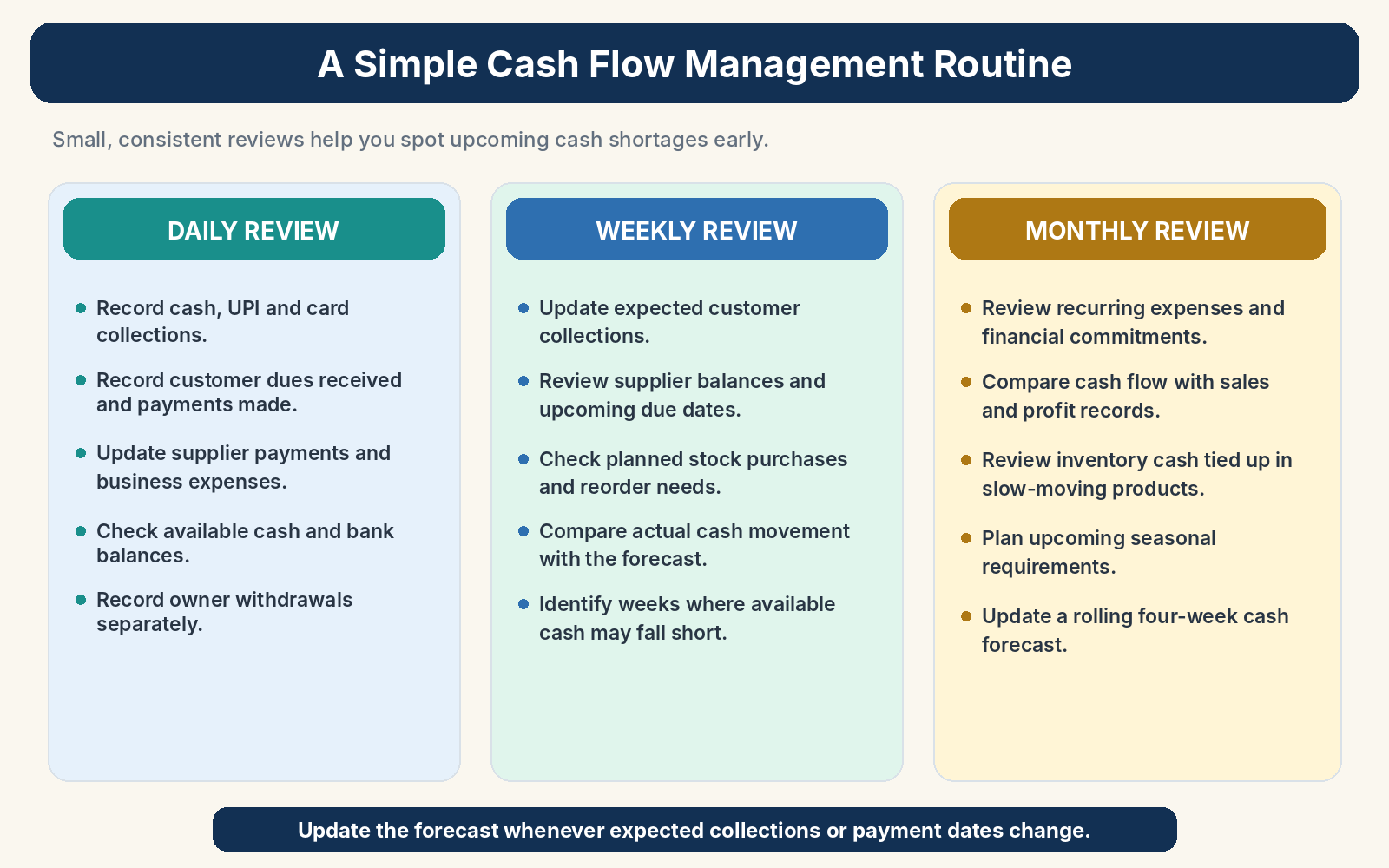
12. Create a Simple Daily and Weekly Cash Flow Routine
Cash flow management becomes easier when you follow a regular review process.
You do not have to prepare a complicated financial report every day.
Daily review
- Record the day's cash, UPI, and card collections.
- Record customer payments received against earlier credit sales.
- Enter supplier payments and business expenses.
- Check the available cash and bank balance.
- Record owner withdrawals and other cash movements.
- Note payments that are due soon.
Weekly review
- Update your expected collections.
- Review outstanding customer dues.
- Check supplier payments due in the coming weeks.
- Review inventory purchases and planned orders.
- Compare actual cash movements with your forecast.
- Identify periods where available cash may become insufficient.
- Update your four-week forecast.
Monthly review
- Compare cash flow with sales and profit records.
- Review recurring expenses.
- Check supplier and customer balances.
- Evaluate whether too much money is tied up in inventory.
- Review loan obligations, if applicable.
- Plan upcoming seasonal requirements.
The Institute of Chartered Accountants of India explains cash flow reporting through operating, investing, and financing activities in its educational material on Ind AS 7. A simple shop cash tracker is a management tool and should not be confused with a formal financial statement prepared under applicable accounting requirements.
You can refer to the ICAI educational material on Ind AS 7 for the accounting perspective.
13. Use Digital Records to Monitor Cash Flow
A notebook or spreadsheet may be enough for a shop with a small number of daily transactions.
However, as transactions increase, manually matching sales, collections, customer dues, supplier payments, and expenses can become difficult.
A suitable retail-management system may help you:
- Record daily sales and payment methods
- Maintain customer credit balances
- Track supplier purchase records
- Review outstanding payments
- Record business expenses
- View sales and expense reports
- Export records for further financial review
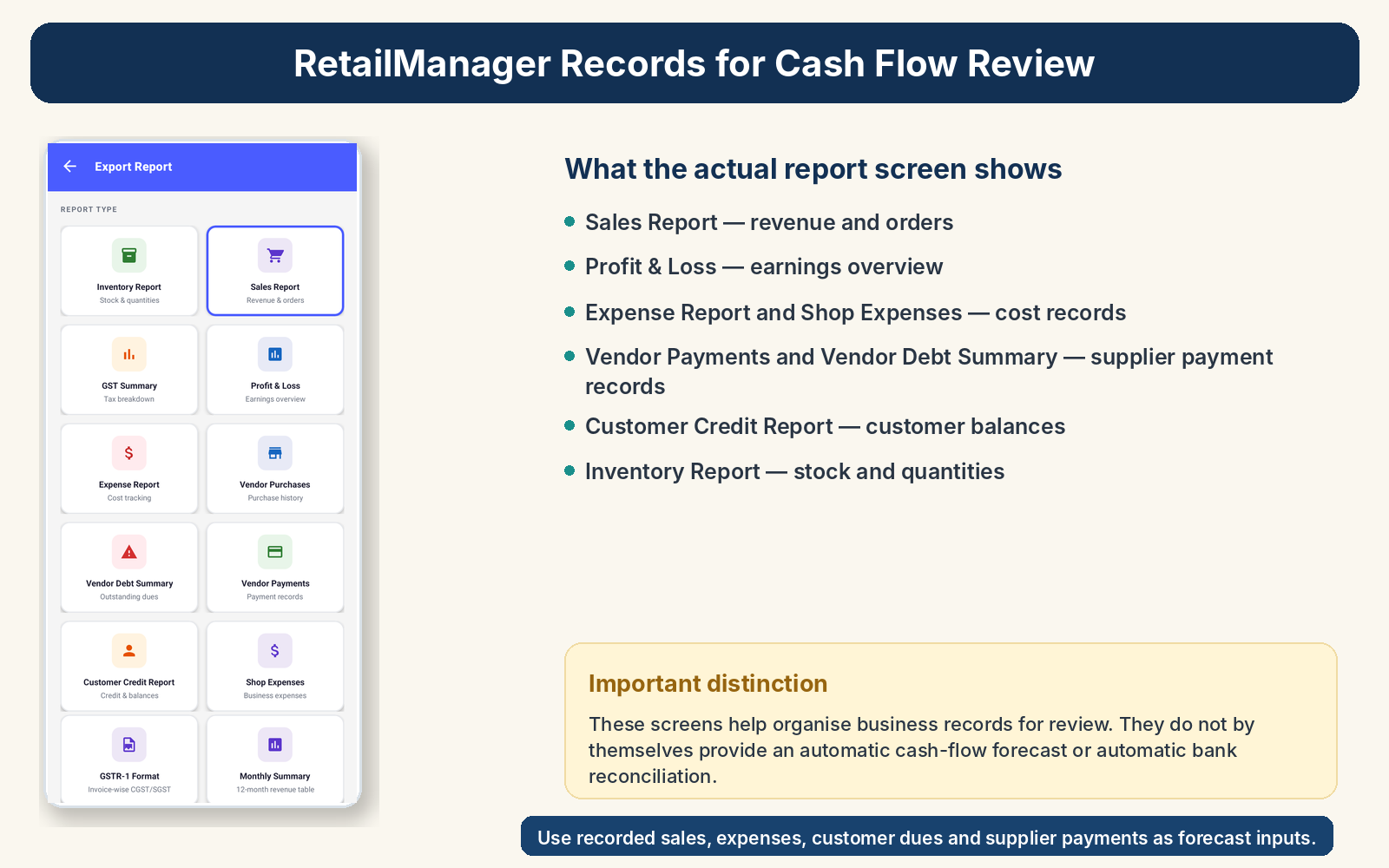
The exact features vary between applications. Before relying on a system for cash flow forecasting or automated bank matching, verify that those features are actually supported.
RetailManager provides product, sales, customer, purchase, expense, and reporting workflows that retailers can evaluate for maintaining business records. Review its current capabilities to determine whether they meet your requirements.
You can also read our guide on how to choose billing software for small shops in India.
Frequently Asked Questions
What is cash flow management in a retail shop?
Cash flow management means monitoring the money entering and leaving your business so that you have enough available funds to pay suppliers, employees, rent, and other business obligations when they become due.
Why is my shop profitable but still short of cash?
This can happen when money is tied up in customer credit, unsold inventory, supplier advances, or other payments. Your shop may record sales and profit today while the actual cash is collected later.
How often should I prepare a cash flow forecast?
For a small retail shop, updating a short-term forecast every week is a useful starting point. You can maintain a four-week forecast and revise it whenever expected collections or payments change.
Should I use sales or collections in a cash flow forecast?
Use actual and expected cash collections. Sales made on credit should be included as expected inflows only when you reasonably expect to receive the money, not simply because the invoice has been created.
How can I improve cash flow without taking a loan?
Improve customer collections, control inventory purchases, reduce unnecessary expenses, organise supplier payment dates, and maintain a realistic forecast. These steps may help release money already tied up in the business.
Is working capital the same as cash flow?
No. Working capital generally refers to current assets minus current liabilities, while cash flow tracks cash entering and leaving the business over a period. Both are useful for understanding short-term financial health.
Should I keep money aside for taxes?
Yes. Estimate applicable tax and statutory obligations with your accountant and plan for their payment dates. Do not treat amounts collected on behalf of the government as unrestricted business cash.
Conclusion
Cash flow management helps retail shop owners understand whether enough money will be available to meet upcoming business payments.
Start by recording all collections and payments, separating sales from actual cash receipts, and preparing a simple weekly forecast. Review customer dues, supplier commitments, inventory purchases, operating expenses, and owner withdrawals regularly.
When a cash shortage is likely, investigate the reason early rather than waiting until payments become overdue.
Whether you operate a kirana store, pharmacy, hardware shop, clothing business, fertilizer shop, or mobile accessories store, a consistent cash flow routine can help you plan purchases, manage working capital, and run your business with greater confidence.