Sales & Payments
How to Manage Credit Sales and Customer Dues in a Retail Shop
Manage credit sales in a retail shop with clear limits, accurate records, payment reminders, and simple steps to collect customer dues.

How to Manage Credit Sales and Customer Dues in a Retail Shop
Many retail shops allow regular customers to purchase products now and pay later. In India, this practice is commonly known as udhaar or running a customer khata. It can help shopkeepers maintain customer relationships, but it can also create problems when payments are delayed or records are incomplete.
A customer may remember paying ₹1,000, while the shopkeeper's notebook shows a different amount. Another customer may continue purchasing even though earlier dues remain unpaid. Over time, these small gaps can affect the money available to purchase new stock and pay business expenses.
Learning how to manage credit sales in a retail shop does not mean stopping all credit transactions. It means setting clear rules, maintaining accurate records, and following a consistent process for collecting payments.
In this guide, we will look at practical ways to manage customer dues in different types of retail businesses.
1. Set Clear Rules Before Offering Credit
Credit should be a business decision rather than an automatic favour. Before allowing a customer to purchase on credit, decide how your shop will handle the transaction.
Start by defining three basic rules:
- Who can purchase on credit? You may choose to offer credit only to known customers or established business buyers.
- What is the credit limit? Set a maximum outstanding amount that you are comfortable carrying for each customer.
- When is payment expected? Agree on a specific date or period, such as payment within seven days or at the end of the month.
For example, suppose a regular customer has a credit limit of ₹5,000 and already owes ₹4,200. Before approving another credit purchase, check whether the additional amount would exceed your chosen limit.
These limits help you make consistent decisions and reduce the risk of accumulating unpaid balances.
2. Record Every Credit Sale Immediately
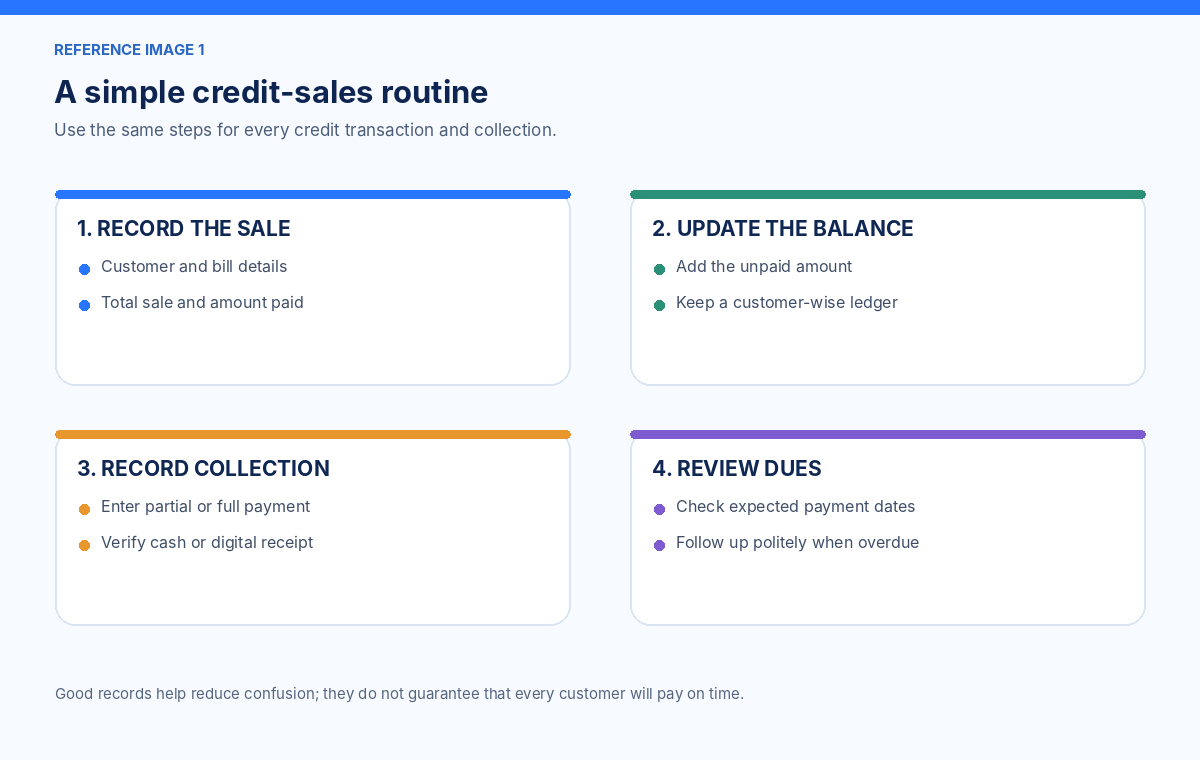
One of the biggest mistakes in credit management is relying on memory. Even a small number of transactions can become difficult to track when the shop is busy.
Every credit sale should have a clear record containing:
- Customer name and a reliable contact number
- Sale date and bill or transaction reference
- Products purchased and total amount
- Amount paid immediately, if any
- Remaining balance and expected payment date
Avoid writing entries such as “Ravi — ₹500” without explaining what the amount represents. A useful record should allow you to understand the transaction even weeks later.
For example, imagine a hardware shop sells goods worth ₹2,400 to a customer who pays ₹900 immediately. The record should show the full sale, the amount received, and the remaining ₹1,500—not just the amount still owed.
This makes it easier to resolve disagreements and explain the balance to the customer.
3. Maintain a Separate Record for Each Customer
A single notebook page containing transactions for several customers can quickly become confusing. Instead, maintain a separate account or ledger for every customer who regularly purchases on credit.
A simple customer-wise record might look like this:
| Date | Transaction | Amount Added | Payment Received | Balance Due |
|---|---|---|---|---|
| 1 Oct | Credit purchase | ₹1,200 | ₹0 | ₹1,200 |
| 4 Oct | Credit purchase | ₹800 | ₹0 | ₹2,000 |
| 7 Oct | Customer payment | ₹0 | ₹1,000 | ₹1,000 |
| 10 Oct | Credit purchase | ₹600 | ₹0 | ₹1,600 |
Illustrative example. The balance assumes all entries relate to the same customer and no other adjustments apply.
A running balance makes it easier to see how much the customer owes after each transaction. Keep bills, payment receipts, and relevant notes so that entries can be checked when needed.
A paper khata may work for a very small shop, but a digital ledger or suitable retail-management system can make searching, reviewing, and maintaining records easier as the number of customers grows.
4. Record Every Payment, Even When It Is Partial
Customers do not always pay their entire outstanding balance in one transaction. Some may settle a bill in instalments, while others may make a payment against several earlier purchases.
Whenever a payment arrives, record it against the correct customer and update the balance.
For example:
- Previous customer balance: ₹3,500
- Payment received through UPI: ₹2,000
- Remaining amount due: ₹1,500
Do not treat the ₹2,000 collection as a new sale. It is a payment against an existing amount owed. Recording it incorrectly can inflate your sales figures and make your records unreliable.
Also, verify cash, UPI, bank transfers, and other payment methods using the appropriate records. For digital payments, check that the transaction was actually received rather than relying only on a screenshot or a customer's message.
5. Review Overdue Customer Dues Regularly
Keeping customer balances is only the first step. You also need to review them to identify payments that are becoming late.
Set aside time at least once a week to check:
- Which customers have outstanding balances
- Which payments are approaching their expected dates
- Which amounts are already overdue
- Which customers have repeatedly delayed payment
- Whether any recorded balances need investigation
Consider this example:
| Customer | Balance Due | Expected Date | Action |
|---|---|---|---|
| Customer A | ₹800 | Tomorrow | Gentle reminder if appropriate |
| Customer B | ₹2,400 | 5 days overdue | Contact and confirm payment date |
| Customer C | ₹4,700 | 20 days overdue | Review account and consider pausing further credit |
The action should depend on your agreed terms and the customer relationship, not just the amount owed.
A smaller balance that remains unpaid for a long time can deserve attention just as much as a larger, more recent balance.
6. Send Polite and Specific Payment Reminders
Asking customers for payment can feel uncomfortable, particularly when they are regular buyers. A consistent reminder process helps make the conversation professional rather than personal.
A useful reminder should include the amount due, the relevant bill or transaction, and the expected payment date.
For example:
Hello, your account currently has an outstanding balance of ₹1,500 for your recent purchases. Could you please confirm when payment may be made? Let me know if you would like me to share the transaction details. Thank you.
Send reminders privately and keep the tone respectful. Avoid repeatedly messaging customers without checking whether a payment has already been made.
If the customer disagrees with the balance, review the transaction history together before requesting payment again. Correcting an error quickly can protect trust and prevent unnecessary disputes.
7. Protect the Cash Needed to Run Your Shop
Credit sales can create a cash-flow problem even when your shop is making sales. The products have already left the store, but the money needed to replace them may not have arrived.
Suppose your shop sells ₹10,000 worth of goods on credit in a week. That represents sales, but it does not mean ₹10,000 is available in your bank account or cash drawer.
Meanwhile, you may still need to pay suppliers, rent, staff, electricity bills, and other operating expenses.
To reduce this pressure:
- Set credit limits that match your shop's financial capacity.
- Avoid allowing outstanding balances to grow indefinitely.
- Collect dues before making large stock purchases when practical.
- Be cautious about extending new credit to customers with repeated overdue payments.
- Review actual cash received separately from sales made on credit.
For a deeper understanding of shop performance, read our guide on how to calculate daily sales and profit in a retail shop. Remember that sales, profit, and cash collected are different measures.
8. Use a Consistent Daily and Weekly Routine
Credit management becomes easier when it is part of your normal shop operations instead of a task that gets postponed until the end of the month.
At the time of each sale: Record the customer, bill amount, payment received, and remaining balance.
At the time of collection: Record the payment immediately and verify the amount received.
At closing time: Check that recorded collections match the cash and digital payments received, while keeping credit sales separate from money collected.
Once a week: Review overdue balances, send appropriate reminders, investigate discrepancies, and decide whether additional credit should be approved for customers with unpaid dues.
If employees handle billing, make sure everyone follows the same procedure. Assign responsibility for updating records and resolving disputed balances so that transactions do not remain incomplete.
9. Know When to Move From a Paper Ledger to Digital Records
A notebook can be sufficient when a shop has only a few credit customers and a limited number of transactions. As business grows, paper records can become harder to search, reconcile, and review.
A digital system may be useful when you need to:
- Find a customer's transaction history quickly
- Maintain clear sales and payment records
- Review outstanding balances without manually adding entries
- Reduce mistakes caused by duplicate or missed transactions
- Give authorised staff a consistent way to record transactions
Choose a system based on your actual workflow. Before relying on an app for customer credit management, confirm that it supports the specific features you need, such as customer-wise outstanding balances, partial payments, payment entries, due-date tracking, or overdue reports. Not every billing app includes all these capabilities.
Good software can improve record-keeping, but it cannot replace sensible credit limits, accurate entries, and timely follow-up.
Conclusion
Managing credit sales is an important part of running a healthy retail business. Offering udhaar may help you maintain customer relationships, but uncontrolled credit can leave you short of the cash needed to restock and pay expenses.
Start with clear credit rules, record every sale and payment, maintain customer-wise balances, and review overdue amounts regularly. Follow a polite reminder process and make decisions about further credit based on reliable records.
Whether you run a grocery shop, pharmacy, hardware store, fertilizer business, or mobile accessories shop, a consistent credit-management routine can help you maintain better records, reduce confusion, and manage customer dues more confidently.
Looking to improve your shop's day-to-day operations? Explore RetailManager on Google Play to learn more about the app's retail-management features. Check that its current functionality matches your business requirements before relying on it for a particular credit workflow.
- #Credit Sales
- #Udhaar Management
- #Customer Payments
- #Retail Management
- #Small Business Tips