Sales & Marketing
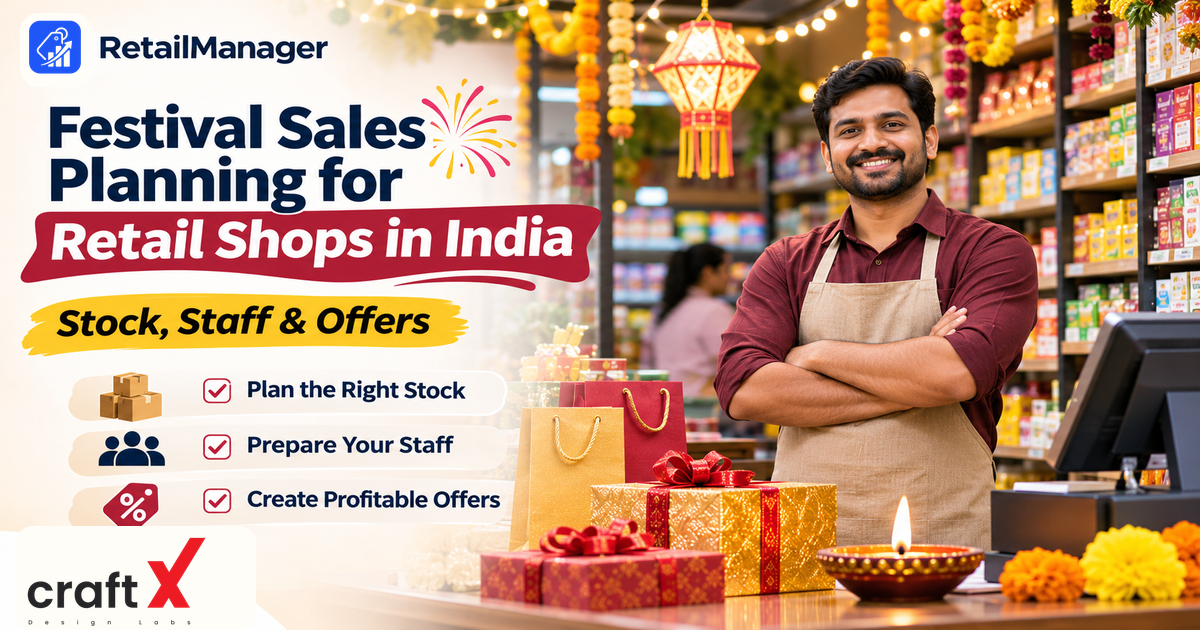
Festival Sales Planning for Retail Shops in India: Stock, Staff & Offers
Prepare your shop for festival season with practical tips for stock, suppliers, staffing, promotions, and post-festival review.
Festival Sales Planning for Retail Shops in India: Stock, Staff & Offers
Festival sales planning is an important part of running a retail shop in India. Festivals and seasonal occasions can change what customers purchase, how much they spend, and when they visit shops. Preparing in advance helps you arrange the right products, coordinate suppliers, manage busy periods, and avoid purchasing too much inventory.
Whether you operate a kirana store, pharmacy, clothing shop, hardware store, fertilizer business, or mobile accessories shop, your preparation should reflect the products your customers actually need.
Diwali, Pongal, Onam, Eid, Navratri, Christmas, school-opening periods, harvest seasons, and local celebrations can all create different purchasing opportunities.
In this guide, we will explain how to prepare your retail shop for festival season, from reviewing sales history and planning stock to organising employees, creating offers, and reviewing the results afterwards.
1. Start Planning Around the Festival and Your Customers
Not every festival creates the same demand. A clothing shop may see more interest in traditional wear during certain celebrations, while a grocery shop may experience increased demand for ingredients, sweets, snacks, and household essentials.
Before placing orders or announcing promotions, identify which occasions are relevant to your customers.
Ask yourself:
- Which festivals or seasonal events are important in your area?
- What products do customers usually purchase during these periods?
- Are customers buying for personal use, celebrations, gifting, or business requirements?
- Does demand increase for a few days or continue over several weeks?
- Are there local events, fairs, or community celebrations that influence shopping patterns?
For example, a hardware shop may experience demand for lighting and decoration-related products before a festival, while a stationery shop may prepare for school-opening periods rather than focusing only on religious festivals.
Create a simple calendar of the important selling periods for your shop. Include the expected event dates, purchasing deadlines, promotional periods, and staff-planning requirements.
Most importantly, plan according to your local customers rather than assuming every festival will affect every retail category in the same way.
2. Review Previous Sales Before Estimating Demand
One of the most useful sources of information for festival planning is your own sales history.
If your shop operated during the previous year's festival period, review the transactions from a comparable period. Look for products that sold consistently, items that ran out early, and stock that remained unsold after the event.
Review:
- Total sales during the comparable festival period
- Products and categories with higher sales
- Quantities sold for individual products
- Products that experienced stockouts
- Discounts and promotional activity
- Unsold seasonal inventory after the festival
- Customer requests for unavailable products
For example, a grocery shop may discover that certain ingredients and packaged snacks sold more frequently before a particular festival. That information can help the shop plan its next purchase.
Do not simply copy the previous year's quantities. Consider changes in product prices, customer preferences, local competition, shop size, and the timing of the festival.
If this is your first festival season, use customer enquiries, local market observations, supplier information, and a conservative initial purchase plan. Treat the first season as an opportunity to build useful data for future planning.
You can review how to calculate daily sales and profit in a retail shop to understand the sales and profit records worth tracking.
3. Choose the Right Products for Your Festival Stock
Festival preparation does not mean increasing the quantity of every product in your shop.
Focus on the products that are relevant to the occasion and your customers.
A practical way to organise your festival assortment is to divide products into three groups.
Everyday essentials
These are products customers continue to purchase regardless of the festival.
For a grocery shop, this could include regular household essentials and frequently purchased food products. For a pharmacy, it may include everyday healthcare products that customers regularly need.
Do not allow festival-specific purchases to reduce the availability of important everyday products.
Seasonal and festival-specific products
These are products that become more relevant during particular occasions.
Examples include:
- Decorative items and lighting
- Festival clothing and accessories
- Gift packs and packaging materials
- Seasonal food ingredients
- School supplies during the academic season
- Relevant agricultural or local seasonal products
Purchase quantities should reflect the length of the selling period and the likelihood of demand continuing after the event.
Related and impulse products
These are additional items customers may find useful when purchasing their main products.
For example, a clothing shop might display matching accessories alongside festive clothing, while a grocery shop may arrange commonly used ingredients together.
Keep these recommendations relevant. The objective is to make shopping convenient, not to fill the shop with products that customers are unlikely to purchase.
4. Calculate How Much Stock You Actually Need
After identifying the products you want to sell, estimate the quantities required.
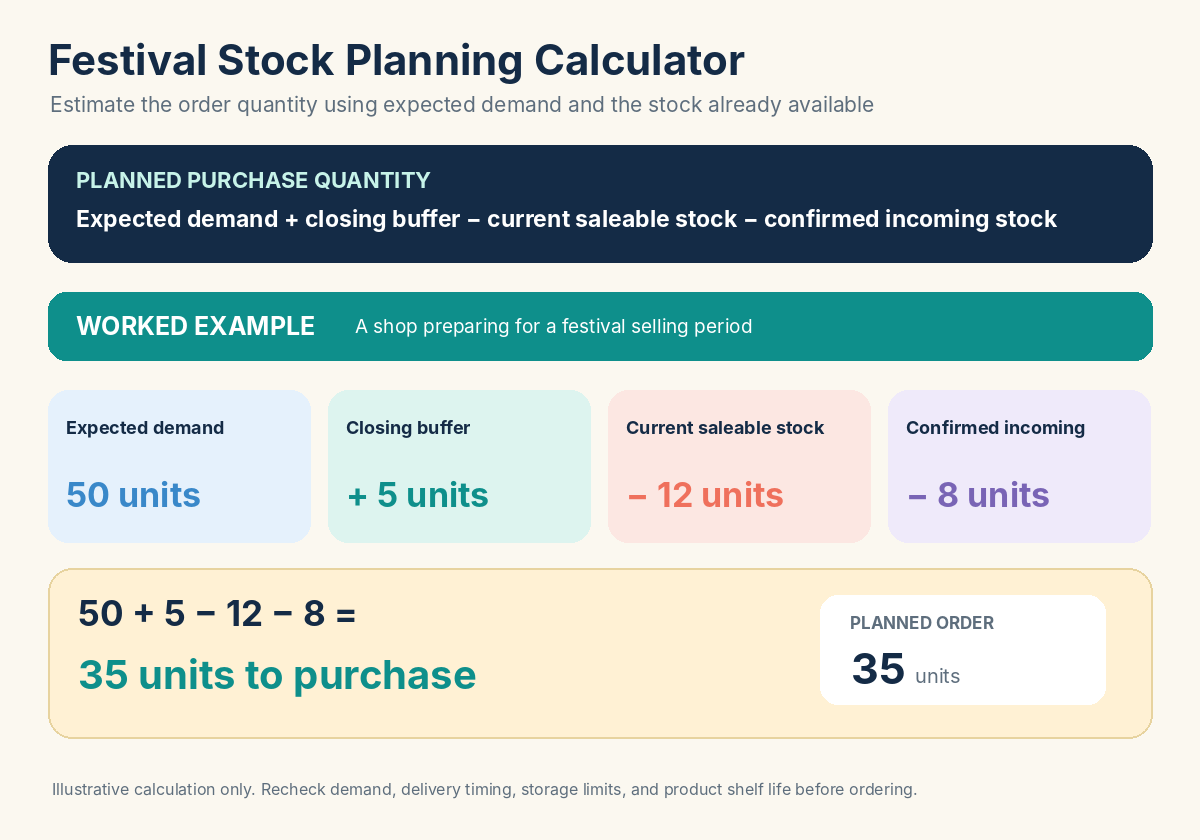
A useful planning formula is:
Planned purchase quantity = Expected demand + Desired closing buffer − Current saleable stock − Confirmed incoming stock
Consider this illustrative example:
A shop expects to sell 50 units of a particular product during the festival period. It wants a closing buffer of five units, currently has 12 saleable units, and already has eight units confirmed from a supplier.
Planned purchase quantity = 50 + 5 − 12 − 8
Planned purchase quantity = 35 units
This is a planning estimate, not a guaranteed sales forecast. Adjust the expected demand and buffer according to product sales, supplier delivery time, storage conditions, and how easily additional stock can be obtained.
For perishable products, avoid maintaining unnecessarily large buffers. For seasonal products that may lose demand immediately after the festival, be especially careful about over-ordering.
Your goal is to keep enough products available without tying up too much money in inventory.
For more guidance, read how to prevent stockouts in a retail shop.
5. Coordinate Supplier Orders Before the Busy Period
Supplier coordination becomes particularly important when several retailers are ordering products for the same seasonal occasion.
Do not assume that normal delivery arrangements will remain unchanged during busy periods.
Contact suppliers in advance and confirm:
- Product availability
- Current purchase prices
- Minimum order quantities
- Expected delivery dates
- Transport and handling charges
- Payment terms
- Return or exchange conditions, where offered
For important products, confirm order quantities and delivery commitments in writing.
You may also divide purchases into stages instead of placing one large order.
For example, purchase the essential quantities first, review early sales, and then place a smaller replenishment order for products that are moving faster than expected.
This approach is useful when supplier lead times and product availability allow additional orders.
Avoid placing duplicate orders because an earlier shipment has not yet arrived. Maintain a list of pending purchases and include confirmed incoming quantities when planning new orders.
For more detail, see our guide on managing supplier purchases and purchase orders in a retail shop.
6. Prepare a Festival Budget and Protect Working Capital
Higher purchasing activity can increase the amount of money tied up in stock. Before placing orders, decide how much your shop can comfortably spend.
Separate your festival-related expenses into categories such as:
| Expense | Examples |
|---|---|
| Inventory purchases | Regular and seasonal products |
| Transport | Supplier delivery and goods movement |
| Shop preparation | Decorations, displays, and signage |
| Staffing | Additional working hours or temporary support |
| Marketing | Local advertisements and promotional materials |
| Offers | Discounts, bundles, or other promotional costs |
| Working capital | Money reserved for regular expenses and replenishment |
Do not use your entire available cash balance for festival inventory.
Your shop may still need money for rent, salaries, electricity, supplier payments, and other regular expenses. You may also need additional cash for fast-moving products during the event.
Keep a record of festival purchases and related costs so you can later understand whether the additional business activity was financially worthwhile.
You can refer to how to track daily expenses in a retail shop to maintain better expense records.
7. Plan Offers Without Sacrificing Profit
Festival offers can help attract customers, but discounts should be calculated rather than selected randomly.
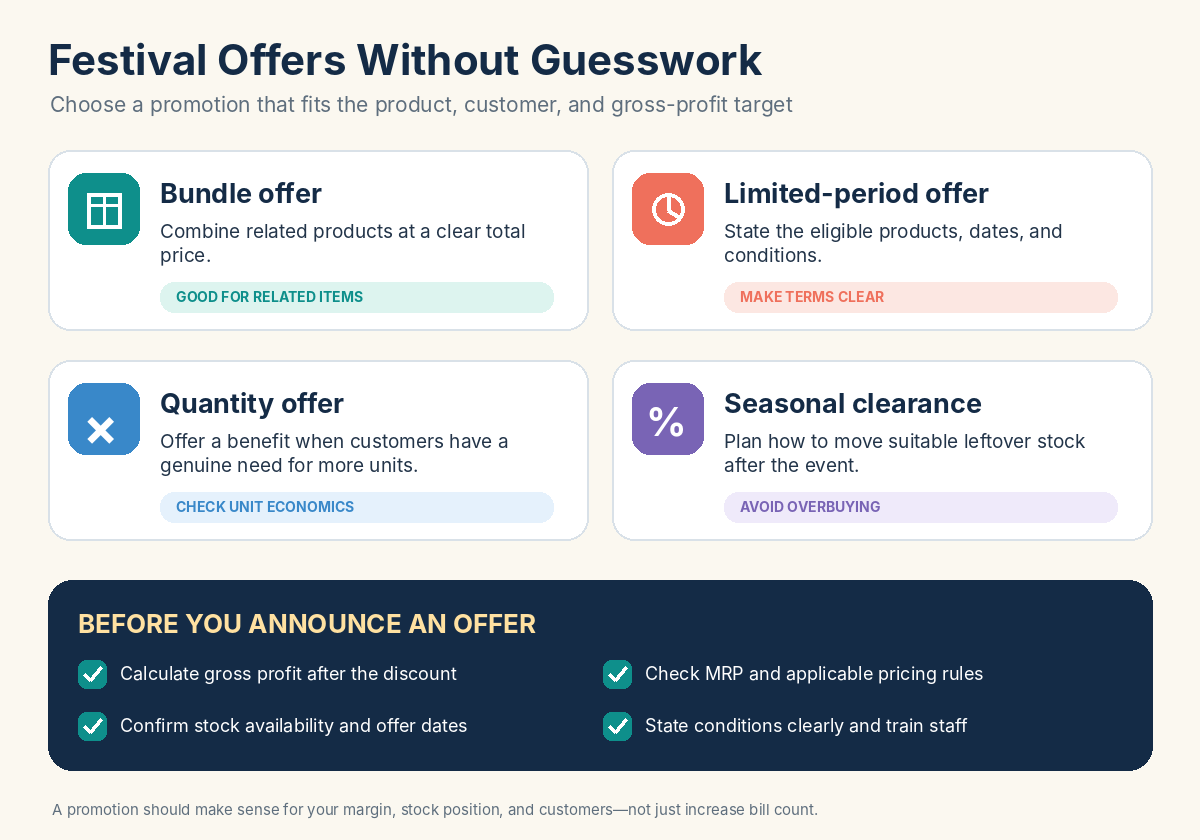
Consider these promotional approaches:
Product bundles: Combine related products at a clearly explained price.
Limited-period offers: Provide a genuine discount for a stated period, with the applicable terms visible.
Quantity-based offers: Offer a benefit for purchasing larger quantities when customers genuinely need those additional products.
Gift options: Include suitable packaging or complementary products for customers purchasing gifts.
Clearance offers: Reduce prices on appropriate seasonal stock when the event is approaching its end, while considering the product's condition and remaining demand.
Before announcing a promotion, calculate its effect on gross profit.
For example, reducing a product's selling price may increase the number of units sold but also reduce the amount earned on every unit. Compare the expected benefit with the discount cost, additional operating expenses, and likely sales volume.
Make sure promotion details are accurate. Explain the eligible products, offer period, conditions, and any restrictions clearly.
Check MRP requirements
For pre-packaged commodities covered by India's Legal Metrology rules, retailers should follow the applicable declared retail sale price and current requirements. Do not assume that a festival promotion permits you to charge above the applicable MRP.
The Department of Consumer Affairs' Legal Metrology guidance provides information about packaged commodity declarations and the relevant rules. Check the latest amendments and category-specific requirements before changing your pricing process.
For more detailed pricing guidance, read retail product pricing: markup, margin, and profit.
8. Prepare Your Staff for Increased Customer Traffic
More customers can mean longer queues, additional product enquiries, and a greater workload for employees.
Prepare your team before the busy period begins.
Make sure employees understand:
- Which products are part of the festival assortment
- Where new products are arranged
- Which offers are currently active
- How to answer common product questions
- How discounts should be applied
- Who handles payment or billing issues
- How to report low stock
- When to request manager approval
If you have multiple employees, assign responsibilities for customer assistance, billing, shelf replenishment, and stock handling.
Review the expected customer traffic and plan employee coverage accordingly. A shop may require additional help during evening hours, weekends, or the days immediately before a major festival.
Allow for appropriate breaks and shift handovers. Do not rely on one employee to handle every busy-period activity.
Clear instructions and a short daily briefing can help everyone understand the priorities for the day.
9. Organise Your Shop for Faster Shopping and Billing
During a busy period, customers should be able to find products without searching through disorganised shelves.
Prepare the store layout before the rush begins.
Consider these steps:
- Place seasonal products in suitable, visible locations.
- Group related items together.
- Keep popular products accessible.
- Display prices and offer conditions clearly.
- Keep walkways and checkout access clear.
- Arrange sufficient storage for additional inventory.
- Keep fragile and sensitive products in appropriate locations.
Review your billing counter as well.
Check that the billing device, receipt printer, payment methods, and internet connection work correctly where required.
Make sure employees know how to handle cash, UPI, cards, returns, and billing corrections using your normal procedures.
If your shop expects long queues, consider how customers will move through the store and where temporary billing or customer assistance may be needed.
For a complete daily preparation routine, see our daily retail shop checklist.
10. Promote Your Festival Offers Through Local Channels
Customers need to know what your shop offers and when they can visit.
You do not necessarily need a large advertising budget. Start with the local channels your customers already use.
Google Business Profile
Keep your shop's name, address, contact details, and opening hours accurate.
Where available for your profile and business category, use Google Business Profile posts to share updates, events, photographs, and eligible offers.
Google explains how businesses can create updates, offers, and event posts in its official Business Profile help guide.
WhatsApp Business
You can use WhatsApp Business to communicate relevant product arrivals or offers to customers who have agreed to receive those messages.
Avoid adding customers to promotional lists without appropriate permission. WhatsApp's Business Messaging Policy explains its expectations around opt-in, clear communication, and opt-out requests.
Keep promotional messages useful and reasonably paced. Respect customers who do not want to receive further marketing messages.
Local social media
Share genuine photographs of your shop, festival product displays, new arrivals, and clearly explained offers.
For example, a clothing retailer can show its festive collection, while a hardware shop can highlight products relevant to seasonal home improvements.
Keep information accurate and ensure that advertised products are actually available or that any availability limitations are clearly communicated.
For further ideas, read how to increase retail sales in a small shop.
11. Monitor Sales and Stock During the Festival
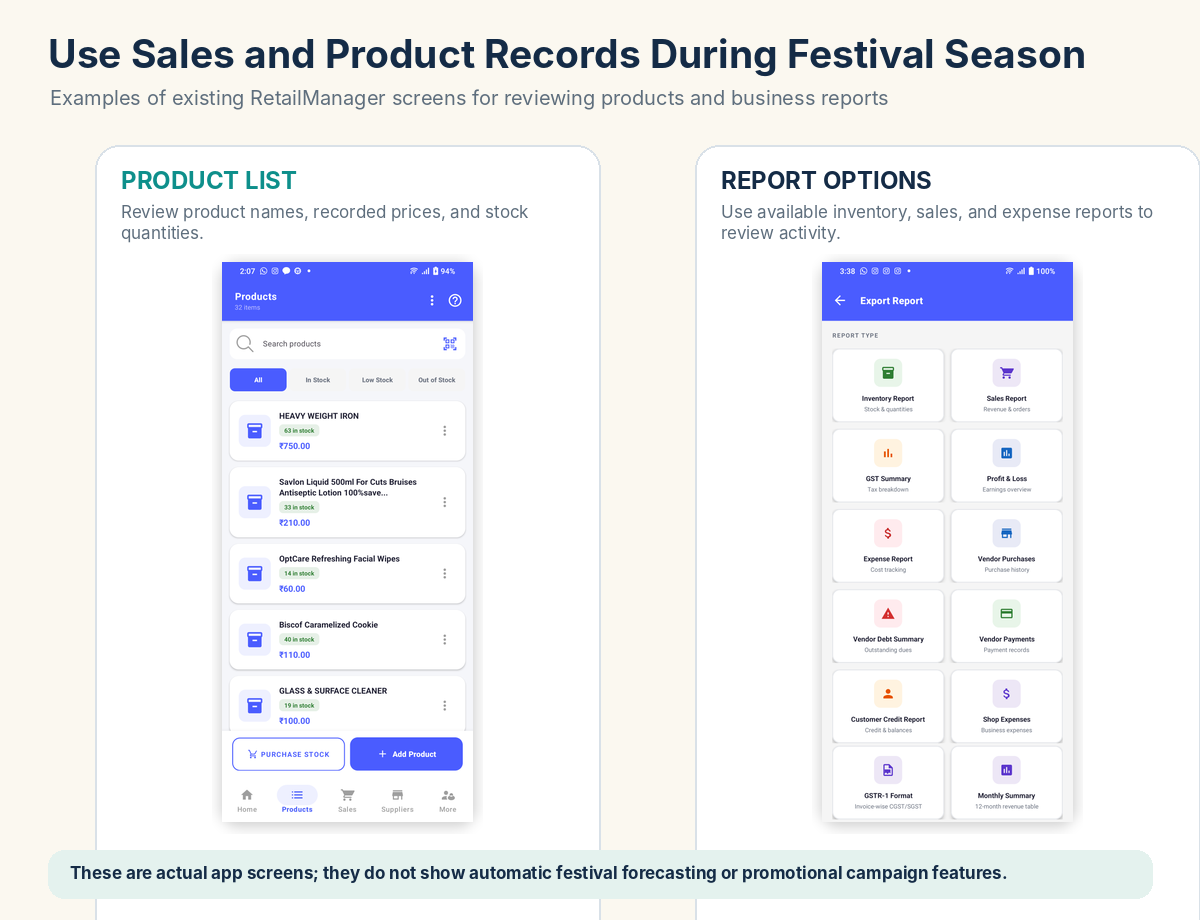
Once the festival period begins, review your performance regularly.
Do not wait until the event ends to discover that important products have run out or that too much inventory has accumulated.
During busy days, check:
- Which products are selling fastest
- Which products need replenishment
- Which products are not attracting customer interest
- Whether supplier deliveries are arriving as expected
- Whether customers are asking for unavailable products
- Whether discounts are being applied correctly
- Whether billing or payment problems are occurring
Review stock quantities and sales reports at suitable intervals.
If a product is selling faster than expected, check whether another supplier order is practical and likely to arrive before demand reduces.
If another product is moving slowly, avoid automatically buying more of it simply to complete a supplier order.
Use actual sales information to make decisions throughout the event.
12. Review Your Results and Clear Leftover Seasonal Stock
Your festival planning should not end when the event is over.
After the selling period, review what happened and identify improvements for the next season.
Compare:
Sales performance: Which products and categories performed well?
Gross profit: Did additional sales also produce suitable gross profit?
Inventory: Which products sold out, and which remained unsold?
Promotions: Which offers attracted customers without reducing profit unnecessarily?
Supplier performance: Were products delivered on time and at the agreed prices?
Customer feedback: What did customers request, appreciate, or complain about?
Pay special attention to seasonal products that may lose demand after the event.
First, identify which remaining products can continue to sell normally. Then consider suitable actions for seasonal inventory, such as an appropriate clearance offer, an eligible supplier exchange, or another planned route.
Do not automatically discount every remaining item. Check its condition, likely future demand, product restrictions, and financial value before deciding.
Our guide on how to identify and clear dead stock in a retail shop explains how to review unsold inventory and prevent excess stock from building up.
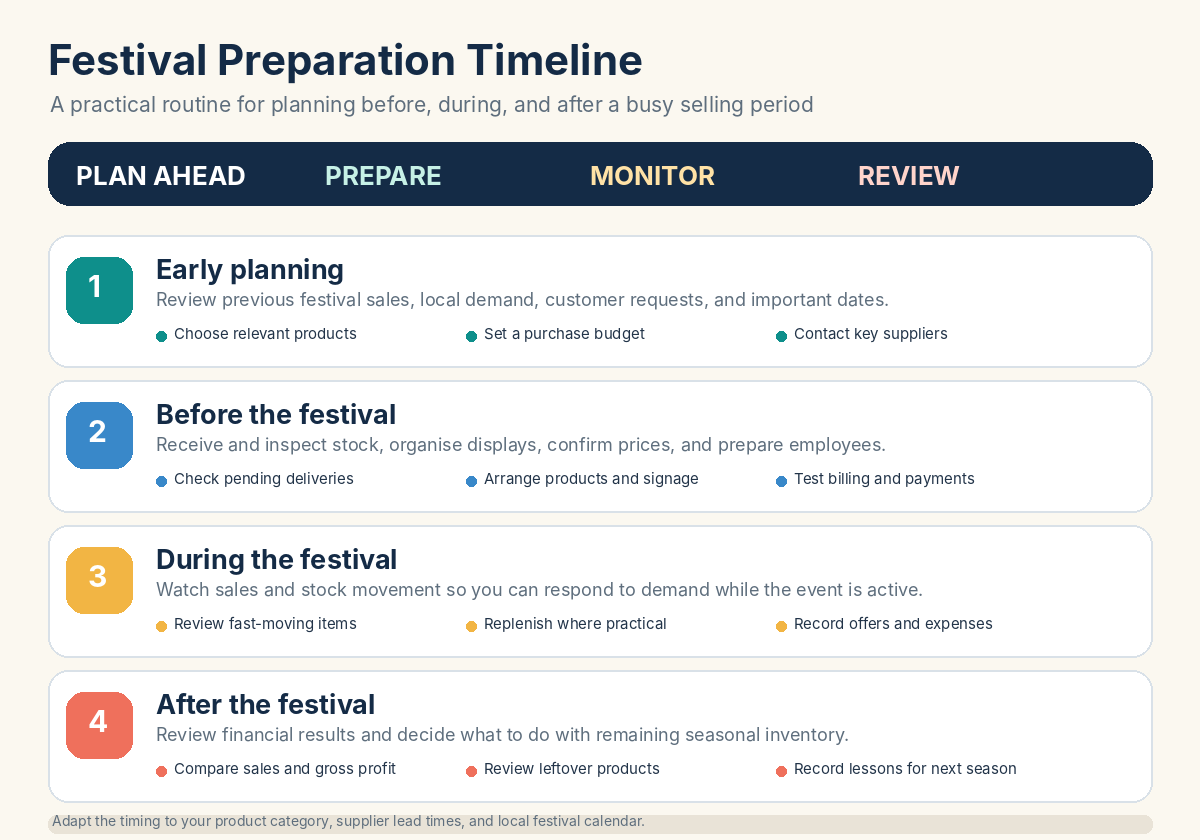
13. A Simple Festival Preparation Timeline
The exact preparation period depends on your products and supplier lead times. Use this as a planning framework and adjust it to your business.
Early planning
- Identify the important festivals and seasonal events.
- Review previous sales and customer requests.
- Decide which products to promote.
- Prepare an initial purchase and budget plan.
- Contact suppliers and confirm delivery arrangements.
Before the selling period
- Receive and inspect important stock.
- Confirm product prices and offer conditions.
- Organise displays and storage.
- Prepare employee responsibilities and schedules.
- Test billing and payment equipment.
- Update local business information and promotional materials.
During the festival
- Review sales and stock frequently.
- Replenish suitable fast-moving products.
- Monitor payment and billing processes.
- Respond to customer enquiries.
- Record expenses, discounts, and stock movements.
After the festival
- Review sales and gross profit.
- Count remaining seasonal stock.
- Resolve pending supplier deliveries.
- Plan appropriate clearance actions.
- Record lessons for the next seasonal period.
Following a simple timeline helps prevent important work from being postponed until the last few days.
Frequently Asked Questions
How early should a retail shop prepare for festival season?
Start as soon as you understand the event dates and expected demand. The actual preparation period depends on supplier lead times, product availability, storage requirements, and the length of the selling season. Products that require longer sourcing or special orders may need earlier planning.
How much additional stock should I purchase for a festival?
There is no universal percentage that works for every shop. Review comparable sales, customer enquiries, current stock, confirmed incoming deliveries, supplier lead times, and the risk of leftover inventory before deciding quantities.
What products should I stock during festival season?
Choose products based on your customers and business category. Grocery shops may focus on relevant food and household items, clothing shops on seasonal apparel, and mobile accessory shops on products customers commonly request as gifts or during travel. Use actual local demand rather than copying another store's assortment.
Should I offer discounts during every festival?
No. Discounts are one promotional option, not a requirement. Product bundles, convenient displays, new arrivals, and helpful customer service may also support sales. Calculate the effect of any discount on gross profit before announcing it.
How can a small shop manage festival stock without software?
A notebook or spreadsheet can be used to record product names, purchase quantities, opening stock, sales, remaining stock, and supplier deliveries. Review important products regularly and keep a record of stock movements. As the business grows, consider whether inventory software would save time and improve accuracy.
How can I avoid leftover festival inventory?
Review past sales, buy seasonal products in sensible quantities, confirm supplier terms, and monitor sales while the event is active. Plan a suitable post-festival action for remaining stock before making the purchase.
Conclusion
Festival sales planning is not simply about buying more products or offering bigger discounts. It is about understanding customer demand, choosing suitable products, coordinating supplier orders, protecting working capital, preparing employees, and making the shopping experience convenient.
Start with your previous sales records, plan purchases carefully, and monitor stock throughout the selling period. Use clear promotional terms, maintain accurate prices, and review the results after the festival.
Whether you operate a kirana store, pharmacy, clothing shop, hardware store, fertilizer business, or mobile accessories shop, a consistent seasonal planning process can help you prepare for busy periods while reducing avoidable purchasing and stock-management mistakes.
- #Festival Sales
- #Seasonal Retail
- #Inventory Planning
- #Retail Marketing
- #Small Shop Management