Inventory & Purchasing
Inventory Turnover Ratio for Retail Shops: Formula & Example
Calculate inventory turnover, understand stock days, and improve inventory flow with a practical example for small retail shops.

Inventory Turnover Ratio for Retail Shops: Formula & Example
The inventory turnover ratio helps retail shop owners understand how quickly their products sell and how efficiently they manage the money invested in stock.
A shop may have thousands of rupees worth of products on its shelves, but that does not necessarily mean the inventory is moving efficiently. Some products may sell every day, while others remain unsold for months.
Whether you operate a kirana store, pharmacy, hardware shop, clothing store, fertilizer business, or mobile accessories shop, understanding inventory turnover can help you make better purchasing decisions and identify products that need attention.
In this guide, we will explain the inventory turnover ratio, show how to calculate it using a simple Indian rupee example, and discuss practical ways to improve inventory movement without creating unnecessary stock shortages.
1. What Is the Inventory Turnover Ratio?
The inventory turnover ratio measures how many times a business sells and replaces its average inventory during a particular period.
In simple terms, it helps answer this question:
How quickly is the money invested in my stock being converted into sales and replaced with new inventory?
For example, suppose a retail shop has an annual inventory turnover ratio of 4.
This means that, based on its cost of goods sold and average inventory, the business turned over its average inventory approximately four times during the year.
A higher ratio generally indicates faster inventory movement. A lower ratio may indicate that products are taking longer to sell or that the shop is holding more inventory than its sales activity requires.
However, a high turnover is not automatically better. If the shop does not maintain sufficient stock, it may run out of products that customers want to purchase.
The goal is to maintain a suitable balance between product availability and the amount of money tied up in inventory.
2. What Is the Inventory Turnover Ratio Formula?
The standard inventory turnover formula is:
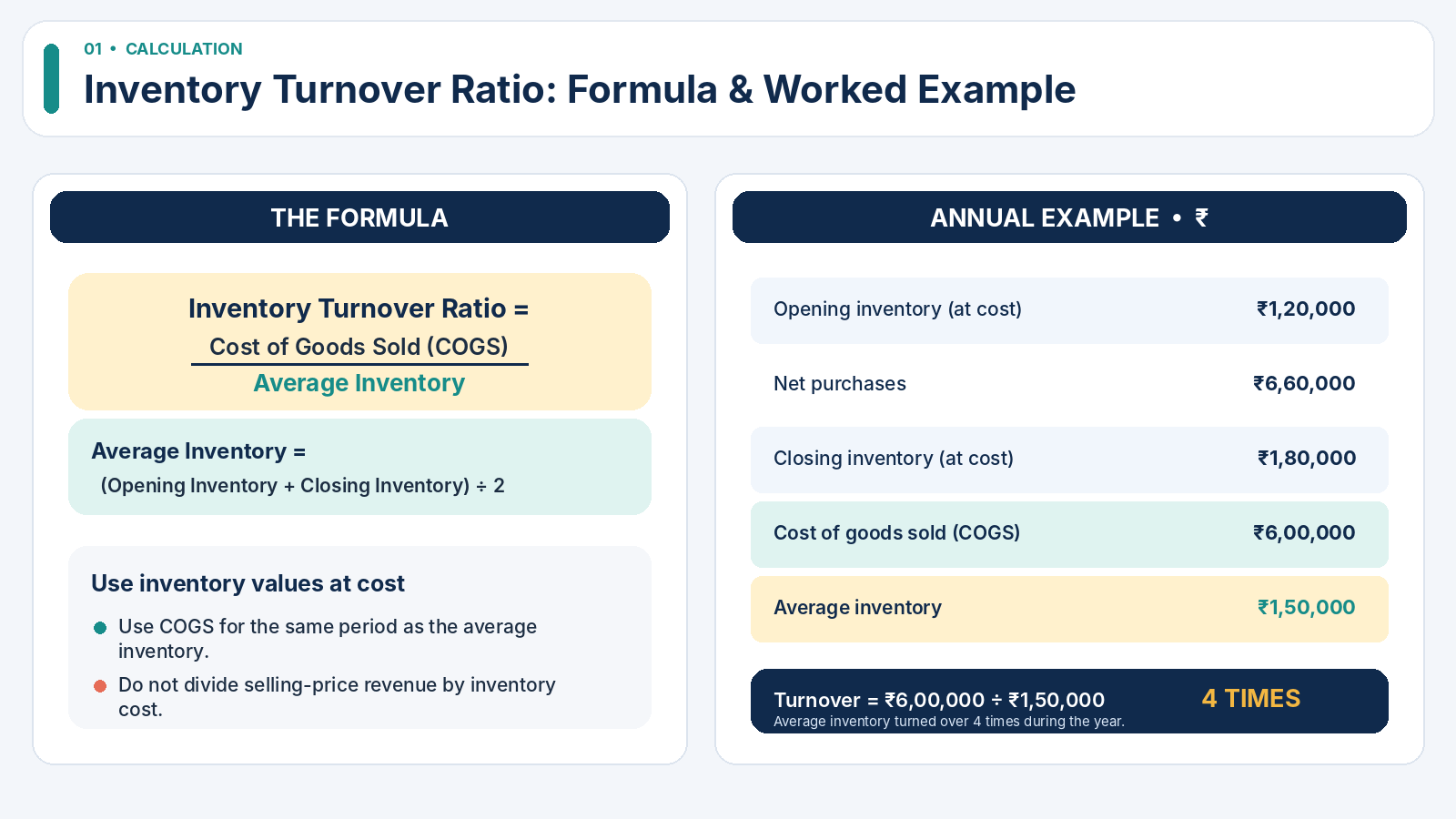
Inventory Turnover Ratio = Cost of Goods Sold ÷ Average Inventory
Both figures should be calculated using a consistent inventory cost basis.
Calculate average inventory
The basic formula for average inventory is:
Average Inventory = (Opening Inventory + Closing Inventory) ÷ 2
Use inventory values at cost, not selling price.
For example:
| Inventory details | Amount |
|---|---|
| Opening inventory at cost | ₹1,20,000 |
| Closing inventory at cost | ₹1,80,000 |
| Total | ₹3,00,000 |
| Average inventory | ₹1,50,000 |
Calculation:
(₹1,20,000 + ₹1,80,000) ÷ 2 = ₹1,50,000.
The average inventory for this example is ₹1,50,000.
Calculate cost of goods sold
Cost of goods sold, commonly called COGS, represents the cost assigned to the products sold during the selected period.
A simplified inventory calculation is:
COGS = Opening Inventory + Net Purchases − Closing Inventory
All values must be measured consistently at cost, with appropriate adjustments for purchase returns and other inventory-related movements.
For example:
| Inventory calculation | Amount |
|---|---|
| Opening inventory at cost | ₹1,20,000 |
| Net purchases | ₹6,60,000 |
| Closing inventory at cost | ₹1,80,000 |
| Cost of goods sold | ₹6,00,000 |
Calculation:
₹1,20,000 + ₹6,60,000 − ₹1,80,000 = ₹6,00,000.
The shop's cost of goods sold for this example is ₹6,00,000.
3. Calculate Inventory Turnover With a Simple ₹ Example
Now that we have both figures, calculate the inventory turnover ratio.
Inventory Turnover Ratio = COGS ÷ Average Inventory
Using the previous example:
- Cost of goods sold = ₹6,00,000
- Average inventory = ₹1,50,000
Inventory Turnover Ratio = ₹6,00,000 ÷ ₹1,50,000
Inventory Turnover Ratio = 4 times per year
This means the shop turned over its average inventory approximately four times during the year.
What does four times mean?
It does not mean that every individual product was sold exactly four times.
Some products may have sold many times during the year, while others may have remained in stock for several months.
The figure represents the overall relationship between the cost of products sold and the average inventory value during the selected period.
This is why it is useful to calculate inventory turnover separately for important product categories when the necessary records are available.
4. Calculate How Many Days Your Inventory Takes to Turn Over
The inventory turnover ratio can also be converted into an approximate number of inventory days.
This helps shop owners understand how long their average inventory takes to move through the business.
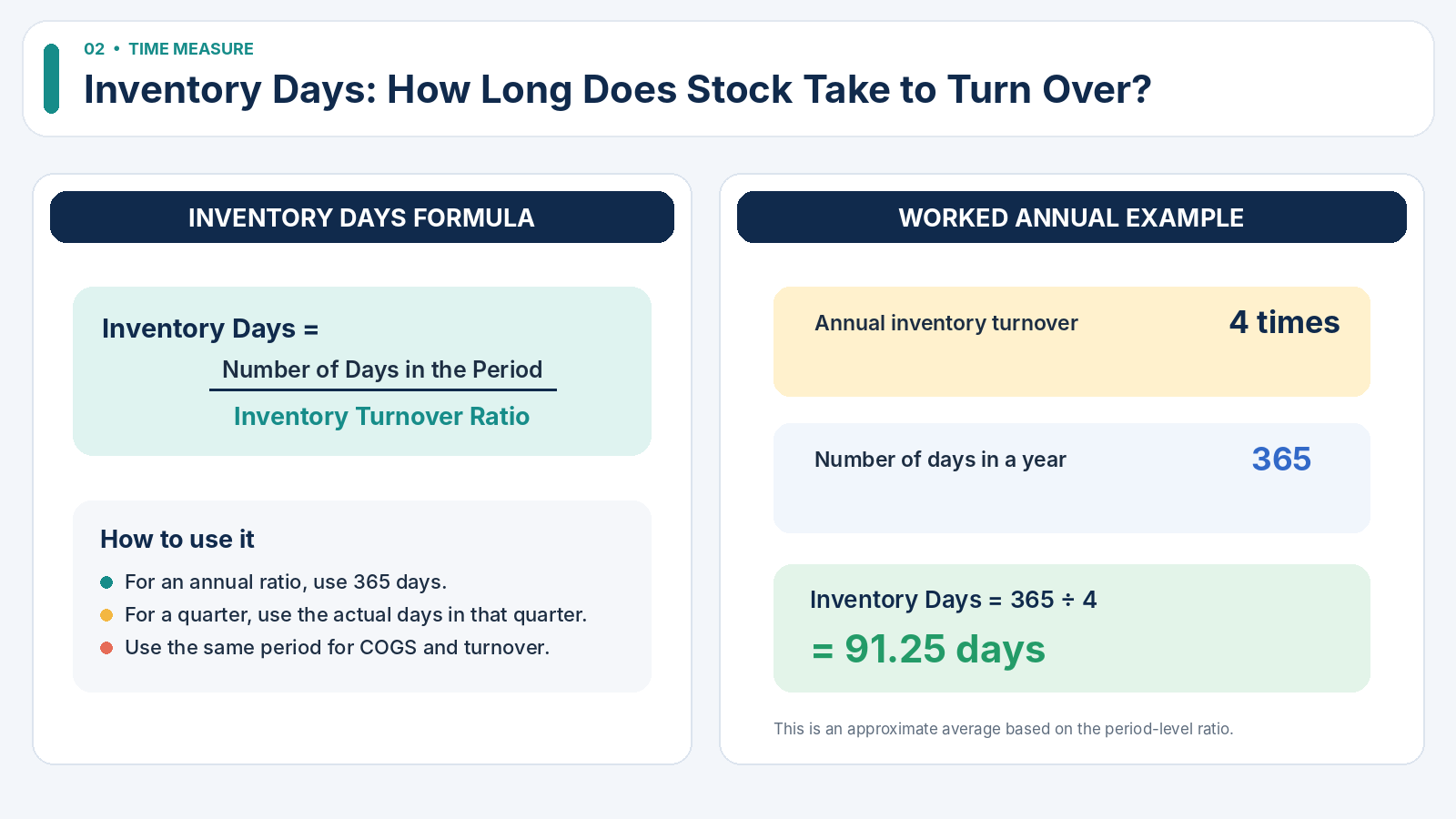
Inventory Days = Number of Days in the Period ÷ Inventory Turnover Ratio
For an annual calculation, use 365 days.
Using our previous example:
- Annual inventory turnover = 4 times
- Period = 365 days
Inventory Days = 365 ÷ 4
Inventory Days = 91.25 days
This means the average inventory represents approximately 91 days of cost of goods sold.
You can also use this formula:
Inventory Days = (Average Inventory ÷ Cost of Goods Sold) × Number of Days in the Period
For a 90-day quarterly review, use 90 days rather than 365.
Do not mix an annual COGS figure with a 90-day period. The cost of goods sold and the number of days must refer to the same period.
5. What Is a Good Inventory Turnover Ratio for a Retail Shop?
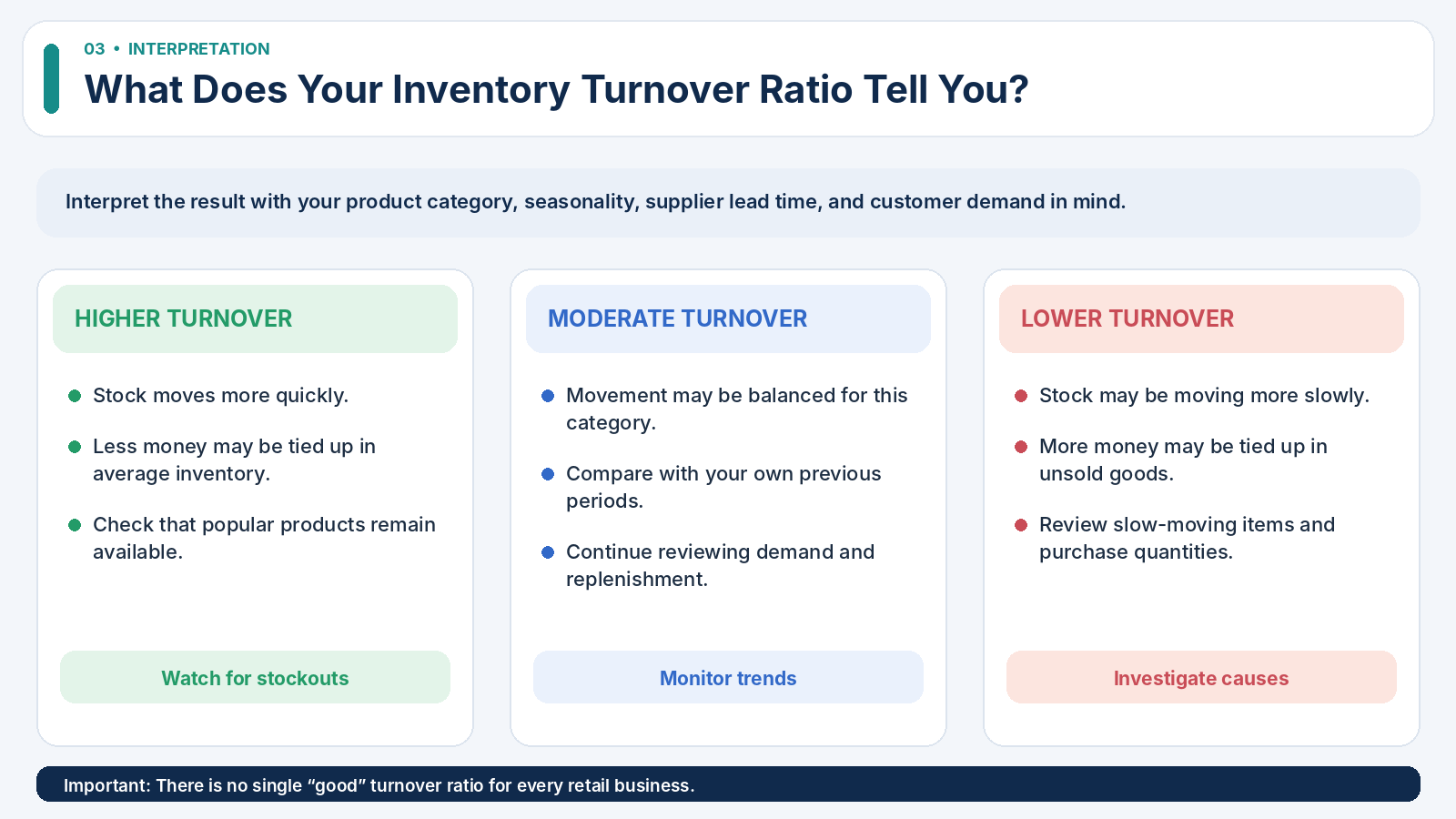
There is no single inventory turnover ratio that is suitable for every retail business.
Different product categories have different selling patterns, storage requirements, supplier arrangements, and customer demand.
Consider these examples:
Grocery shop: Many everyday grocery products sell frequently, while specialty or seasonal products may move more slowly.
Pharmacy: Regularly used products may move quickly, while specialised products may have lower sales frequency. Expiry dates and storage conditions also matter.
Clothing store: Seasonal collections, sizes, colours, and changing fashion preferences can influence how quickly individual products sell.
Hardware shop: Frequently required tools and accessories may move faster than specialist products that customers purchase only occasionally.
Mobile accessories shop: Popular chargers and cables may sell regularly, while accessories for older phone models may take longer to move.
For this reason, compare your turnover:
- With your own previous periods
- With similar product categories
- With your purchasing and sales plans
- With suitable industry benchmarks, where reliable comparisons are available
A ratio of four may be useful for one type of shop but unsuitable for another.
The OpenStax Principles of Accounting textbook explains inventory turnover and why it should be considered alongside business conditions and comparable ratios.
6. What Does a High or Low Inventory Turnover Ratio Tell You?
Your inventory turnover result is more useful when you understand what may be causing it.
High inventory turnover
A higher ratio generally means products are moving through the shop more quickly relative to the average inventory held.
Possible benefits include:
- Less money tied up in inventory
- Lower storage and holding requirements
- Faster movement of products
- Reduced exposure to outdated or unsold stock
However, excessively high turnover can also indicate that the shop is keeping too little stock.
For example, a grocery shop may sell popular products quickly but fail to reorder them in time. Customers may then visit the shop and find those products unavailable.
High turnover should therefore be considered alongside stock availability and customer demand.
Low inventory turnover
A lower ratio means that inventory is moving more slowly relative to the average stock held.
Possible reasons include:
- Purchasing more products than customers need
- Incorrect demand estimates
- Slow-moving or outdated products
- Seasonal demand changes
- Products that customers no longer prefer
- Large quantities purchased to obtain supplier discounts
A low turnover does not automatically mean that every product is performing poorly.
Some shops must maintain specialist or high-value products that sell less frequently. The important thing is to understand whether the quantity held is justified by customer demand and business requirements.
For more detail, read how to identify and clear dead stock in a retail shop.
7. Calculate Inventory Turnover for Individual Product Categories
A shop-wide inventory turnover ratio provides an overall picture, but it may hide differences between product categories.
For example, a grocery shop may sell everyday essentials very quickly while decorative or specialty products remain on the shelves for much longer.
Calculating turnover by category helps you identify these differences.
Consider this illustrative annual example:
| Category | Annual COGS | Average inventory | Turnover |
|---|---|---|---|
| Grocery essentials | ₹3,60,000 | ₹60,000 | 6 times |
| Household products | ₹1,20,000 | ₹60,000 | 2 times |
| Specialty products | ₹60,000 | ₹60,000 | 1 time |
This suggests that grocery essentials moved faster than the other two categories during the period.
The specialty category may deserve a closer review, but do not immediately stop purchasing those products.
Check whether customers expect them to be available, whether they are seasonal, and whether their slower movement is normal for the category.
Category-level calculations are often more useful than comparing completely different products using one shop-wide number.
8. Use Inventory Turnover to Improve Your Purchasing Decisions
Inventory turnover can help you decide what to purchase, how much to order, and which products need closer attention.
Instead of ordering based entirely on memory or supplier recommendations, use your sales history and stock information.
Consider these practices.
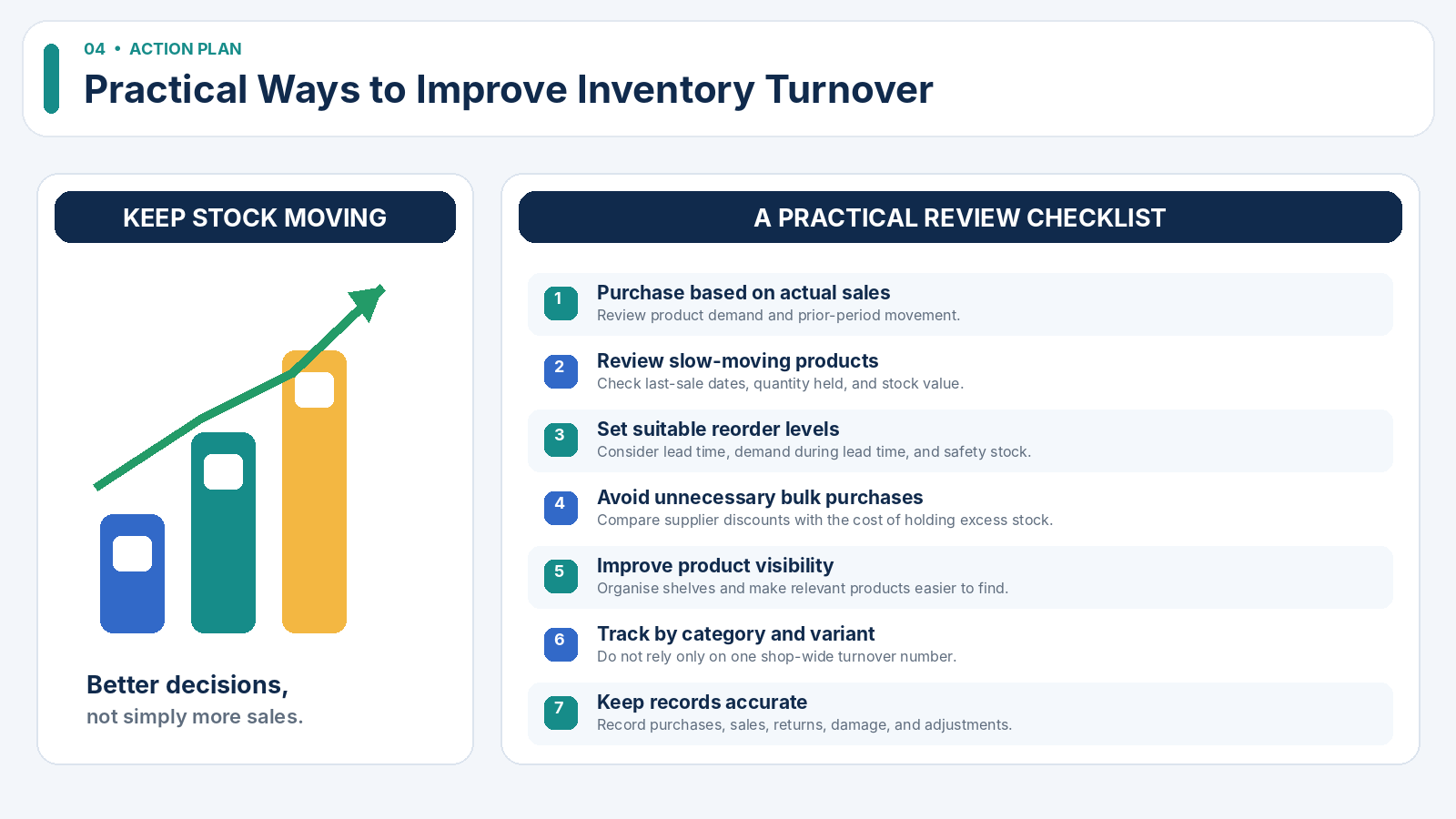
Purchase based on actual product movement
Review the products that customers buy regularly.
Use their sales history, current quantity, supplier lead time, and expected demand to plan future orders.
Avoid purchasing large quantities simply because the supplier offers a discount.
Review products with low turnover
Find categories that have high stock values but low movement.
Check whether the products are still relevant, whether prices are competitive, and whether you need to change the quantity you purchase.
Maintain suitable reorder levels
A product with high turnover may need more frequent replenishment.
Plan reorder levels around actual sales, expected delivery time, and an appropriate safety buffer.
Read our guide on how to prevent stockouts in a retail shop for practical stock replenishment guidance.
Review supplier delivery performance
If a supplier takes too long to deliver, you may need to maintain additional stock to avoid running out of products.
If deliveries are frequent and reliable, smaller orders may be practical.
For guidance, see how to manage supplier purchases and purchase orders in a retail shop.
9. Practical Ways to Improve Inventory Turnover
If your inventory turnover is lower than expected, do not immediately reduce every product quantity.
Identify the reason first, then take appropriate action.
Improve demand forecasting
Use previous sales, customer requests, seasonal activity, and local market observations to estimate future demand.
Update your purchase plans when customer preferences change.
Reduce unnecessary bulk purchases
Review minimum order quantities and supplier discounts carefully.
A lower purchase price may not be worthwhile if products remain unsold for a long time.
Review slow-moving products
Identify items that have not sold for a significant period.
Consider improving their display, adjusting future purchases, or creating a suitable promotion where it makes financial sense.
Organise products for better visibility
Customers may overlook products that are difficult to find.
Arrange related products clearly and make important items accessible.
Improve stock accuracy
Incorrect stock records can lead to unnecessary purchases or missed sales.
Compare physical quantities with your inventory records periodically and investigate discrepancies.
Monitor product variants separately
In clothing, mobile accessories, and other product categories, one variant may sell quickly while another remains unsold.
Review sizes, colours, brands, models, and other relevant variants separately where the records allow it.
Review promotions carefully
A promotion may help move products faster, but discounts can also reduce gross profit.
Calculate the financial impact before using discounts to increase stock movement.
The objective is not simply to make inventory turnover as high as possible. It is to improve stock movement while maintaining availability and profitability.
10. Common Mistakes When Calculating Inventory Turnover
A calculation can produce a misleading result if the underlying figures are not prepared consistently.
Avoid these common mistakes.
Using sales instead of cost of goods sold: The standard inventory turnover formula uses COGS divided by average inventory, not selling-price revenue divided by inventory at cost.
Using selling price instead of stock cost: Inventory valuation and COGS should use a consistent cost basis.
Mixing different periods: Do not compare annual COGS with average inventory from only one month without adjusting the calculation period.
Ignoring seasonal stock changes: A simple average of opening and closing inventory may not represent a shop that experiences large seasonal fluctuations.
Combining different product categories: Grocery, clothing, pharmacy, and hardware products can have very different turnover patterns.
Treating high turnover as always positive: A very high ratio can mean that the shop does not carry enough stock to satisfy demand.
Ignoring inventory accuracy: Missing purchases, unrecorded returns, or incorrect stock adjustments can distort average inventory.
When calculating turnover, use accurate sales, purchase, and inventory records. Our article on manual stock registers versus inventory software explains how different record-keeping approaches affect stock management.
11. How Often Should You Review Inventory Turnover?
The appropriate review frequency depends on your shop's size, product range, and stock movement.
You can use different review periods for different purposes.
Monthly review: Useful for monitoring fast-moving product categories and identifying changes in demand.
Quarterly review: Helps you examine broader inventory trends, purchasing decisions, and slower-moving categories.
Annual review: Provides a longer-term view of inventory efficiency and allows comparisons with the previous year.
For seasonal products, compare similar periods rather than assuming that every month should produce the same turnover.
For example, a clothing store may have a very different inventory movement pattern during a festival season compared with a quieter period.
Use the same calculation method from one review to the next so that changes in the ratio reflect business performance rather than changes in how you calculated it.
12. Use Inventory Records to Track Stock Movement
Calculating inventory turnover manually is possible, but you need reliable information about purchases, sales, and inventory values.
A suitable retail-management system may help you organise:
- Product details and cost prices
- Purchase records
- Sales transactions
- Stock quantities
- Returns and adjustments
- Inventory and sales reports
The exact features available vary between applications.
RetailManager provides product, purchase, sales, and reporting workflows that retailers can evaluate when organising their records. Check its current reporting capabilities before assuming that it automatically calculates inventory turnover or inventory days.
For better results, keep purchase prices updated, record sales correctly, and review stock quantities regularly.
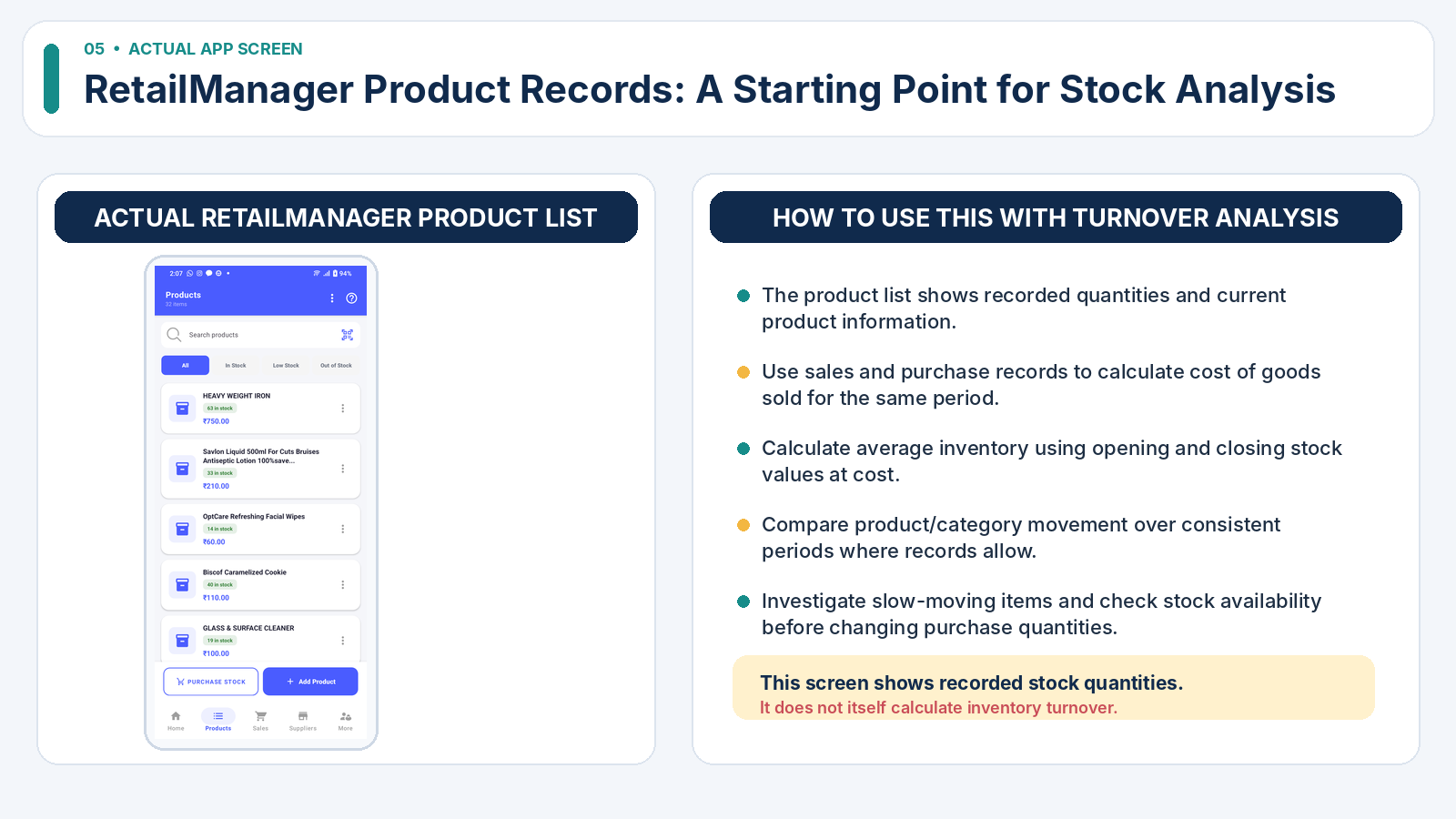
You can explore RetailManager on Google Play and review its current features to see whether they suit your business requirements.
Frequently Asked Questions
What is a good inventory turnover ratio for a retail shop?
There is no universal target. The appropriate ratio depends on the product category, selling frequency, supplier lead times, seasonality, and business model. Compare your results with similar products and your own historical performance.
How do I calculate inventory turnover?
Divide the cost of goods sold during the selected period by the average inventory value at cost.
Inventory Turnover Ratio = COGS ÷ Average Inventory.
Should I use sales or cost of goods sold in the formula?
Use cost of goods sold. It is measured at product cost, which makes it more consistent with the average inventory value used in the denominator.
What does an inventory turnover ratio of four mean?
It means the business turned over its average inventory approximately four times during the selected period. If the period is one year, the result is four times per year.
How do I calculate inventory days?
Divide the number of days in the period by the inventory turnover ratio.
For example, if annual turnover is four times:
365 ÷ 4 = 91.25 inventory days.
Is a high inventory turnover ratio always good?
No. High turnover may indicate that products sell quickly, but it could also mean that the shop is holding insufficient stock and losing sales. Consider product availability, demand, and profitability alongside turnover.
What is the difference between inventory turnover and stock turnover?
They are commonly used to describe the same inventory-efficiency measure in retail and accounting discussions. Both refer to how frequently inventory moves through the business during a selected period.
Conclusion
The inventory turnover ratio helps retail shop owners understand how quickly their products sell relative to the average inventory they hold.
Start by calculating the cost of goods sold and average inventory using consistent cost values. Then calculate the turnover ratio and convert it into approximate inventory days to understand how long stock takes to move through your shop.
Review the result by product category, compare it with previous periods, and investigate slow-moving inventory or possible stock shortages.
Whether you operate a kirana store, pharmacy, hardware shop, clothing business, fertilizer shop, or mobile accessories store, tracking inventory turnover can help you make more informed purchasing decisions and manage the money invested in stock.
- #Inventory Turnover
- #Stock Management
- #Inventory Control
- #Retail Metrics
- #Small Business Finance