Inventory & Purchasing
How to Choose the Right Products for Your Retail Shop
Learn how to choose the right products for your retail shop, understand customer demand and build a profitable product assortment.
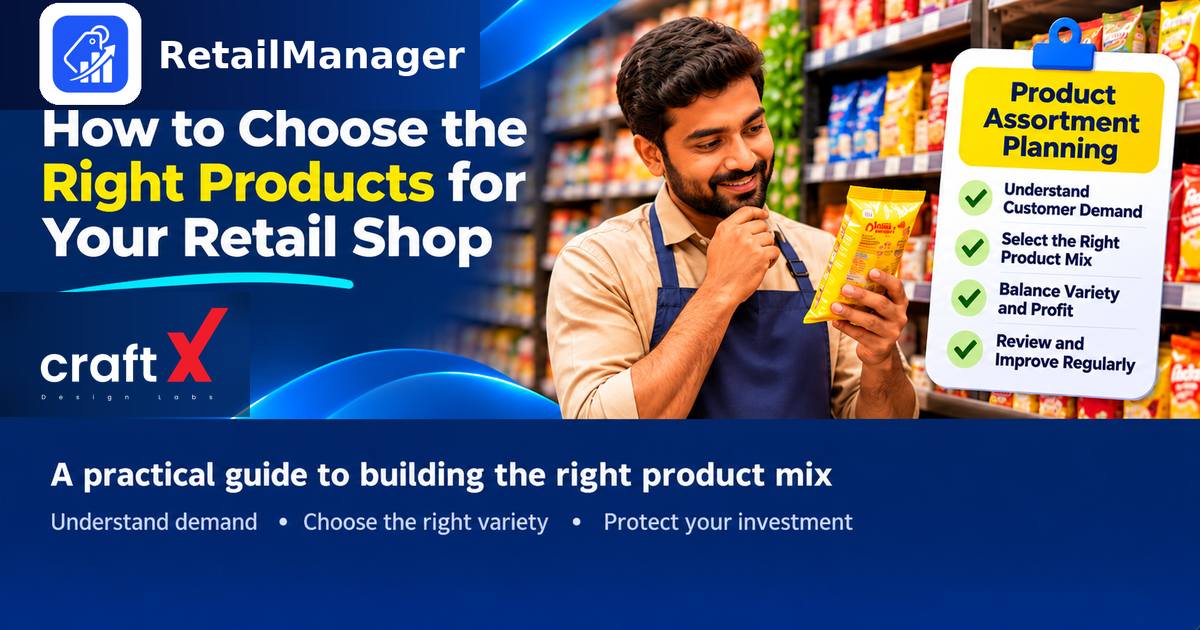
Choosing the right products is one of the most important decisions a retail shop owner makes. A shop may have enough storage space, reliable suppliers and sufficient investment, but if it stocks products customers do not want, money can remain tied up in the wrong inventory.
At the same time, offering too few options can make customers visit another shop. For example, a customer looking for a particular brand of cooking oil, toothpaste or mobile accessory may leave if the shop does not offer a suitable alternative.
This is where product assortment planning becomes important.
Product assortment planning helps retailers decide which products to sell, how many brands and varieties to offer, and how much space and investment to allocate to different categories. Instead of purchasing products simply because suppliers offer discounts or competitors stock them, shop owners can make decisions based on customer demand, buying patterns and profitability.
Whether you operate a kirana store, pharmacy, hardware shop, clothing store or mobile accessories shop, a well-planned product assortment can help you serve customers better and use your investment more effectively.
In this guide, we will explain how to choose the right products for your retail shop using practical examples and simple steps.
1. What Is Product Assortment Planning?
Product assortment planning is the process of deciding which products, brands, sizes, models, flavours, colours and variations your retail shop should offer to customers.
It involves answering questions such as:
- Which product categories should your shop carry?
- Which products are customers purchasing regularly?
- How many brands should you offer within a category?
- Should you introduce premium or budget alternatives?
- Which products deserve more shelf space?
- Are customers asking for products that you currently do not stock?
For example, imagine you operate a kirana store.
You sell cooking oil, rice, biscuits, soaps, detergents, snacks and personal care products. Within the cooking oil category, you might offer:
- Sunflower oil
- Groundnut oil
- Palm oil
- Coconut oil
You may also offer different brands and pack sizes.
Product assortment planning helps you decide whether you need all these varieties, which ones customers prefer and how much investment each deserves.
The objective is not to stock every available product. It is to offer the right selection for your target customers.
2. Understand Your Customers Before Selecting Products
The first step in choosing the right products is understanding who purchases from your shop.
Different customers have different preferences, budgets and buying habits. A product assortment that works well in one locality may not perform equally well in another.
For example:
- A residential neighbourhood may have strong demand for everyday grocery and household products.
- A shop near a college may see more demand for snacks, stationery and affordable personal care products.
- A pharmacy may need to understand local demand for healthcare essentials and permitted over-the-counter products.
- A mobile accessories shop may need different charging cables, adapters, covers and screen protectors depending on the phones commonly used by local customers.
Identify your main customer groups
Start by observing the customers who regularly visit your shop.
Consider:
| Customer group | Possible buying preferences |
|---|---|
| Families | Grocery, household essentials and monthly-use products |
| Students | Affordable snacks, stationery and personal care products |
| Working professionals | Convenience products and quick-purchase essentials |
| Budget-conscious customers | Smaller packs and economical alternatives |
| Premium customers | Recognised brands and higher-quality products |
These are starting points, not fixed rules. Your actual customer behaviour should guide your decisions.
Ask customers what they need
You do not need an expensive survey to understand demand.
Ask simple questions during regular transactions:
- Is there any product you regularly need but cannot find here?
- Would you prefer another brand or pack size?
- Are you looking for a budget-friendly alternative?
- Which products do you usually purchase from another shop?
Keep a small notebook or digital record of repeated requests.
If several customers ask for the same product over a few weeks, it may be worth testing that product in your shop.
Related Guide: Managing Your Retail Customers
For more practical guidance on managing customer needs, products and daily shop operations, read our guide on How to Manage a Kirana Store Efficiently.
3. Analyse Your Existing Sales Before Adding New Products
Your existing sales provide useful information about what customers already prefer.
Before introducing new products, review your current product performance.
Look at three important factors:
- Sales frequency: How regularly is the product purchased?
- Sales quantity: How many units do customers purchase?
- Profit contribution: How much gross profit does the product generate?
For example, consider a small grocery shop selling the following products in one month.
| Product | Units sold | Selling price | Purchase cost |
|---|---|---|---|
| Rice (5 kg) | 80 | ₹350 | ₹320 |
| Cooking oil (1 L) | 120 | ₹150 | ₹135 |
| Biscuits | 250 | ₹10 | ₹8 |
| Premium dry fruits (250 g) | 12 | ₹180 | ₹145 |
| Detergent (1 kg) | 45 | ₹110 | ₹95 |
The figures show different customer buying patterns.
- Biscuits have high unit sales.
- Cooking oil has regular demand.
- Rice contributes a higher amount per transaction.
- Premium dry fruits sell less frequently but may provide a higher gross profit per unit.
This does not automatically mean you should remove products with lower sales. Some products serve specific customers or complement other purchases.
Instead, use sales data to understand the role each product plays in your shop.
Look beyond total sales
A product with high sales revenue does not necessarily generate the highest profit.
For example:
- Product A sells 100 units and earns ₹5 gross profit per unit.
- Product B sells 40 units and earns ₹20 gross profit per unit.
Product A generates ₹500 gross profit, while Product B generates ₹800.
This is why product selection should consider both customer demand and profitability.
Related Guide: Understanding Product Performance
You can also learn how to measure how quickly products move through your inventory by reading our guide on the Inventory Turnover Ratio for Retail Shops.
4. Decide Which Product Categories Your Shop Should Stock
Once you understand your customers and existing sales, organise your products into categories.
A category-based approach makes assortment planning easier because you can evaluate the purpose and performance of each product group.
For example, a kirana store may organise its assortment as follows:
| Category | Example products |
|---|---|
| Staples | Rice, wheat flour, pulses and sugar |
| Cooking essentials | Cooking oil, spices and salt |
| Snacks | Biscuits, chips and namkeen |
| Beverages | Tea, coffee, juices and soft drinks |
| Personal care | Soap, shampoo and toothpaste |
| Household cleaning | Detergent, dishwash and floor cleaner |
A hardware shop may use categories such as electrical items, plumbing materials, hand tools, paints and fasteners.
A clothing shop may organise products by men's wear, women's wear, children's wear, seasonal collections and accessories.
Evaluate every category
For each category, ask:
- Is there regular customer demand?
- Does the category match the purpose of my shop?
- Are there enough customers interested in these products?
- Can I source the products reliably?
- Is there sufficient room for the category?
- Does the category contribute to overall shop profitability?
Do not introduce a completely new category simply because another retailer is selling it successfully.
First check whether your customers have a genuine need for it.
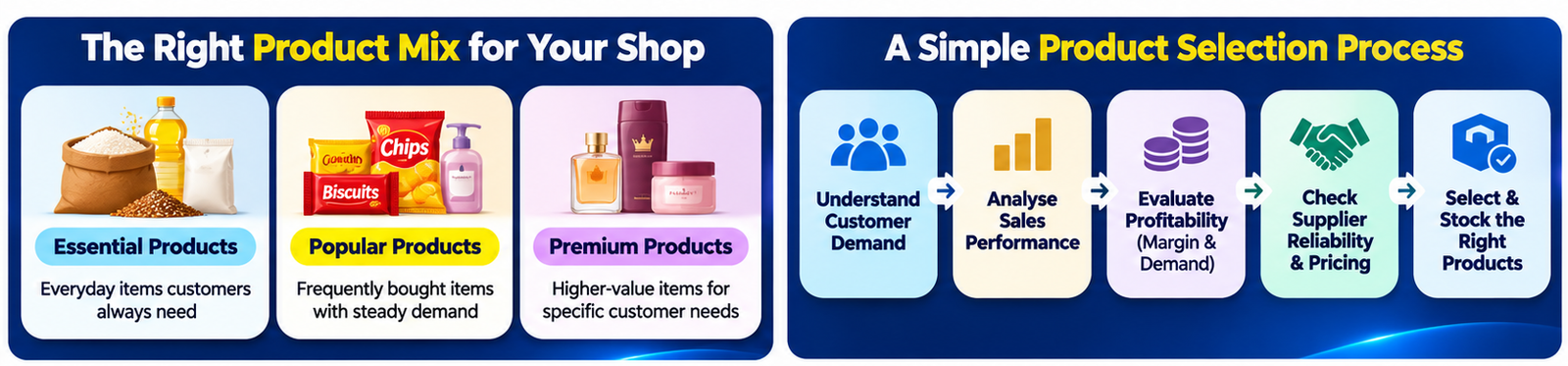
5. Balance Essential, Popular and Premium Products
A good product assortment should serve customers with different needs and budgets.
One practical approach is to divide products into three groups.
A. Essential products
These are products customers expect to find in your shop.
Examples include:
- Rice, flour and cooking oil in a grocery store
- Common household cleaning products
- Frequently needed pharmacy essentials, subject to applicable regulations
- Basic charging cables and screen protectors in a mobile accessories shop
Essential products help customers complete routine purchases.
B. Popular products
These are products that customers regularly request or purchase because of brand preference, local demand or convenience.
Examples include:
- Frequently purchased biscuit brands
- Popular detergent variants
- Common beverage flavours
- Frequently requested mobile phone accessories
You should understand which brands and variants your customers prefer rather than assuming that popular national brands will always perform well locally.
C. Premium and specialised products
These products serve customers looking for higher quality, specialised features or premium brands.
Examples include:
- Premium cooking oils
- Speciality food products
- Branded personal care products
- Premium mobile accessories
- Higher-end clothing collections
You do not need to stock many premium variations initially. Start with a limited selection and evaluate customer response.
Example product assortment
Suppose your shop sells toothpaste.
You could start with:
| Product type | Purpose |
|---|---|
| Budget toothpaste | Serves price-conscious customers |
| Regular toothpaste | Covers everyday demand |
| Premium toothpaste | Offers a higher-priced alternative |
| Sensitive-teeth toothpaste | Serves a specific customer requirement |
This provides useful choices without unnecessarily expanding the number of products.
6. How Many Brands and Variants Should You Offer?
Offering more choices can attract customers, but too much variety can make purchasing decisions difficult and increase the investment required to maintain stock.
For example, imagine your shop sells packaged drinking water.
You introduce five brands, each in four different pack sizes. That creates 20 product variations.
If customers regularly purchase only two brands and two pack sizes, the remaining variations may not justify the investment or shelf space.
Start with a focused selection
For a new category:
- Identify the most commonly requested product types.
- Select a small number of suitable brands.
- Offer the pack sizes or variants customers actually need.
- Monitor sales and customer requests.
- Expand only when demand supports it.
Avoid unnecessary duplication
Two products may have nearly identical features, pack sizes and target customers.
Before stocking both, consider:
- Do customers specifically ask for both?
- Is one brand significantly more affordable?
- Does each product serve a different customer group?
- Is there enough demand to justify both?
If two products serve exactly the same purpose and customers consistently prefer one, the other may not need as much shelf space.
However, do not remove a product simply because its sales are lower. Some customers may purchase it because of a specific brand preference or requirement.
7. Evaluate Product Profitability and Supplier Reliability
A product should not be selected based on its selling price alone.
Consider its purchase cost, selling price, expected demand, supplier reliability and the investment required to maintain it.
Calculate gross profit per unit
The basic formula is:
Gross Profit per Unit = Selling Price − Purchase Cost
For example:
- Selling price: ₹200
- Purchase cost: ₹160
- Gross profit: ₹40
Gross profit percentage on selling price can be calculated as:
Gross Profit Margin = (Gross Profit ÷ Selling Price) × 100
In this example:
₹40 ÷ ₹200 × 100 = 20%
Remember that gross profit is not the same as net profit. Rent, salaries, electricity, transport, payment charges and other operating expenses still need to be considered.
Compare similar products
Suppose two brands of detergent have the following details:
| Detail | Brand A | Brand B |
|---|---|---|
| Purchase cost | ₹90 | ₹100 |
| Selling price | ₹110 | ₹125 |
| Gross profit | ₹20 | ₹25 |
| Gross margin | 18.18% | 20% |
Brand B provides a higher gross profit per unit and margin.
However, if customers strongly prefer Brand A and it sells much faster, Brand A may still contribute more total gross profit over a month.
Therefore, evaluate profitability alongside actual demand.
Check supplier reliability
Before introducing a product, consider:
- Is the supplier dependable?
- Are products consistently available?
- Can you order smaller quantities initially?
- Are the purchase prices competitive?
- Are return or replacement terms clear?
- Are delivery times suitable for your shop?
A product with attractive margins may still be a poor choice if the supplier frequently delays deliveries or cannot provide consistent stock.
8. Avoid Overstocking and Unnecessary Product Variety
Adding more products does not always mean increasing sales.
Every additional product requires investment, storage space, purchasing attention and sometimes special handling.
A common mistake is purchasing large quantities of new products before understanding customer demand.
For example, a shop owner may see a new snack brand being promoted by a supplier and purchase 100 packets immediately.
But if customers are unfamiliar with the brand, the product may take much longer to sell than expected.
Use a small trial purchase
When introducing a new product:
- Purchase a limited quantity.
- Place it where customers can notice it.
- Inform regular customers about its availability.
- Track how many units sell.
- Collect customer feedback.
- Decide whether to reorder, increase or discontinue it.
This reduces the risk of committing too much money to an untested product.
Consider shelf space
Shelf space is limited, especially in small retail shops.
Products that sell regularly and serve important customer needs should receive appropriate visibility.
Review whether a product deserves its current shelf position based on:
- Sales frequency
- Customer demand
- Gross profit contribution
- Product size
- Storage and handling requirements
Do not allow a large number of slow-moving variations to occupy the most valuable display areas.
Related Guide: Managing Stock Availability
To understand how to maintain product availability without purchasing unnecessary quantities, read our guide on How to Manage Stock and Prevent Stockouts in a Retail Shop.
9. Consider Seasonal and Local Demand
Customer demand changes throughout the year.
A product that sells well during one season may have limited demand during another.
For example:
| Period or occasion | Possible product demand |
|---|---|
| Summer | Cold beverages, ice creams and seasonal essentials |
| Monsoon | Rainwear, umbrellas and related products |
| School reopening | Stationery, school supplies and bags |
| Festivals | Sweets, decorations, gift items and seasonal products |
| Winter | Warm clothing and seasonal personal care products |
The examples depend on your shop type and local market.
Plan based on your location
A retailer in a residential area may experience different seasonal demand from a shop near a school, bus stand or commercial market.
Observe previous sales, speak with customers and check supplier availability before making seasonal purchases.
Avoid buying large quantities just because a festival or seasonal event is approaching. Estimate realistic demand and purchase accordingly.
10. Review and Improve Your Product Assortment Regularly
Product assortment planning is not a one-time activity.
Customer preferences, competitors, suppliers, prices and local demand can change over time.
Set a regular review schedule.
Weekly review
Check:
- Products customers requested but could not find
- Frequently sold products
- New products introduced during the week
- Customer feedback
- Products requiring replenishment
Monthly review
Evaluate:
- Sales quantity by product
- Gross profit contribution
- Products with consistently low demand
- Customer requests for new brands or variants
- Supplier performance
- Seasonal demand changes
Quarterly review
Take a broader look at your shop:
- Are your product categories still relevant?
- Are customers purchasing the range you offer?
- Are there categories worth expanding?
- Are there products that no longer fit customer demand?
- Are you investing too much in unnecessary variety?
Make changes gradually. A product with low sales in one month may still have a valid purpose in your assortment.
11. A Practical 30-Day Product Assortment Planning Process
If you have never planned your product assortment systematically, you can start with a simple 30-day process.
| Period | Activity | Expected outcome |
|---|---|---|
| Days 1–7 | Observe customers and record product requests | Understand customer needs |
| Days 8–14 | Review existing product sales and profitability | Identify strong and weak categories |
| Days 15–20 | Identify missing products and possible alternatives | Prepare a shortlist of new products |
| Days 21–25 | Compare suppliers, costs and expected demand | Select products for a small trial |
| Days 26–30 | Introduce selected products and monitor response | Decide what to continue or adjust |
At the end of 30 days, review the results.
Ask yourself:
- Did customers purchase the newly introduced products?
- Did customers request more brands or variants?
- Did the new products generate reasonable gross profit?
- Did the purchases require too much investment?
- Should you reorder, modify or discontinue any products?
Repeat the process regularly to keep your product assortment aligned with customer demand.
12. How Retail Billing and Inventory Software Helps with Assortment Planning
Managing product selection becomes difficult when a shop has hundreds or thousands of products.
A manual register may help record purchases and sales, but reviewing product-level performance can take considerable time.
Retail billing and inventory software can make this process easier by keeping product and sales information organised.
Depending on the software and its available reporting features, retailers can use it to:
- Maintain a structured product list.
- Organise products into categories.
- Record product purchases and sales.
- Review product-level sales information.
- Monitor stock quantities.
- Identify products that may need further attention.
For example, a retailer can review sales records to understand which products customers purchase regularly and which products receive less demand.
This information can support better purchasing decisions.
RetailManager, developed by CraftX Design Labs, is designed to help small retailers manage billing, products, sales and inventory operations. Keeping product and sales records organised can provide a useful foundation for making more informed product-selection decisions.
You can explore RetailManager to learn more about retail management solutions for small shops.
Conclusion
Choosing the right products is not about filling every shelf or offering the largest number of brands. It is about understanding your customers and building a product assortment that meets their actual needs.
Start by studying customer preferences, reviewing existing sales and identifying the categories that matter most to your shop. Balance essential, popular and premium products, compare profitability and supplier reliability, and introduce unfamiliar products in small quantities.
Most importantly, review your assortment regularly. Customer preferences change, and your product selection should change with them.
A carefully planned product assortment can help you serve customers better, make more effective use of your investment and build a stronger retail business.
Frequently Asked Questions (FAQs)
1. What is product assortment planning in retail?
Product assortment planning is the process of deciding which products, brands, sizes, models and variations a retail shop should offer. It helps retailers match their product selection with customer demand, available investment and shop capacity.
2. How do I choose the right products for my retail shop?
Start by understanding your customers, observing their buying patterns and reviewing existing sales. Select products that match local demand, compare their profitability and supplier reliability, and test unfamiliar products with small purchases before expanding.
3. How many brands should a small retail shop stock?
There is no fixed number. It depends on the product category, customer preferences, available shelf space and purchasing budget. Start with a focused selection of commonly requested brands and introduce additional options when there is evidence of demand.
4. Should I stock products with high profit margins?
Not necessarily. A high-margin product may sell slowly, while a lower-margin product may sell frequently. Consider both gross profit per unit and total gross profit over a period, along with customer demand and the investment required.
5. How often should I review my product assortment?
A weekly review can help you understand customer requests and recent sales. A more detailed monthly review can help evaluate product performance, profitability and supplier reliability. A quarterly review is useful for making broader changes to product categories and selection.
6. How can I identify products customers want but my shop does not sell?
Record customer requests, ask regular customers about missing products and observe what they purchase elsewhere. If multiple customers request the same product, investigate its demand, supplier availability and profitability before introducing it.
7. Can inventory software help with product assortment planning?
Yes. Retail billing and inventory software can help organise product records, capture sales information and monitor inventory. These records can help shop owners understand buying patterns and make more informed decisions about which products to stock.
- #Product Assortment Planning
- #Retail Inventory Management
- #Product Selection
- #Retail Purchasing
- #Small Retail Business
- #Inventory Planning
- #Retail Management
- #Indian Retail Stores