Retail Operations
How to Handle Customer Complaints in a Retail Shop: A Practical Guide
Learn practical ways to handle customer complaints, resolve billing and service issues, and build stronger customer relationships in your retail shop.
Introduction
Handling customer complaints in retail is an important part of running a successful shop. Even retailers who provide good products, competitive prices and friendly service may occasionally receive complaints from customers.
A customer might receive the wrong product, notice a difference between the displayed price and the bill, experience a delayed service, or feel that an employee has not treated them properly.
How you respond to these situations can influence whether customers continue shopping at your store or decide to visit a competitor.
For example, imagine a customer visits your grocery shop and discovers that an item has been charged twice. If the employee listens, checks the bill and corrects the mistake professionally, the customer may continue trusting your shop. If the employee argues or ignores the complaint, a small billing error can become a much bigger customer-service problem.
Customer complaints are also useful sources of feedback. They can reveal problems with products, pricing, billing procedures, employee training and daily shop operations.
Whether you operate a kirana store, pharmacy, clothing shop, hardware store, supermarket or mobile accessories business, having a clear complaint-handling process can help you resolve problems consistently and maintain customer trust.
In this guide, we will explain how to handle customer complaints professionally, resolve common retail problems, train employees and use customer feedback to improve your shop.
1. Understand the Common Types of Customer Complaints
Before creating a complaint-handling process, understand the issues customers are likely to raise.
Not every complaint is about a defective product. Customers may be dissatisfied with different parts of their shopping experience.
A. Product-related complaints
Customers may complain when:
- A product is damaged or defective.
- The product does not match its description.
- The wrong size, colour or variant was supplied.
- Packaging is damaged or incomplete.
- A product appears to be expired or unsuitable.
- The product does not perform as expected.
For example, a customer purchasing a mobile charger may return to your shop because it does not work with their device.
B. Billing and payment complaints
Billing-related complaints are common in busy retail stores.
Examples include:
- The wrong quantity was billed.
- The same product was charged twice.
- A discount was not applied correctly.
- The displayed price differs from the billed price.
- The customer paid through UPI but the transaction status is unclear.
- The customer received an incorrect bill.
These complaints should be checked against the actual transaction and payment records.
C. Pricing and promotion complaints
Customers may question a product's price, promotional offer or discount.
For example, a shop displays a product with a promotional price, but the billing counter charges a different amount.
Such situations can create confusion and reduce customer confidence.
D. Employee behaviour and service complaints
Customers may report:
- Rude or impatient communication.
- Lack of assistance.
- Incorrect product information.
- Long waiting times.
- Employees ignoring customer requests.
- Poor handling of an exchange or refund request.
These issues require attention because they relate directly to the customer's experience.
E. Availability and delivery complaints
Customers may be dissatisfied when:
- A requested product is unavailable.
- A promised delivery is delayed.
- An order is incomplete.
- The wrong product is delivered.
- An employee provides inaccurate availability information.
Understanding the complaint category helps you identify the right solution.
2. Why Handling Customer Complaints Properly Matters
A complaint should not automatically be treated as a negative interaction. It can help you understand where your shop's processes need improvement.
Consider the following benefits.
Maintains customer trust
Customers want to feel that their concerns are taken seriously.
Even when a mistake occurs, a fair and professional response can help preserve the relationship.
Identifies operational problems
Repeated complaints may indicate problems with:
- Product quality checks.
- Billing procedures.
- Supplier deliveries.
- Employee training.
- Product displays and pricing.
- Customer-service processes.
Correcting the underlying issue can prevent similar complaints from happening again.
Encourages repeat purchases
Customers may be more willing to return when they know that the shop takes their concerns seriously.
For more ideas on maintaining customer relationships, read our guide on How to Build Customer Loyalty and Increase Repeat Purchases in a Retail Shop.
Helps improve your shop's reputation
A customer who receives a fair resolution may share a positive experience with others. On the other hand, unresolved complaints can lead to negative feedback and lost business.
The objective is not to avoid every complaint. It is to resolve genuine issues consistently and learn from them.
3. Follow a Simple Six-Step Customer Complaint Handling Process
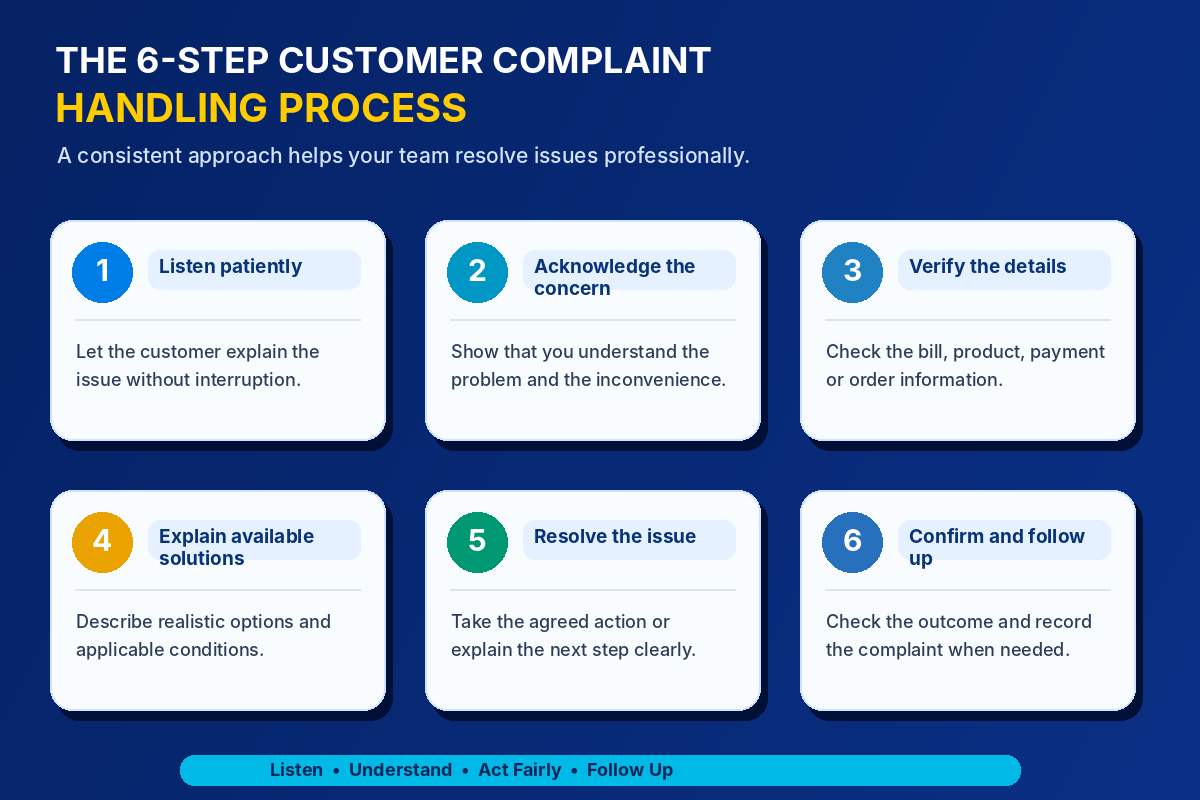
Every shop should have a basic process that employees can follow when customers raise concerns.
A consistent approach reduces confusion and makes it easier to resolve problems.
Step 1: Listen Without Interrupting
Allow the customer to explain the issue.
Avoid interrupting, arguing or immediately blaming another employee.
Pay attention to the specific details:
- What happened?
- When did it happen?
- Which product or service was involved?
- What does the customer believe went wrong?
- What outcome are they requesting?
For example, a customer may say:
"I purchased this product yesterday, but it stopped working today."
Listen to the explanation before deciding whether the product is defective, incorrectly used or covered by an applicable warranty or return arrangement.
Step 2: Acknowledge the Concern
Show the customer that you understand the issue.
You do not need to accept responsibility for something that has not been verified. However, you can acknowledge the inconvenience.
Useful responses include:
- "I understand the problem."
- "Thank you for bringing this to our attention."
- "Let me check what happened."
- "I understand why this is frustrating."
Avoid statements that make the customer feel ignored, such as:
- "That is not our problem."
- "You must have done something wrong."
- "There is nothing we can do."
Step 3: Ask Questions and Verify the Details
Once the customer explains the problem, collect the information required to investigate it.
Depending on the issue, you may need:
- Original bill or transaction reference.
- Product name and quantity.
- Date of purchase.
- Applicable price or offer details.
- Payment confirmation.
- Product condition.
- Relevant warranty or return information.
For example, if a customer reports being charged twice, check the bill and payment records before processing a refund.
Do not ask for unnecessary personal information. Keep customer details private and record only what is needed to handle the complaint.
Step 4: Explain the Available Solutions
After checking the issue, explain what can reasonably be done.
Possible solutions may include:
- Correcting a billing error.
- Replacing an eligible defective product.
- Processing an eligible refund.
- Providing the correct product.
- Correcting a promotional price.
- Arranging an agreed delivery.
- Escalating the matter to the shop owner or manager.
Explain the available options clearly, including any applicable conditions or time requirements.
Avoid promising a solution that your shop cannot deliver.
Step 5: Resolve the Issue or Explain the Next Step
If the complaint can be resolved immediately and the employee has the necessary authority, complete the action.
If additional investigation is required, explain:
- What needs to be checked.
- Who will handle it.
- Whether the customer needs to provide anything else.
- When and how the shop expects to provide an update.
Do not leave the customer uncertain about what happens next.
Step 6: Confirm the Outcome
After taking action, confirm that the issue has been addressed.
For example:
- "The incorrect billing amount has been corrected."
- "We have recorded your replacement request."
- "The refund has been processed through the original payment method."
- "We have checked the product and explained the available options."
For more complicated complaints, record the final outcome and check whether further follow-up is necessary.
4. How to Handle Common Customer Complaints in a Retail Shop
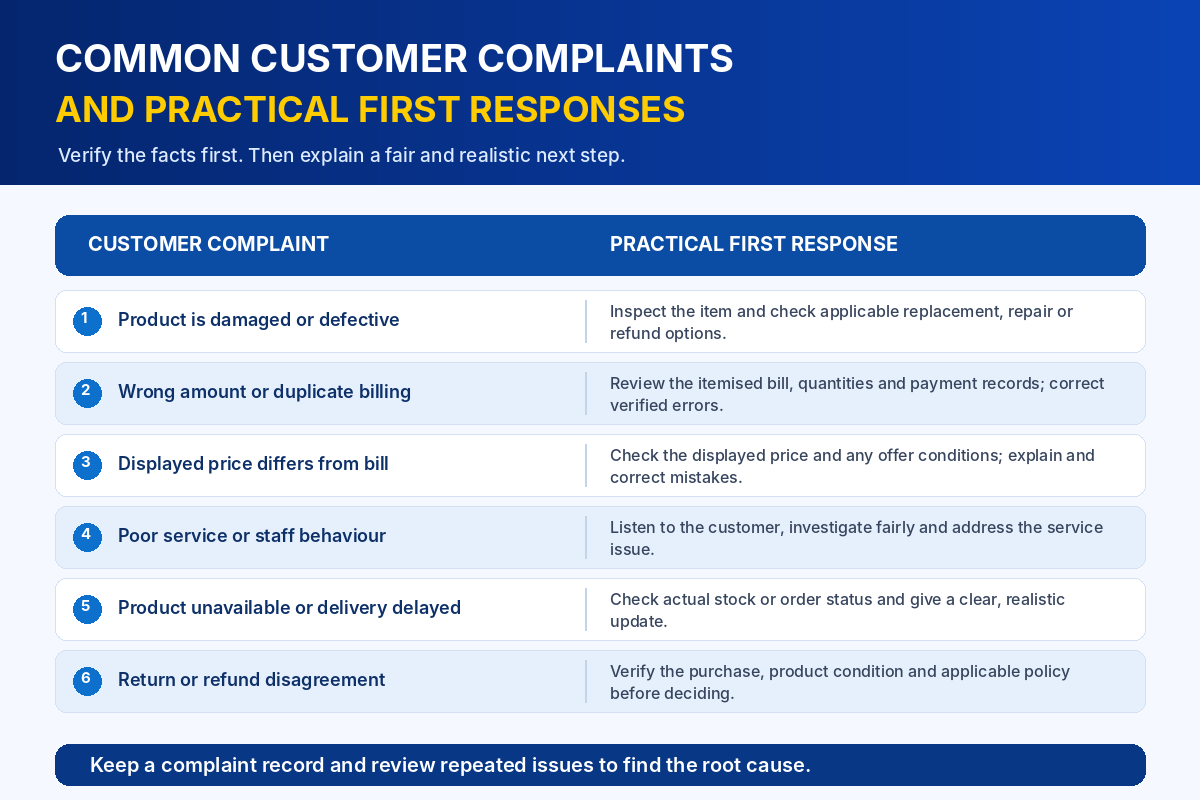
Different complaints require different solutions. Here are practical examples that small retailers can use.
| Customer complaint | Recommended response |
|---|---|
| Wrong amount charged | Review the bill and correct verified errors |
| Product is damaged | Inspect the product and check applicable replacement or refund options |
| Discount not applied | Verify the offer conditions and correct billing if appropriate |
| Product unavailable | Explain availability and suggest a suitable alternative without misleading the customer |
| Employee behaviour complaint | Listen, investigate and address the service issue fairly |
| UPI payment confusion | Check the actual transaction records before taking further action |
| Delayed delivery | Check the order status, explain the delay and provide a realistic update |
| Incorrect product supplied | Verify the order and arrange the appropriate correction |
The most important principle is to investigate the issue rather than making assumptions.
5. Handle Billing and Pricing Disputes Carefully
Billing and pricing complaints should be checked using the original transaction details.
For example, imagine a customer purchases the following products:
| Product | Quantity | Price |
|---|---|---|
| Rice packet | 1 | ₹120 |
| Cooking oil | 2 | ₹150 each |
| Biscuits | 3 | ₹10 each |
Expected bill total:
₹120 + (2 × ₹150) + (3 × ₹10) = ₹480
Suppose the customer is charged ₹510.
The difference is ₹30.
Instead of immediately arguing with the customer, review the transaction:
- Check the product quantities.
- Verify the entered selling prices.
- Check whether a product was scanned or entered twice.
- Review any applicable discount.
- Compare the bill total with the payment amount.
- Correct any confirmed error.
Prevent repeated billing complaints
Introduce simple controls:
- Maintain accurate product prices.
- Review promotional prices before applying them.
- Train employees to select the correct products.
- Verify quantities before completing transactions.
- Make itemised bills available to customers.
- Review unusual cancellations, discounts and refunds.
A reliable billing process can prevent many avoidable disagreements.
6. Create a Clear Process for Product Returns and Refund Complaints
Product returns and refund requests require special attention because they affect customer satisfaction, payments and inventory records.
A customer may complain because a product is defective, damaged, incorrectly supplied or unsuitable.
Do not automatically reject every request or promise an unconditional refund. Verify the product, original transaction, applicable policy, product-specific rules and relevant consumer requirements.
A suitable return-handling process should include:
- Verify the original purchase where possible.
- Check the product's condition.
- Understand the reason for the request.
- Review the applicable return or warranty terms.
- Explain the available options.
- Record the refund, exchange or replacement correctly.
- Update inventory according to the product's actual condition.
For detailed guidance, read How to Manage Customer Returns and Exchanges in a Retail Shop.
This article focuses on the broader complaint-handling process, while the return guide explains the specific procedures for refunds and exchanges.
7. Train Employees to Handle Complaints Professionally
In many small retail shops, employees are the first people customers approach when something goes wrong.
If employees do not know how to respond, even a simple complaint can become difficult to manage.
Teach employees basic communication skills
Employees should learn to:
- Listen patiently.
- Speak respectfully.
- Avoid arguments.
- Ask relevant questions.
- Explain policies clearly.
- Avoid making promises without approval.
- Escalate complicated problems.
Define employee authority
Not every complaint should require the shop owner's involvement.
Create simple rules describing what employees can resolve independently.
For example:
| Complaint type | Suggested responsibility |
|---|---|
| Simple product-location question | Sales employee |
| Basic billing clarification | Cashier |
| Verified minor billing correction | Authorised cashier or supervisor |
| Refund request | Employee authorised under shop policy |
| Repeated product-quality complaint | Shop owner or manager |
| Serious customer dispute | Shop owner or manager |
The exact responsibilities depend on your shop's size and operating procedures.
Explain when to escalate
Employees should involve the owner or manager when:
- The complaint involves a large financial amount.
- The customer alleges serious misconduct.
- The product may involve a safety issue.
- The complaint involves a disputed warranty or legal obligation.
- The customer threatens or behaves aggressively.
- The employee does not have the authority to resolve the matter.
Employees should never feel pressured to argue with an aggressive customer. Personal safety takes priority, and serious threats should be handled through appropriate security or emergency channels.
8. Record Customer Complaints and Their Resolutions
One of the most useful practices for a retail shop is maintaining a complaint register.
Without written records, the same problem may be reported several times without anyone identifying its cause.
A simple complaint register can be maintained in a notebook, spreadsheet or suitable business application.
Suggested complaint register
| Date | Complaint category | Issue | Action taken | Status |
|---|---|---|---|---|
| 01 Nov | Billing | Wrong quantity charged | Bill corrected | Resolved |
| 02 Nov | Product quality | Damaged packaging | Product inspected | Follow-up |
| 03 Nov | Service | Delay at billing counter | Staff schedule reviewed | Monitoring |
| 04 Nov | Availability | Requested product unavailable | Supplier availability checked | Pending |
You can also record a transaction reference, responsible employee and follow-up date where useful.
Avoid collecting unnecessary sensitive customer information.
Why should you maintain complaint records?
They can help you identify:
- Frequently reported products.
- Repeated billing mistakes.
- Employees who require additional training.
- Supplier-related problems.
- Common customer-service issues.
- Complaints that remain unresolved.
For a small shop, even a basic notebook can be a useful starting point.
9. Handle Online Reviews and Social Media Complaints
Customers may also raise complaints through Google reviews, WhatsApp, social media or other online channels.
An online complaint can be visible to many potential customers, so the response should remain professional.
Follow these practices
Respond politely: Acknowledge the customer's feedback without becoming defensive.
Avoid public arguments: Do not exchange accusations or post emotional replies.
Protect customer privacy: Never publish a customer's phone number, bill details, payment information or other private information in a public response.
Move detailed discussions to a private channel: Ask the customer to contact the shop through an appropriate business contact method when transaction details need to be checked.
Investigate before responding further: Verify the complaint using available records.
Follow up: If you resolve the problem, respond appropriately without pressuring the customer to remove a genuine review.
Example response to a negative review
"Thank you for sharing your feedback. We are sorry to hear about your experience. We would like to understand what happened and review the issue. Please contact our shop through our official contact details so we can check the details and assist you."
A professional response demonstrates that your shop takes feedback seriously.
10. Measure Complaint Resolution and Identify Repeated Problems
Recording complaints is useful, but reviewing them regularly is even more important.
You do not need complicated analytics software. Start with a few simple measurements.
A. Total complaints
Count the number of complaints received during a week or month.
Compare the figures over time and investigate significant changes.
B. Complaint resolution rate
Formula:
Complaint Resolution Rate = (Complaints Resolved ÷ Total Complaints) × 100
Example:
- Total complaints received: 40
- Complaints resolved: 36
Resolution rate:
(36 ÷ 40) × 100 = 90%
This means 90% of the recorded complaints were resolved during the measurement period.
Define clearly what counts as resolved so that pending cases are not incorrectly marked complete.
C. Average resolution time
Record how much time it takes to resolve different types of complaints.
Some issues, such as a simple billing correction, may be handled immediately. Supplier or warranty-related issues may require more time.
Track the time consistently and set realistic service targets for your shop.
D. Repeat complaints
Identify complaints that happen repeatedly.
For example, if customers repeatedly report incorrect billing for the same product, investigate the product's price record or billing procedure rather than correcting each bill without addressing the cause.
E. Customer feedback after resolution
Where appropriate, ask customers whether the issue was resolved satisfactorily.
A simple question such as "Is everything okay now?" can help you understand whether further action is needed.
11. Use Daily Shop Records to Prevent Repeated Complaints
Some customer complaints can be prevented by improving routine shop operations.
For example:
- Check product prices regularly.
- Keep promotional displays updated.
- Verify supplier deliveries.
- Maintain accurate stock records.
- Keep the billing counter organised.
- Replenish important products.
- Train employees on service procedures.
- Review unresolved complaints.
You can incorporate these tasks into your existing shop routines.
Our guide on the Daily Retail Shop Checklist: Opening, During Business & Closing covers practical daily checks for customer service, billing, inventory and general shop operations.
For kirana store owners, our guide on How to Manage a Kirana Store Efficiently provides additional guidance on organising products, purchases, payments and daily records.
12. How Retail Management Software Can Support Better Customer Service
When a shop handles many products and transactions, investigating customer complaints can become difficult without organised records.
Retail billing and inventory software can help retailers maintain information needed to check certain types of complaints.
Depending on the software's available features, useful records may include:
- Product details and selling prices.
- Sales bills and transaction information.
- Purchase and inventory records.
- Product returns and stock adjustments.
- Customer and supplier records.
- Daily sales information.
For example, if a customer questions the quantity billed, the original transaction record can help the employee investigate the issue.
If a customer reports that a product was unavailable, product and inventory records may help the shop review its stock position.
RetailManager, developed by CraftX Design Labs, helps small retailers manage billing, products, sales and inventory operations. Maintaining organised transaction and product records can provide a useful foundation for investigating certain customer complaints.
RetailManager should be used alongside clear employee procedures and a proper complaint register. Do not assume that every complaint-management feature described in this article is automatically available in the software.
Explore RetailManager by CraftX Design Labs to learn more.
13. A Practical 7-Day Customer Complaint Management Plan
You can introduce a basic complaint-handling process in one week.
| Day | Activity | Expected outcome |
|---|---|---|
| Day 1 | Identify common complaint types in your shop | Understand recurring problems |
| Day 2 | Create a simple complaint register | Start recording customer issues |
| Day 3 | Prepare a six-step complaint-handling procedure | Establish a consistent process |
| Day 4 | Explain complaint-handling responsibilities to employees | Improve employee readiness |
| Day 5 | Define which complaints require owner approval | Reduce confusion during disputes |
| Day 6 | Review unresolved complaints and repeated issues | Identify areas needing attention |
| Day 7 | Evaluate the process and collect feedback | Plan further improvements |
After introducing the process, review the complaint register weekly.
Ask yourself:
- Which complaints occur most frequently?
- Are billing mistakes increasing or decreasing?
- Are employees following the correct process?
- Are unresolved issues receiving follow-up?
- Have customers reported similar problems more than once?
- What changes can prevent these complaints?
Use the answers to improve your procedures gradually.
Conclusion
Customer complaints are an unavoidable part of running a retail business. What matters is how your shop responds when something goes wrong.
Listen carefully, acknowledge the concern, verify the details, explain the available solutions and confirm the outcome. Train employees to handle common issues and establish clear rules for complaints that require the owner's attention.
Most importantly, maintain a record of complaints and review recurring problems. A repeated billing error, unclear product policy or service delay should lead to a process improvement rather than repeated arguments with customers.
You do not need an expensive customer-service system to begin. A simple complaint register, professional communication and consistent follow-up can make a meaningful difference.
By handling complaints fairly and using customer feedback to improve daily operations, you can build trust and create a better shopping experience for your customers.
Frequently Asked Questions (FAQs)
1. How should a retail shop handle customer complaints?
Listen carefully, acknowledge the customer's concern, ask relevant questions, verify the details, explain the available solutions and confirm the outcome. Record the complaint when necessary so that repeated problems can be identified.
2. What are the most common customer complaints in retail stores?
Common complaints involve defective products, incorrect billing, price differences, unavailable products, delayed deliveries, employee behaviour and problems with returns or refunds.
3. How can a small shop handle angry customers?
Remain calm, listen without interrupting, acknowledge the concern and avoid arguing. Explain what can be done and involve the owner or manager when the complaint is serious or outside the employee's authority. Prioritise personal safety if a customer becomes threatening.
4. Should every customer complaint result in a refund?
No. A refund is not the appropriate solution for every complaint. Depending on the issue, the product condition, applicable policies and legal requirements, the appropriate response may be a correction, replacement, repair, explanation or another suitable resolution.
5. Why should a retail shop maintain a complaint register?
A complaint register helps track customer issues, actions taken, pending cases and final outcomes. It also helps identify repeated billing, product, supplier and service problems.
6. How quickly should a retail shop resolve customer complaints?
Simple issues should be addressed as soon as reasonably possible. More complicated complaints may require investigation or supplier confirmation. Give customers realistic updates and avoid promising deadlines that cannot be met.
7. How can customer complaints improve retail business performance?
Complaints can reveal issues that affect product quality, billing accuracy, customer service, inventory availability and shop procedures. Reviewing repeated complaints helps retailers identify the underlying problems and improve operations.
8. Can billing software help with customer complaint management?
Billing software can help investigate transaction-related complaints when it maintains accurate sales, product and payment records. However, customer communication, complaint documentation and follow-up still require clear procedures and responsible employees.
- #Customer Complaint Management
- #Retail Customer Service
- #Customer Satisfaction
- #Retail Operations
- #Customer Experience
- #Small Retail Business
- #Customer Retention
- #Retail Management