Retail Operations
How to Prevent Retail Shrinkage in a Small Shop: Theft, Damage & Stock Loss
Discover practical ways to prevent retail shrinkage, reduce theft and damage, identify stock discrepancies and protect your retail shop's profits.

Introduction
Every retail shop owner wants to sell products, serve customers and make a reasonable profit. However, not every product purchased by a shop eventually reaches a paying customer. Some products get damaged, some go missing, some are recorded incorrectly, and others may be lost through theft or operational mistakes.
These losses are commonly associated with retail shrinkage.
Retail shrinkage is the difference between the inventory a shop's records say should be available and the inventory that is actually available. It can happen because of shoplifting, employee theft, supplier delivery discrepancies, billing errors, damaged products, incorrect stock entries and other operational problems.
For example, imagine your shop's inventory records show 500 units of a product, but a physical count finds only 485 units. There is a difference of 15 units. Before assuming that the products were stolen, you should investigate whether there were unrecorded sales, damaged goods, delivery errors or other stock movements.
Even small inventory differences can affect a retailer's profitability over time.
Whether you operate a kirana store, pharmacy, hardware shop, clothing store, supermarket or mobile accessories business, controlling stock loss is an important part of running a healthy retail business.
In this guide, we will explain the common causes of retail shrinkage and practical ways to prevent stock loss, improve inventory accuracy and protect your shop's investment.
1. What Is Retail Shrinkage?
Retail shrinkage refers to inventory loss that causes the actual stock available in a shop to be lower than the stock recorded in its inventory records.
It can occur because of several reasons:
- Shoplifting and external theft.
- Employee theft or unauthorised use of products.
- Supplier shortages or delivery discrepancies.
- Incorrect billing and transaction entries.
- Damaged or mishandled products.
- Unrecorded returns, transfers or stock adjustments.
- Administrative and inventory-recording errors.
For example, suppose your inventory system shows that you should have 100 units of a product. After checking the shelves and storage area, you find only 94 units.
The difference is six units.
However, these six units should not automatically be classified as theft. Some may have been damaged, returned to a supplier, sold without the correct stock entry or moved to another storage location.
The first step is to investigate the difference and identify its actual cause.
Why does retail shrinkage matter?
Every product represents money invested in purchasing, transporting and storing inventory. When products disappear or become unsaleable without being properly accounted for, the shop may lose part of that investment.
Uncontrolled shrinkage can also lead to:
- Inaccurate inventory records.
- Unexpected stock shortages.
- Unnecessary replacement purchases.
- Increased operating costs.
- Incorrect profit calculations.
- Poor purchasing decisions.
Controlling shrinkage helps retailers understand where inventory is going and take corrective action.
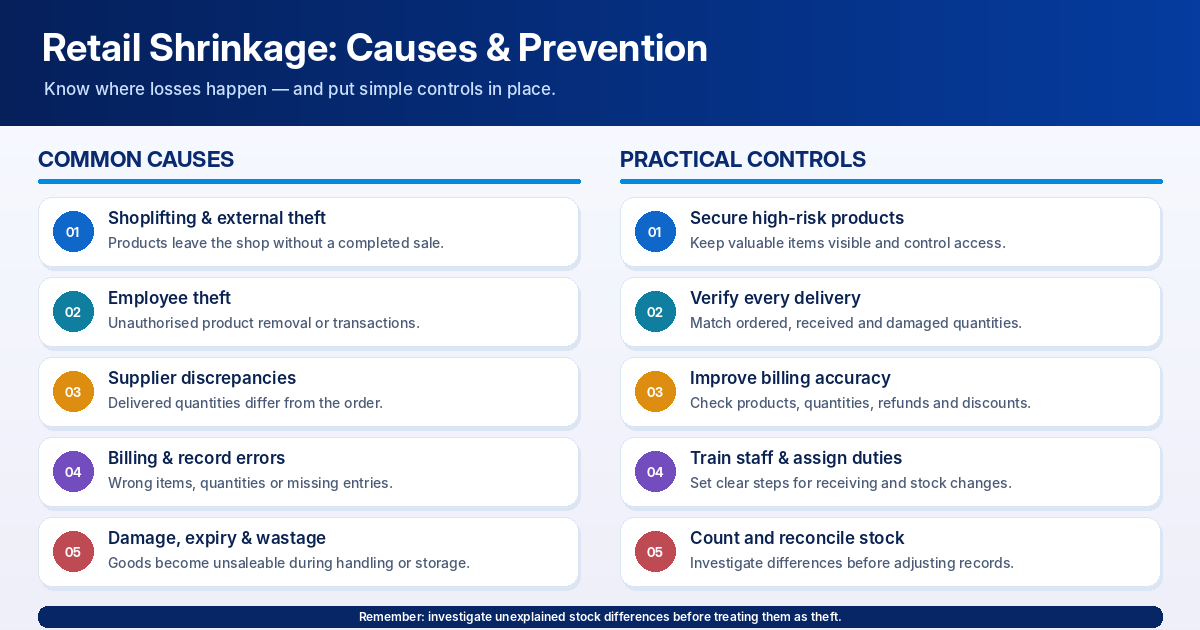
2. Understand the Common Causes of Retail Shrinkage
Before preventing stock loss, you need to understand how it happens in your shop.
A. Shoplifting and external theft
Shoplifting happens when someone takes products from a store without paying for them.
It may be more difficult to identify in shops that have crowded shelves, limited staff visibility or busy billing counters.
Small products, expensive accessories, cosmetics, packaged goods and easily carried items may require additional attention depending on the shop's product range.
B. Employee theft
Products or money may also be lost through unauthorised employee activity.
Examples include:
- Taking products without recording them.
- Giving products to someone without an approved bill.
- Processing unauthorised discounts or refunds.
- Removing products from stock without documentation.
- Misusing cash collected from customers.
However, an inventory mismatch alone does not prove employee theft. Billing mistakes, receiving errors and unrecorded stock movements can create similar differences.
Use consistent controls and investigate discrepancies fairly before reaching conclusions.
C. Supplier delivery discrepancies
Sometimes the quantity delivered by a supplier does not match the purchase order or invoice.
For example:
You order 50 units of a product, but the supplier delivers only 47 units. If your employee records all 50 units as received, your inventory will show three more units than the shop actually possesses.
These differences can accumulate when deliveries are not checked properly.
D. Billing and administrative mistakes
A product may physically leave the shop without the correct inventory entry.
For example:
- An employee selects the wrong product while preparing a bill.
- The quantity entered is incorrect.
- A product is sold without being billed.
- A customer return is not recorded.
- A damaged item is removed without updating inventory.
These mistakes can create differences between physical stock and system records.
E. Product damage, expiry and wastage
Products may become unsaleable during transportation, storage, display or everyday handling.
Examples include:
- Broken glass bottles.
- Torn food packaging.
- Leaking containers.
- Damaged clothing.
- Expired packaged products.
- Electronics damaged by improper storage.
Even when products are not stolen, their value can be lost if they are damaged and not handled or recorded correctly.
3. Prevent Stock Loss During Supplier Deliveries
Receiving inventory is one of the most important control points in retail operations.
A mistake at the receiving stage can affect your stock records from the beginning.
Follow a consistent process whenever a supplier delivers products.
Step 1: Compare the delivery with the purchase order
Check the products and quantities against the original purchase order.
Confirm:
- Product names and variants.
- Ordered quantities.
- Delivered quantities.
- Product prices, where relevant.
- Packaging and visible product condition.
For example, if you ordered 30 boxes of biscuits but received 28, record the actual quantity received.
Step 2: Inspect the product condition
Check for:
- Broken or damaged packaging.
- Leakage or signs of tampering.
- Missing pieces or incomplete cartons.
- Incorrect product variants.
- Expired or unsuitable products.
- Differences in batch or product details, where applicable.
Step 3: Document discrepancies
Take photographs where useful and record shortages, damage or incorrect deliveries.
Inform the supplier and request the appropriate correction, replacement or credit adjustment.
Do not update your inventory as though all ordered products were received when they were not.
Step 4: Update stock after verification
Enter the quantity actually accepted into your inventory records.
For a more detailed process, read our guide on How to Manage Supplier Purchases and Purchase Orders in a Retail Shop.
A proper receiving process helps prevent incorrect stock entries and supplier-related losses.
4. Improve Billing Accuracy to Reduce Inventory Errors
Billing mistakes can create stock discrepancies even when there is no physical theft.
For example, a customer purchases three units of a product, but the employee accidentally enters two units in the billing system.
The shop physically loses three units, while the inventory system deducts only two.
Over time, similar mistakes can make stock records unreliable.
Introduce simple billing controls
Train employees to:
- Select the correct product and variant.
- Verify quantities before completing a bill.
- Check prices before confirming transactions.
- Record cancellations and refunds correctly.
- Avoid creating bills under the wrong product name.
- Follow the approved procedure for discounts.
Restrict unnecessary billing permissions
Employees should only receive the permissions needed for their responsibilities.
For example, a cashier may need permission to create sales bills, while refunds, voids, large discounts or stock adjustments may require approval from the owner or manager.
Review unusual transactions regularly rather than waiting until stock differences become significant.
Verify digital payments
When customers pay through UPI or another digital method, verify the transaction using the shop's payment application, merchant notification or relevant bank record.
Do not treat a customer's payment screenshot alone as confirmation that money has reached your account.
For more information about maintaining consistent daily records, read our Daily Retail Shop Checklist: Opening, During Business & Closing.
5. Organise Your Shop Layout and Improve Security
A shop's physical arrangement can make it easier or harder to monitor products.
You do not necessarily need expensive security equipment. Basic improvements to visibility and product placement can make a difference.
Keep important products within visible areas
Place valuable or easily carried products where employees can monitor them.
For example:
- Keep expensive mobile accessories near the billing counter.
- Place small high-value products in visible display units.
- Avoid hiding frequently handled products behind large displays.
- Arrange shelves so that important sections can be observed more easily.
Keep storage areas organised
Restrict access to stockrooms and storage areas to authorised employees.
Avoid leaving valuable products in unsecured areas or mixing received goods with verified inventory.
Use suitable security equipment
Depending on the size and requirements of your shop, consider:
- CCTV cameras.
- Secure storage cabinets.
- Suitable display locks.
- Door and entry monitoring systems.
- Alarm systems where appropriate.
Cameras should be installed responsibly, with access to recordings restricted to authorised people. Follow applicable privacy, workplace and local legal requirements, and avoid recording private areas.
Maintain a visible billing counter
A well-organised billing counter makes it easier to monitor sales transactions, payment collection and products leaving the shop.
Security improvements should support normal customer service rather than make customers uncomfortable.
6. Train Employees and Establish Clear Responsibilities
Employees play an important role in preventing retail shrinkage.
Even a small shop should have clear procedures for receiving goods, preparing bills, handling returns and reporting damaged products.
Explain stock-handling responsibilities
Every employee should understand:
- Who is allowed to receive supplier deliveries.
- Who verifies product quantities.
- Who updates inventory records.
- Who can approve refunds or discounts.
- Who can authorise stock adjustments.
- How to report missing or damaged products.
When responsibilities are unclear, employees may assume someone else has completed an important task.
Avoid unnecessary access to sensitive operations
Where practical, separate important responsibilities.
For example, the person who receives a supplier delivery should not automatically approve every stock adjustment related to that delivery.
In a very small shop, one person may need to perform multiple activities. In that case, the owner can review important transactions and supporting documents.
Create a simple reporting process
Encourage employees to report:
- Missing products.
- Damaged inventory.
- Incorrect deliveries.
- Billing mistakes.
- Suspicious transactions.
- Unusual stock differences.
The objective is to identify problems early and correct the process, not simply blame employees for every discrepancy.
7. Prevent Product Damage, Expiry and Unnecessary Wastage
Not all inventory losses happen because products are stolen or missing.
Poor storage and handling can also reduce the value of your stock.
Store products correctly
Follow product-specific storage requirements.
For example:
- Keep packaged food in suitable storage conditions.
- Protect electronics from moisture and physical damage.
- Store glass bottles carefully.
- Keep clothing dry and organised.
- Protect sensitive products from excessive heat or direct sunlight where required.
Inspect products regularly
Check shelves and storage areas for damaged packaging, leakage, broken items and unsuitable products.
Remove products that cannot be sold safely or legally through your normal sales process and record the appropriate stock adjustment.
Monitor expiry dates
For products with expiry dates, use a consistent process to identify approaching expiry and arrange products appropriately.
The First Expiry, First Out (FEFO) approach helps retailers prioritise products with earlier expiry dates.
Read our detailed guide on How to Manage Expiry Dates and Batch Numbers in a Retail Shop.
Preventing avoidable damage and expiry-related losses is especially important for grocery stores, pharmacies and other businesses handling date-sensitive products.
8. Manage Customer Returns and Refunds Carefully
Returns and refunds are normal parts of retail operations, but they must be recorded accurately.
A returned product may be:
- Suitable for resale.
- Damaged and unsuitable for resale.
- Incomplete or missing accessories.
- Incorrectly supplied.
- Returned to the supplier.
If a customer returns a product and the refund is processed without updating the inventory correctly, the records may no longer match the physical quantity.
Follow a return verification process
Before completing a return:
- Check the original purchase or transaction details.
- Verify the product and quantity being returned.
- Inspect the product condition.
- Decide whether it can be returned to saleable inventory.
- Record the refund or exchange correctly.
- Update stock according to the product's actual condition.
Do not automatically add every returned product back to available stock.
For a complete explanation of return procedures, read How to Manage Customer Returns and Exchanges in a Retail Shop.
9. Conduct Regular Physical Stock Verification
One of the best ways to identify inventory differences is to compare your actual stock with your inventory records.
Suppose your system shows that 200 units of a product should be available, but a physical count finds only 192.
There is a difference of eight units.
Rather than immediately changing the system quantity, investigate the reason.
Follow a consistent stock-counting process
- Select the products or sections to count.
- Temporarily control stock movements during the count.
- Count products physically.
- Compare the actual quantity with the recorded quantity.
- Recount important or unusual differences.
- Check recent bills, purchase entries and returns.
- Review damaged-stock records and transfers.
- Document the reason for the discrepancy.
- Approve and record the necessary adjustment.
For more guidance, read our article on How to Do Physical Stock Verification in a Retail Shop.
Investigate repeated differences
If the same product repeatedly shows shortages, investigate its process.
Possible reasons include:
- Incorrect billing.
- Supplier delivery differences.
- Poor storage arrangements.
- Unrecorded damage.
- Inadequate employee training.
- Unauthorised stock movement.
Correcting the underlying cause is more effective than repeatedly changing the recorded stock quantity.
10. How to Calculate Retail Shrinkage
Retailers can use a simple formula to estimate inventory shrinkage.
Shrinkage Value = Recorded Inventory Value − Actual Inventory Value
For meaningful comparisons, use the same valuation basis for both figures, such as inventory cost value. Do not compare the recorded value at purchase cost with the physical value at selling price.
To calculate the shrinkage percentage:
Retail Shrinkage Rate = (Shrinkage Value ÷ Adjusted Recorded Inventory Value) × 100
Practical example
Suppose a retail shop has the following inventory details at purchase cost:
| Particulars | Amount |
|---|---|
| Recorded inventory value | ₹2,00,000 |
| Documented damaged stock not yet adjusted | ₹800 |
| Other documented stock adjustment not yet recorded | ₹200 |
| Adjusted recorded inventory value | ₹1,99,000 |
| Actual physical inventory value | ₹1,96,000 |
| Unexplained inventory difference | ₹3,000 |
Now calculate the shrinkage rate:
Shrinkage Value = ₹1,99,000 − ₹1,96,000
Shrinkage Value = ₹3,000
Shrinkage Rate = (₹3,000 ÷ ₹1,99,000) × 100
Shrinkage Rate ≈ 1.51%
This means the unexplained inventory difference is approximately 1.51% of the adjusted recorded inventory value.
Remember that this is an investigation starting point, not proof of theft. Review the relevant records and correct any remaining documented errors before classifying the difference as unexplained shrinkage.
Track the rate over time using consistent valuation and counting methods. The trend can help you identify whether your loss-prevention measures are improving.
11. How Inventory Software Helps Prevent Retail Shrinkage
Managing stock manually becomes challenging when a shop handles hundreds or thousands of products.
A notebook may be sufficient for a very small shop, but multiple employees, frequent purchases, returns and daily transactions can make recordkeeping more difficult.
Retail billing and inventory software can help organise important business information.
Depending on its available features, retailers can use it to:
- Maintain product and category records.
- Record purchases and received quantities.
- Track sales and inventory movements.
- Record returns and stock adjustments.
- Review product-level sales information.
- Identify differences between recorded and physical quantities during stock verification.
- Maintain more consistent transaction records.
However, software cannot prevent every form of theft or guarantee that inventory records are correct. Employees still need to follow the right procedures, and physical verification remains important.
RetailManager, developed by CraftX Design Labs, helps small retailers manage billing, products, sales and inventory operations. Organised sales and product records can provide a useful foundation for monitoring stock movements and identifying discrepancies.
Explore RetailManager by CraftX Design Labs to learn more.
12. A Practical 30-Day Retail Shrinkage Prevention Plan
You do not have to introduce every security measure at once. Start with a few manageable improvements and review their effectiveness.
| Period | Activities | Expected outcome |
|---|---|---|
| Days 1–7 | Review inventory records, identify important products and check common stock discrepancies | Understand existing loss risks |
| Days 8–14 | Improve supplier receiving, delivery verification and stock-entry procedures | Reduce receiving errors |
| Days 15–20 | Review billing permissions, employee responsibilities and return procedures | Improve transaction controls |
| Days 21–25 | Organise product displays, storage areas and damage reporting | Reduce preventable physical losses |
| Days 26–30 | Conduct physical verification and review inventory differences | Identify recurring problems and corrective actions |
At the end of 30 days, review:
- Which products showed the biggest differences?
- Were the losses caused by theft, damage or recording errors?
- Were supplier deliveries checked properly?
- Were billing and refund procedures followed?
- Did employees understand their responsibilities?
- Have the same problems occurred again?
Continue reviewing these areas every month.
Small improvements made consistently can help reduce unnecessary inventory losses.
Conclusion
Retail shrinkage is a challenge that can affect shops of every size. Products may go missing because of theft, delivery discrepancies, billing mistakes, damage or incorrect inventory entries.
The best way to control these losses is to understand where they occur and establish simple procedures to prevent them.
Start by checking supplier deliveries, improving billing accuracy, organising storage areas, training employees and conducting regular physical stock verification. Record damaged products and returns correctly, and investigate unexplained stock differences instead of adjusting quantities without a reason.
You do not need an expensive security system to begin improving inventory control. Consistent records, clear responsibilities and regular reviews can make a meaningful difference.
By identifying the causes of stock loss and addressing them early, you can protect your investment, improve inventory accuracy and run a more reliable retail business.
Frequently Asked Questions (FAQs)
1. What is retail shrinkage?
Retail shrinkage is the difference between the inventory quantity or value recorded in a shop's records and the inventory actually available. It can result from theft, supplier discrepancies, billing errors, product damage and other operational mistakes.
2. What are the main causes of retail shrinkage?
Common causes include shoplifting, employee theft, supplier delivery shortages, incorrect billing, unrecorded stock movements, product damage, expiry and administrative errors.
3. How can a small retail shop prevent stock theft?
Keep valuable products in visible or secured areas, organise the shop layout, restrict access to storage areas, maintain accurate billing records, train employees and review unusual stock discrepancies regularly.
4. How often should a retail shop conduct physical stock verification?
It depends on the shop's size, product category and risk level. Fast-moving or high-value products may need more frequent checks, while a broader inventory count can be scheduled weekly, monthly or at another suitable interval.
5. Is retail shrinkage the same as dead stock?
No. Retail shrinkage refers to missing or lost inventory compared with recorded stock. Dead stock refers to products that remain unsold or move very slowly. Dead stock may still physically exist in the shop, while shrinkage represents an inventory discrepancy or loss.
6. How do I calculate retail shrinkage?
Subtract actual inventory value from adjusted recorded inventory value to calculate the shrinkage value. Divide that difference by adjusted recorded inventory value and multiply by 100 to calculate the shrinkage percentage. Use the same valuation basis for both figures.
7. Can billing software prevent inventory shrinkage?
Billing and inventory software can improve recordkeeping by connecting recorded sales with stock movements and maintaining purchase, return and adjustment records where those features are supported. However, it cannot independently prevent all theft or operational mistakes. Physical checks and employee procedures are still necessary.
8. What should I do when the physical stock does not match the system?
Recount the products, check recent purchases and sales, review customer returns, supplier deliveries, damaged items and stock transfers, and investigate the difference. Record an adjustment only after the discrepancy has been reviewed and its reason documented.
- #Retail Shrinkage
- #Inventory Loss Prevention
- #Retail Theft Prevention
- #Stock Management
- #Retail Inventory Management
- #Small Retail Business
- #Retail Operations
- #Inventory Control