People & Operations
How to Manage Retail Staff in a Small Shop: Roles, Training & Daily Tasks
Practical tips for managing retail staff, assigning roles, training employees, planning shifts, and running a smoother small shop.
How to Manage Retail Staff in a Small Shop: Roles, Training & Daily Tasks
Learning how to manage retail staff is an important part of running a successful shop. Employees interact with customers, handle billing, arrange products, manage stock, and support daily operations. When responsibilities are unclear or employees are not properly trained, even simple tasks can lead to mistakes and delays.
Whether you operate a kirana store, pharmacy, hardware shop, clothing store, fertilizer business, or mobile accessories shop, you need a team that understands its responsibilities and follows consistent procedures.
You do not need a large management team or complicated HR system to organise a small shop. Clear job responsibilities, practical training, fair scheduling, and regular communication can make everyday operations easier.
In this guide, we will explain how to manage retail staff, assign responsibilities, train employees, organise shifts, and build a more reliable team.
1. Define Clear Roles and Responsibilities
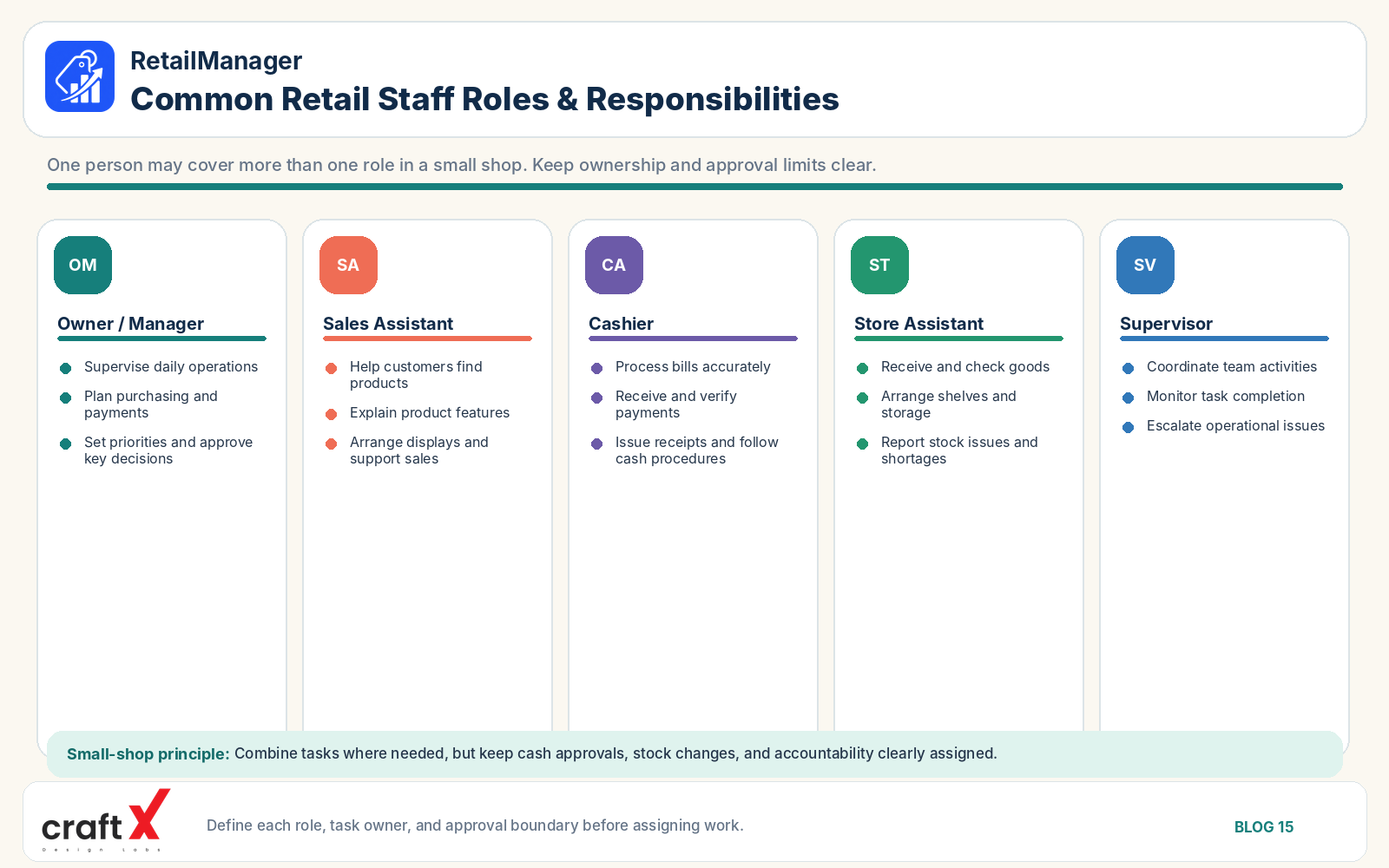
The first step in retail staff management is making sure every employee understands what they are responsible for.
In a small shop, one employee may handle several tasks. That is perfectly normal, but employees should still know which responsibilities belong to them and which tasks require approval from the owner or manager.
Here are some common retail roles:
| Role | Main responsibilities |
|---|---|
| Owner or manager | Supervise operations, purchasing, payments, staff, and business decisions |
| Sales assistant | Help customers, explain products, arrange displays, and support sales |
| Cashier | Process bills, receive payments, issue receipts, and follow billing procedures |
| Store assistant | Receive goods, arrange shelves, organise storage, and support stock checks |
| Supervisor | Coordinate employees, monitor daily tasks, and report operational issues |
These roles do not require separate employees in every small shop. One person may act as both cashier and sales assistant, while the owner supervises purchasing and payments.
The important thing is to avoid confusion about responsibility.
For example, if an employee notices that a product is running low, should they simply inform the owner or can they prepare a purchase request? Make that expectation clear.
Write down the main responsibilities for each employee and explain the limits of their authority.
2. Hire Employees Based on Your Shop's Needs
Before hiring someone, identify which part of your shop needs support.
A business that receives many customers during evening hours may need additional billing or sales assistance. A shop with frequent deliveries may need help with receiving goods, arranging products, and maintaining stock records.
Consider these points when hiring:
Relevant experience: Previous experience in retail, billing, customer service, or handling similar products may be useful.
Communication: Employees should be able to understand customers' requirements and explain product information clearly.
Basic numeracy: Billing, quantities, discounts, and payment handling require accuracy with numbers.
Reliability: Attendance, punctuality, and responsible handling of shop property are important for daily operations.
Willingness to learn: Product ranges, billing procedures, and store policies can be taught through practical training.
Teamwork: Employees should be able to coordinate with colleagues during busy periods and shift changes.
Create a simple job description before advertising the position. Mention the responsibilities, working schedule, expected skills, and reporting structure.
Avoid hiring based only on the assumption that someone already knows everything about retail. A new employee may have good communication skills but still need training in your product range and billing process.
3. Train New Employees Before Giving Them Full Responsibility
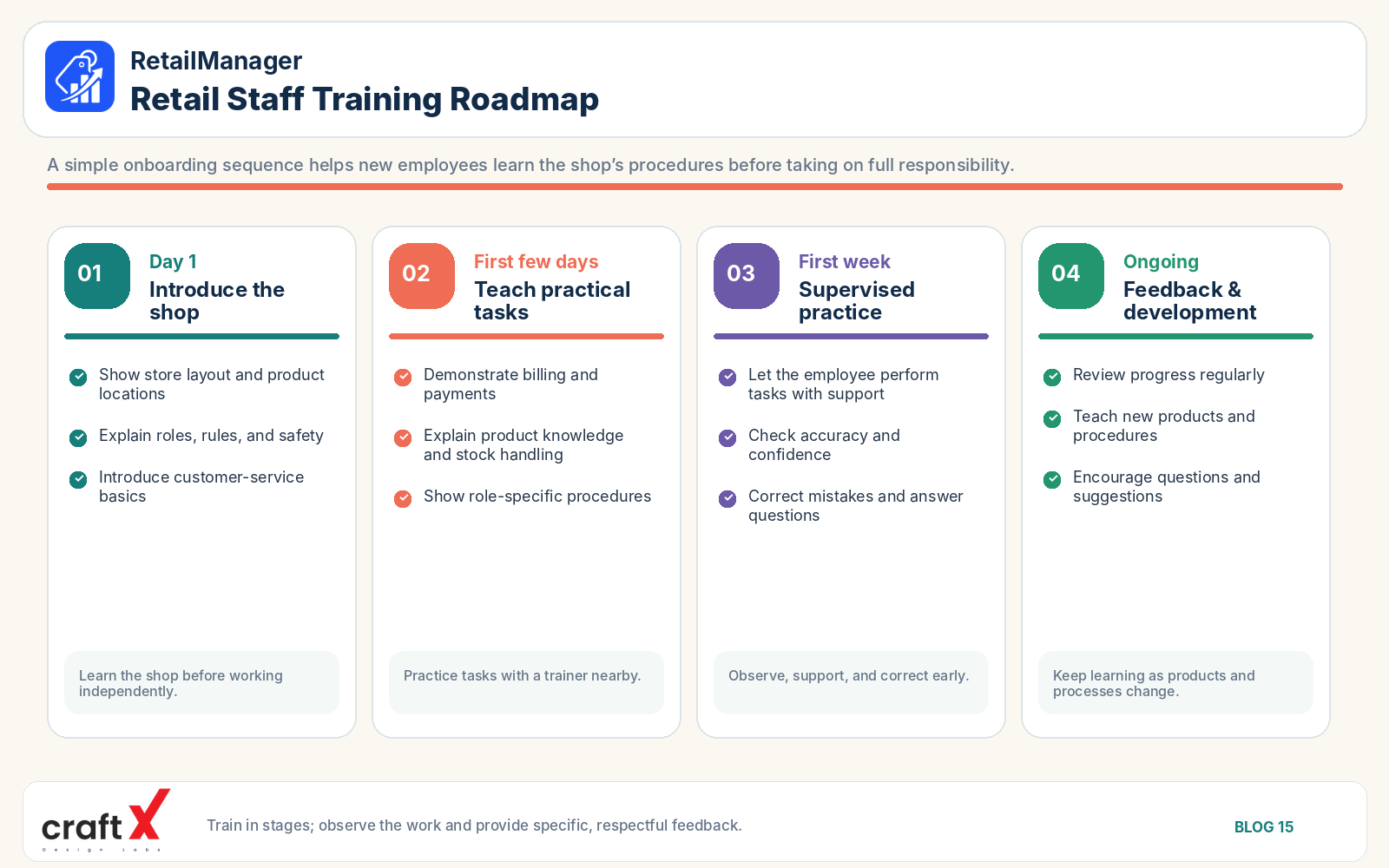
One of the common mistakes in small shops is expecting new employees to learn everything simply by watching others.
A short but structured training process helps employees understand how your business operates and reduces avoidable mistakes.
Day 1: Introduce the shop and its procedures
Show the employee:
- Where products and storage areas are located
- How the shop is organised
- Who is responsible for different tasks
- How to greet and assist customers
- Basic safety and cleanliness procedures
- What to do when they need help
First few days: Teach practical tasks
Train the employee on responsibilities relevant to their role.
For example, a cashier may need to learn product selection, billing, payment confirmation, receipts, and transaction corrections.
A sales assistant may need to understand product categories, prices, common customer questions, and how to check product availability.
A store assistant may need training in receiving deliveries, checking quantities, organising shelves, and reporting damaged goods.
First week: Observe and provide feedback
Allow the employee to perform tasks under supervision.
Check whether they can:
- Complete assigned tasks correctly
- Follow the shop's procedures
- Use billing equipment where required
- Communicate with customers appropriately
- Identify when a decision requires approval
- Ask for assistance when something is unclear
Do not give full responsibility for sensitive activities before the employee understands the required procedures.
Training should continue after the first week. New products, offers, systems, and business processes may require additional guidance.
Use structured retail training resources
India's Retailers Association's Skill Council of India (RASCI) publishes occupational standards and qualification information for retail roles, including Retail Cashier, Retail Sales Assistant, and Retail Team Leader.
Shop owners can refer to its official retail operations qualifications to understand the types of skills associated with different retail positions. These resources can support training plans; they are not a compulsory certification requirement for every shop.
4. Create a Fair and Practical Staff Schedule
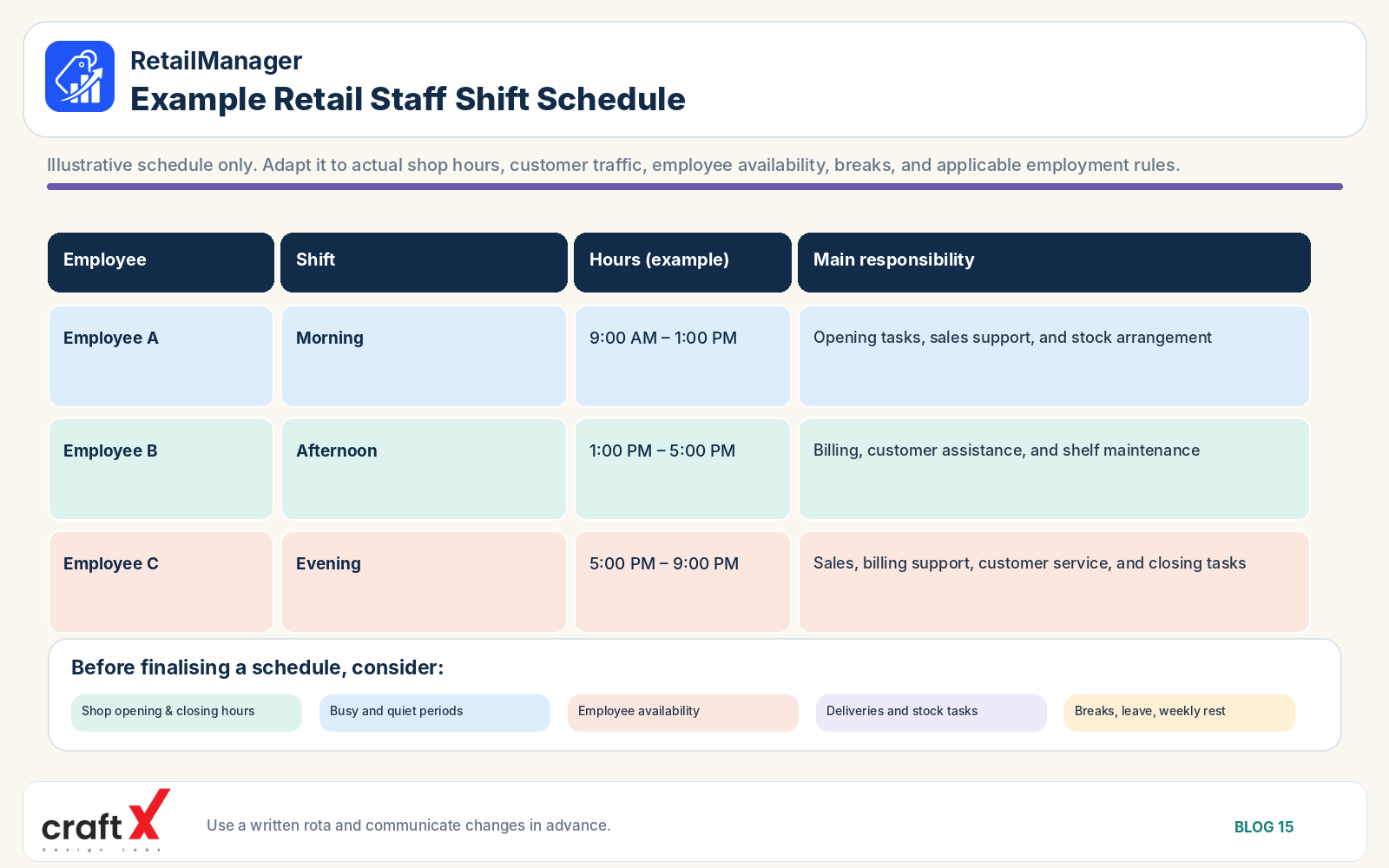
A staff schedule helps ensure that the right people are available when the shop needs them.
You do not necessarily need the same number of employees throughout the day. Customer traffic may change depending on the location, product category, weekday, weekend, or festival season.
Before preparing a schedule, review:
- The shop's opening and closing hours
- Busy and quiet periods
- Expected customer traffic
- Employee availability
- Delivery and stock-handling requirements
- Breaks, weekly rest, and leave arrangements
For example, a grocery shop may experience more customers during morning and evening hours, while a clothing shop may be busier during weekends or festive periods.
A simple schedule might look like this:
| Employee | Shift | Main responsibility |
|---|---|---|
| Employee A | Morning | Opening, sales, and stock arrangement |
| Employee B | Afternoon | Billing and customer assistance |
| Employee C | Evening | Sales, billing support, and closing tasks |
This is only an illustrative arrangement. Actual working hours and staffing levels should suit your business and applicable employment requirements.
Maintain attendance and leave records, communicate schedule changes in advance, and avoid making last-minute changes without a clear reason.
Follow the working-hour, wage, leave, weekly-rest, and other employment rules applicable to your location and type of establishment. Check the relevant state requirements or consult a qualified professional when necessary.
5. Establish Simple Procedures for Everyday Tasks
Employees perform better when they know how a task should be completed.
Create simple written procedures for important activities instead of explaining the same instructions differently to every employee.
Useful procedures may cover:
Opening responsibilities: Who prepares the shop, checks equipment, arranges products, and confirms billing readiness?
Billing: How should employees select products, verify prices, receive payments, and issue receipts?
Stock receiving: Who counts incoming goods, checks damage, and updates records?
Customer complaints: Which problems can employees resolve directly, and which must be referred to the manager?
Returns and exchanges: How should staff verify purchases, inspect products, and obtain approval?
Closing responsibilities: Who reviews transactions, reconciles assigned records, and secures the premises?
Make the procedures short and easy to follow. A one-page instruction sheet may be more useful than a lengthy manual that nobody reads.
For a practical store routine, refer to our daily retail shop checklist.
6. Set Clear Rules for Billing and Cash Handling
Billing and payment handling require accuracy and clear responsibility.
Even in a small shop, decide who can access the billing system, who can approve discounts, and who is responsible for checking cash and payment records.
Consider these practices:
- Give employees individual logins where the billing system supports them.
- Avoid sharing passwords or sensitive account details.
- Explain how to verify cash, UPI, card, and other payment methods.
- Set clear approval limits for discounts and price changes.
- Require approval for unusual refunds or transaction corrections.
- Record cash shortages, excess amounts, and discrepancies promptly.
- Review transaction records regularly.
For example, a cashier may be authorised to complete routine sales, but a large discount or an unusual refund may require manager approval.
The aim is not to make employees feel that they are constantly being monitored. It is to establish a consistent process that protects both the business and the employee.
If your current billing procedure is difficult to manage, read our guide on how to choose billing software for small shops in India.
7. Assign Stock Responsibilities Clearly
Inventory management should not depend entirely on the owner's memory.
Employees who handle products should understand how to arrange stock, report shortages, inspect deliveries, and identify damaged goods.
Depending on your shop's workflow, assign responsibility for:
- Checking products received from suppliers
- Counting quantities before accepting deliveries
- Arranging new stock in the correct locations
- Keeping shelves and storage areas organised
- Reporting products that are running low
- Separating damaged or expired goods
- Recording stock adjustments through the approved process
For example, if a shop receives 40 units of a product, the employee responsible for receiving goods should verify the quantity and report any difference before the stock is recorded as received.
Do not allow every employee to make unrecorded stock adjustments. Important changes should follow a clear approval and record-keeping process.
Review responsibilities whenever products, staff, or shop operations change.
For more guidance, see how to prevent stockouts in a retail shop.
8. Teach Employees to Deliver Consistent Customer Service
Employees are often the first people customers interact with when entering a shop.
The way they communicate can influence whether customers feel comfortable asking questions, comparing products, and returning in the future.
Train staff to:
- Greet customers politely.
- Listen before recommending a product.
- Explain prices, features, and product differences accurately.
- Avoid making promises they cannot fulfil.
- Check availability before confirming an order.
- Handle complaints calmly.
- Refer complicated issues to the person responsible.
Product knowledge is especially important.
An employee in a mobile accessories shop should understand basic compatibility between products and devices. A hardware shop assistant should be familiar with the common applications of the products they sell.
Employees should also understand the shop's return policy and know when to request approval.
Encourage helpful recommendations rather than pressuring customers to buy additional products.
Good customer service is a team responsibility, and consistent training can make the shopping experience more reliable.
For more practical ideas, read how to increase sales in a small retail shop.
9. Monitor Performance Without Creating Unnecessary Pressure
Employees need to understand how their work is evaluated.
Instead of judging performance only by total sales, consider the responsibilities of each employee and the quality of their work.
You can review measures such as:
Attendance and punctuality: Does the employee follow the agreed schedule and communicate absences appropriately?
Billing accuracy: Are transactions recorded correctly, with fewer avoidable corrections?
Customer service: Do employees communicate politely and handle routine questions effectively?
Task completion: Are assigned opening, shelf arrangement, and closing responsibilities completed?
Stock handling: Are deliveries checked and discrepancies reported correctly?
Teamwork: Does the employee coordinate with colleagues and support the shop during busy periods?
If you use sales targets, consider the employee's role, working hours, product availability, and customer traffic. A cashier and a sales assistant should not necessarily be evaluated using identical measures.
Give feedback regularly
Do not wait until a serious mistake occurs before speaking with an employee.
A short weekly conversation can help identify:
- Tasks the employee finds difficult
- Training that may be required
- Repeated process problems
- Customer feedback
- Suggestions for improving shop operations
Recognise good work and explain improvements clearly. Feedback should be specific, fair, and focused on helping employees perform better.
10. Keep Employees Motivated and Build Trust
A good working environment can help employees stay engaged and take greater responsibility.
Small businesses may not always have large budgets for employee benefits, but they can still create a respectful workplace.
Consider these practices:
- Explain responsibilities and expectations clearly.
- Provide training when new tasks are assigned.
- Pay employees accurately and on time.
- Communicate schedules and changes fairly.
- Listen to employee concerns and suggestions.
- Recognise reliable work and improvement.
- Avoid unnecessary public criticism.
- Give employees opportunities to learn additional responsibilities.
When employees understand how their work contributes to the shop, they are more likely to take ownership of their tasks.
You should also make it easy for employees to report mistakes or problems. Hiding a stock discrepancy or billing error can create a larger issue later.
Encourage staff to report problems early so they can be investigated and corrected.
11. Conduct a Short Daily Briefing and Shift Handover
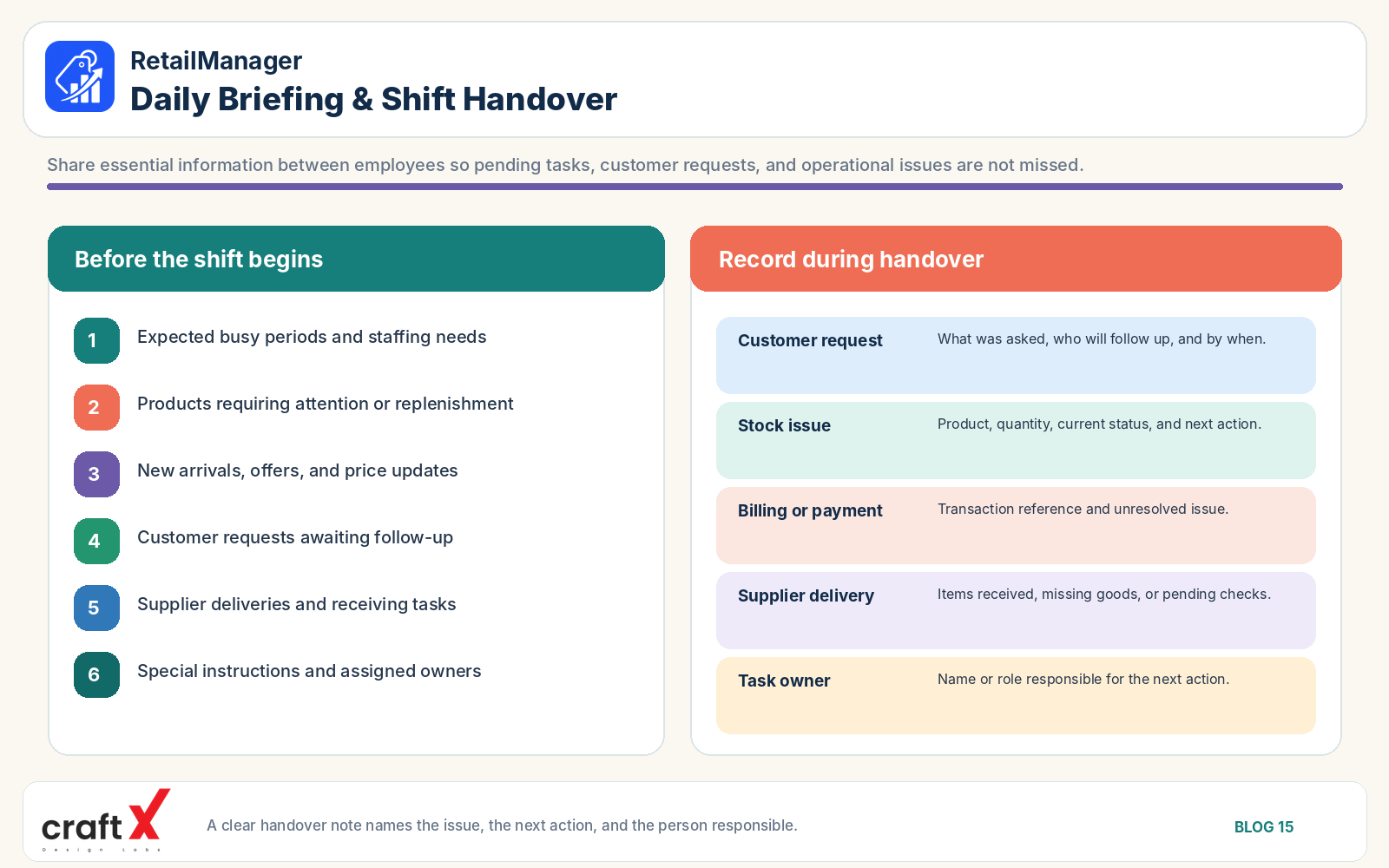
When more than one employee works in your shop, communication between shifts becomes important.
A short briefing before work begins can help everyone understand the day's priorities.
Discuss:
- Expected busy periods
- Products requiring attention
- New arrivals and promotions
- Customer requests awaiting follow-up
- Pending supplier deliveries
- Special instructions or changes
- Responsibilities assigned to each employee
During shift changes, record important information rather than depending only on verbal communication.
For example, the outgoing cashier may need to inform the incoming employee about a pending payment issue, while the store assistant may report a delivery that still requires verification.
A simple handover note can include:
| Item | Details |
|---|---|
| Pending customer request | Product name and follow-up required |
| Stock issue | Product and quantity |
| Billing issue | Transaction reference and status |
| Supplier delivery | Items still pending |
| Other instructions | Task owner and expected action |
This reduces the chance of important information being forgotten between shifts.
12. Use Digital Tools When Manual Staff Coordination Becomes Difficult
A notebook and simple task list may be enough when your shop has one or two employees.
As the team grows, it can become harder to maintain attendance records, communicate responsibilities, review transactions, and coordinate daily tasks manually.
Depending on your requirements, digital tools may help you:
- Record employee attendance
- Maintain staff information
- Assign user access to business systems
- Review sales and billing records
- Monitor product and stock information
- Coordinate tasks and shift handovers
Not every billing or retail-management application includes all these functions. Before adopting a tool, confirm whether it supports the staff-management workflow your business actually needs.
RetailManager is an option you can evaluate for your shop's operational and record-keeping requirements. Review its current capabilities before relying on it for specific employee scheduling, attendance, or performance-management functions.
Frequently Asked Questions
How many employees does a small retail shop need?
There is no fixed number. Staffing depends on store size, customer traffic, operating hours, product range, and the amount of work involved. Start by identifying the tasks that must be covered and schedule employees according to demand.
How should I divide responsibilities in a small shop?
Assign clear responsibility for billing, customer assistance, stock handling, purchasing, and supervision. One employee can perform multiple roles, but approval responsibilities and important record-keeping tasks should remain clear.
How can I train a new retail employee?
Start with shop procedures, product locations, customer interaction, and safety. Then teach role-specific activities such as billing, receiving goods, or arranging stock. Allow supervised practice and provide regular feedback.
How can I reduce mistakes made by retail employees?
Use clear procedures, practical training, individual user accounts where available, approval limits, and regular record reviews. Investigate repeated mistakes to understand whether the cause is insufficient training, unclear instructions, or a process problem.
How can I motivate employees in a small shop?
Provide fair treatment, clear expectations, useful training, reliable schedules, timely payments, and recognition for good work. Listen to employee concerns and create an environment where problems can be reported early.
Conclusion
Learning how to manage retail staff is not about controlling every activity an employee performs. It is about creating clear responsibilities, providing practical training, communicating expectations, and building a team that understands how the shop should operate.
Start with simple job roles, train employees before assigning full responsibility, prepare practical schedules, and establish consistent procedures for billing, stock handling, and customer service.
Review performance fairly and encourage employees to share problems and suggestions. As your shop grows, introduce digital tools where they genuinely make staff coordination and record-keeping easier.
Whether you operate a kirana store, pharmacy, hardware shop, clothing business, fertilizer shop, or mobile accessories store, a well-organised team can help you run daily operations more consistently and provide a better experience for customers.
- #Retail Staff Management
- #Employee Training
- #Staff Scheduling
- #Shop Management
- #Retail Operations