Small Business & Retail Operations
How to Start a Retail Shop in India: A Step-by-Step Guide
A practical guide to starting a retail shop in India, covering business planning, budget, location, registrations, suppliers, inventory, and launch.

How to Start a Retail Shop in India: A Step-by-Step Guide
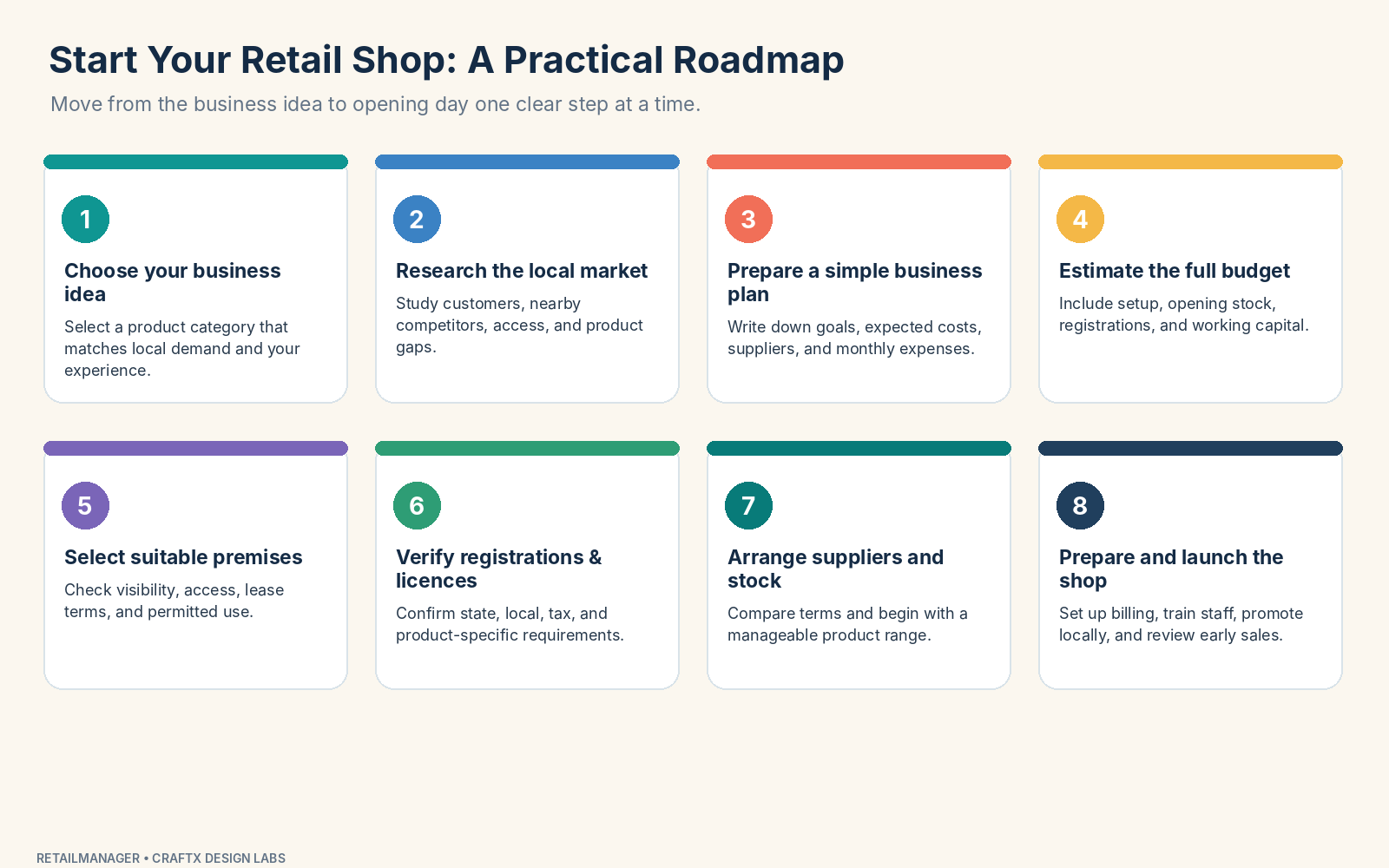
Starting a retail shop can be an exciting business opportunity, but success begins well before the first customer walks through the door. You need to decide what to sell, understand your local market, estimate the investment, choose a suitable location, arrange suppliers, and complete the registrations applicable to your business.
Whether you want to open a kirana store, pharmacy, hardware shop, clothing store, fertilizer business, stationery shop, or mobile accessories store, a little planning can help you avoid common mistakes during the early stages.
You do not need to build a large store immediately. You can start with a manageable product range, organise your basic business records, and expand as you understand customer demand.
In this guide, we will explain how to start a retail shop in India, from choosing your business idea and estimating costs to setting up the premises, arranging stock, and preparing for opening day.
1. Decide What Type of Retail Shop You Want to Open
Start by choosing the products you want to sell and the customers you want to serve.
Avoid selecting a business only because another shop owner appears successful. A product category that works well in one location may not perform equally well in another.
Consider these common retail business options:
| Retail business | Products commonly sold |
|---|---|
| Kirana or grocery shop | Groceries, packaged foods, beverages, and household essentials |
| Pharmacy | Medicines and permitted healthcare products |
| Hardware shop | Tools, plumbing, electrical products, and construction supplies |
| Clothing store | Apparel, footwear, and fashion accessories |
| Fertilizer and agricultural shop | Fertilizers, seeds, and other permitted agricultural inputs |
| Mobile accessories shop | Chargers, cables, cases, screen protectors, and accessories |
| Stationery shop | Books, notebooks, pens, office supplies, and school materials |
Each category has different requirements for purchasing, storage, product knowledge, customer service, and regulatory compliance.
Before making a decision, ask yourself:
- Do people in the area regularly need these products?
- Are there already similar shops nearby?
- What products are customers unable to find easily?
- Can you obtain reliable supplies at suitable prices?
- Do you understand the products well enough to answer customer questions?
- Are there licences or special conditions associated with the products?
Choose a category that matches local demand, your available investment, and your ability to manage the business.
2. Research Your Local Market Before Investing
Once you choose a product category, study the area where you plan to operate.
Do not judge a location only by the number of people walking past it. The important question is whether those people are likely to become your customers.
Visit potential locations at different times of the day. Observe customer movement, nearby businesses, parking, accessibility, and competing shops.
Look for:
Customer demand: Understand the people who live, work, or regularly travel through the area.
Competition: Visit nearby shops and compare their product ranges, prices, service, and customer traffic.
Product gaps: Identify products customers frequently request but cannot easily find locally.
Accessibility: Check whether customers can reach the shop conveniently by walking, two-wheelers, cars, or public transport.
Visibility: Consider whether the shop can be seen easily from the road and whether appropriate signage is possible.
Nearby businesses: Schools, offices, residential communities, hospitals, markets, and commercial areas can influence customer demand depending on your product category.
For example, a stationery shop near schools and coaching centres may have different demand patterns from a stationery business located in an office area.
Similarly, an agricultural supply shop may need to understand the requirements of farmers in its surrounding region rather than relying on general retail trends.
Prepare a simple comparison of two or three possible locations before deciding.
3. Prepare a Simple Retail Business Plan
You do not need a lengthy business document to start a small shop. However, you should have a written plan covering how the business will operate and where the money will come from.
Your basic plan should include:
- Type of shop and product categories
- Target customers
- Proposed location
- Expected business hours
- Competitor information
- Initial supplier list
- Estimated startup costs
- Expected monthly expenses
- Pricing approach
- Approximate sales expectations
- Available working capital
Think about how the shop will earn enough to cover recurring expenses.
For example, if your monthly costs include rent, salaries, utilities, transport, and other expenses, estimate how much gross profit the business needs to generate to cover them.
Avoid planning only around total sales. A shop can record good sales and still struggle if product costs, discounts, and operating expenses leave too little money.
Our guide on how to calculate daily sales and profit in a retail shop explains the difference between sales revenue, cost of goods sold, gross profit, and operating expenses.
4. Estimate the Cost of Starting Your Retail Shop
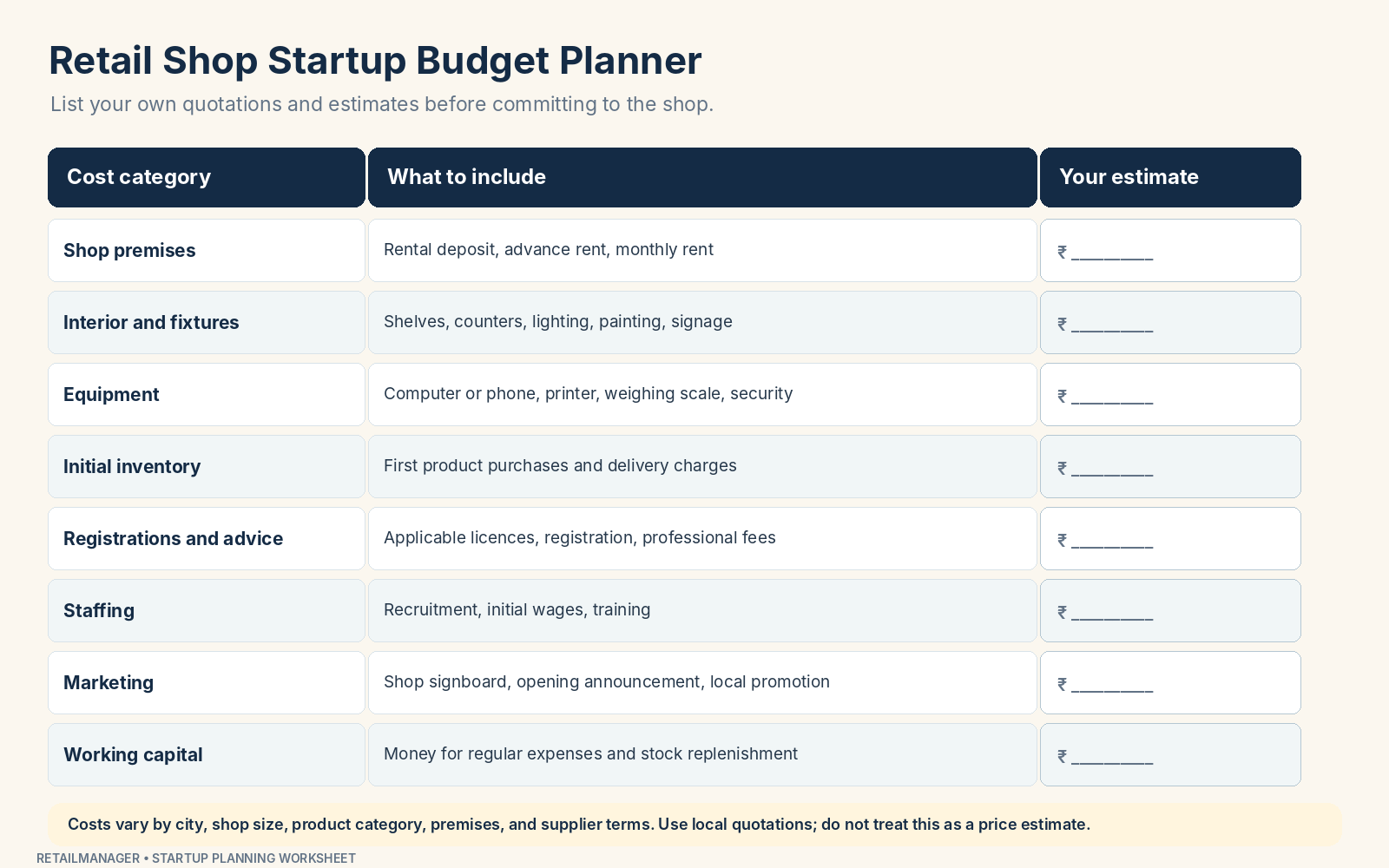
One of the most important parts of opening a business is knowing how much money you need before committing to a location or purchasing inventory.
Separate your expenses into setup costs, initial inventory, and ongoing operating expenses.
Common startup expenses
| Expense category | What to consider |
|---|---|
| Shop premises | Rental deposit, advance rent, and initial rent |
| Interior setup | Shelves, counters, lighting, painting, and signage |
| Equipment | Computer, phone, printer, weighing equipment, or other relevant tools |
| Initial inventory | First purchase of products from suppliers |
| Registrations | Applicable licence, registration, and professional fees |
| Billing setup | Billing software, printer, payment devices, and accessories |
| Staffing | Recruitment, initial wages, and training |
| Marketing | Shop opening announcement, banners, and local promotions |
| Working capital | Cash available for regular expenses and replenishment |
These costs can vary significantly depending on your city, shop size, product category, and business model.
Do not spend your entire budget on interior decoration or opening stock. Keep sufficient money available for rent, supplier payments, utilities, wages, and unexpected expenses during the initial period.
Separate one-time costs from recurring costs
A shop's initial setup expenses are different from its monthly operating requirements.
For example:
One-time or occasional costs: Shelving, counters, initial equipment, signage, and eligible setup work.
Recurring costs: Rent, electricity, salaries, transport, internet, maintenance, and inventory purchases.
Preparing this separation helps you understand how much money is required to open the shop and how much must remain available to keep it running.
5. Choose the Right Shop Location and Verify the Premises
After estimating your budget, shortlist suitable premises.
Before signing a rental agreement or making an advance payment, check more than the monthly rent.
Review:
- Whether the premises can legally be used for your intended commercial activity
- Ownership, lease, and landlord authorisation
- Rental deposit and payment terms
- Lease duration and renewal conditions
- Electricity and water availability
- Storage and delivery access
- Parking and customer access
- Signboard and display permissions
- Maintenance charges and other building expenses
- Safety and accessibility requirements
Confirm whether any local permissions, zoning conditions, building-use requirements, or municipal approvals apply to your planned business.
A low-rent location may become expensive if customers cannot find the shop, deliveries are difficult, or the premises are unsuitable for the products you sell.
For businesses handling food, medicines, chemicals, or other regulated goods, check whether the premises meet the additional storage, safety, and operational requirements applicable to those products.
6. Decide Your Business Structure and Complete the Required Registrations
Before starting operations, decide how the business will be legally organised.
Common business structures include:
Sole proprietorship: The business is operated by an individual owner. It is commonly considered for small owner-managed businesses.
Partnership: Two or more people operate the business according to an agreed partnership arrangement.
Limited Liability Partnership (LLP): A separate legal structure that combines partnership-style management with limited liability provisions.
Private limited company: A separate incorporated business structure that may suit businesses with different ownership, investment, or expansion plans.
The appropriate structure depends on ownership, liability, funding, taxation, and compliance requirements. Discuss your circumstances with a qualified professional before deciding.
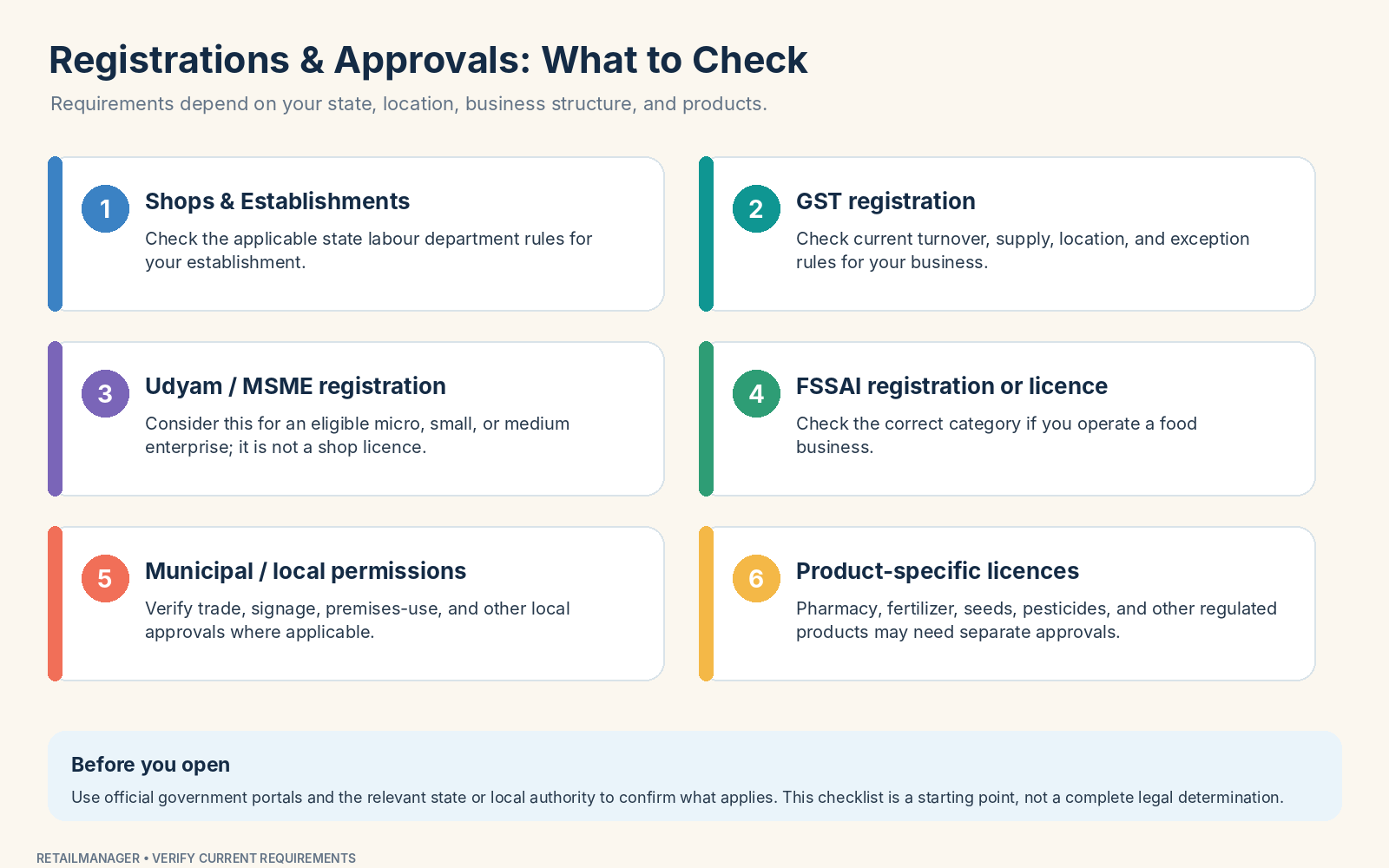
Check the registrations and approvals applicable to your shop
There is no single licence checklist that applies identically to every retail business in India.
Your requirements may depend on the state, city, premises, business structure, employee count, annual turnover, and type of products sold.
Consider the following areas.
Shops and Establishments registration: Check the applicable state labour department requirements for registration, intimation, working hours, employee records, and other establishment conditions.
Municipal or local permissions: Certain activities may require trade licences, signage permissions, or other local approvals from the municipal body or relevant authority.
GST registration: Determine whether your business is required to register under GST. Applicability depends on current law, turnover, the nature of supplies, location, and applicable exceptions. Do not rely on a single threshold figure copied from an old online article.
You can review the official CBIC GST registration rules and the GST registration application guide. Consult a tax professional to determine your specific liability.
Udyam registration: If your business qualifies as a micro, small, or medium enterprise, you can consider MSME registration through the official Udyam portal. The government portal states that registration is free and paperless. Udyam is a separate MSME registration and does not replace other operating licences.
Use the official Udyam Registration portal, not private websites that charge for the government registration process.
Food business registration or licence: If you sell food products as a food business operator, check the applicable FSSAI registration or licensing requirement. Use the official FoSCoS portal to check the current eligibility criteria and application process.
Category-specific approvals: Pharmacies, fertilizer and seed retailers, pesticide sellers, and other regulated businesses may need additional licences or approvals. Verify the rules with the relevant state or central authority before purchasing or selling regulated products.
Use the National Single Window System to identify approvals
The Government of India's National Single Window System (NSWS) provides a Know Your Approvals tool to help businesses identify potentially relevant central and state approvals.
Its results are guidance only and are not a substitute for checking with the relevant authority or obtaining professional advice. Use it as a starting point, then verify the requirements that actually apply to your shop.
7. Arrange Your Business Banking and Basic Records
Before opening, organise how your business will receive payments and record its transactions.
Depending on your business structure and banking requirements, arrange a suitable business bank account and keep business transactions separate from personal spending as far as practical.
Prepare the following:
- Business and owner identification documents
- Relevant registration and licence documents
- Bank account and payment details
- Supplier invoices and purchase records
- Product and price records
- Sales and expense records
- Employee and attendance records, where applicable
- Rental and premises documents
Set up the payment methods your customers are likely to use, such as cash, UPI, card payments, or other supported methods.
Make sure customers can receive bills or receipts appropriate to the transaction and your business's tax status.
Good record-keeping from the beginning makes it easier to review sales, expenses, supplier balances, and stock as your shop grows.
8. Find Reliable Suppliers and Plan Your First Purchases
A retail shop depends on reliable product supply. Before purchasing inventory, identify suppliers who can consistently provide the products your customers need.
Compare suppliers based on:
- Purchase prices
- Product quality and authenticity
- Minimum order quantities
- Delivery time and reliability
- Payment terms
- Transport charges
- Return and replacement conditions
- Availability of regular stock
Do not choose a supplier only because the quoted price is low. Delayed deliveries, poor-quality goods, or unfavourable payment conditions may create larger problems later.
Start with a manageable supplier list. You can add more suppliers as you understand product demand and identify categories that need different sourcing arrangements.
Confirm important order details in writing. Maintain records of quantities, agreed prices, delivery dates, invoices, and outstanding payments.
For more detail, read our guide on how to manage supplier purchases and purchase orders in a retail shop.
9. Plan Your Initial Stock Carefully
One of the biggest challenges for a new retailer is deciding how much inventory to purchase before understanding actual customer demand.
Buying too much stock can lock up money and storage space. Buying too little can lead to missed sales when customers ask for products you do not have.
Start by selecting the products that are most relevant to your target customers.
Consider:
- Essential products customers are likely to request frequently
- Different brands and price ranges
- Product sizes, colours, models, or other variants
- Minimum order quantities
- Supplier delivery times
- Seasonal demand
- Shelf life and storage conditions
- Available working capital
Avoid buying large quantities of unfamiliar products just because a supplier offers a bulk discount.
For a new shop, a controlled opening range may be more practical. Review what sells and gradually expand the product selection.
Maintain product details such as name, category, unit, cost price, selling price, and opening quantity.
You can begin with a notebook or spreadsheet, then evaluate suitable inventory software as the number of products grows.
Read our guide on manual stock registers versus inventory software for small shops to compare the options.
Also, understand how to balance availability with excess inventory. Our guide on how to prevent stockouts in a retail shop explains reorder planning and stock monitoring.
10. Set Product Prices and Prepare Your Billing System
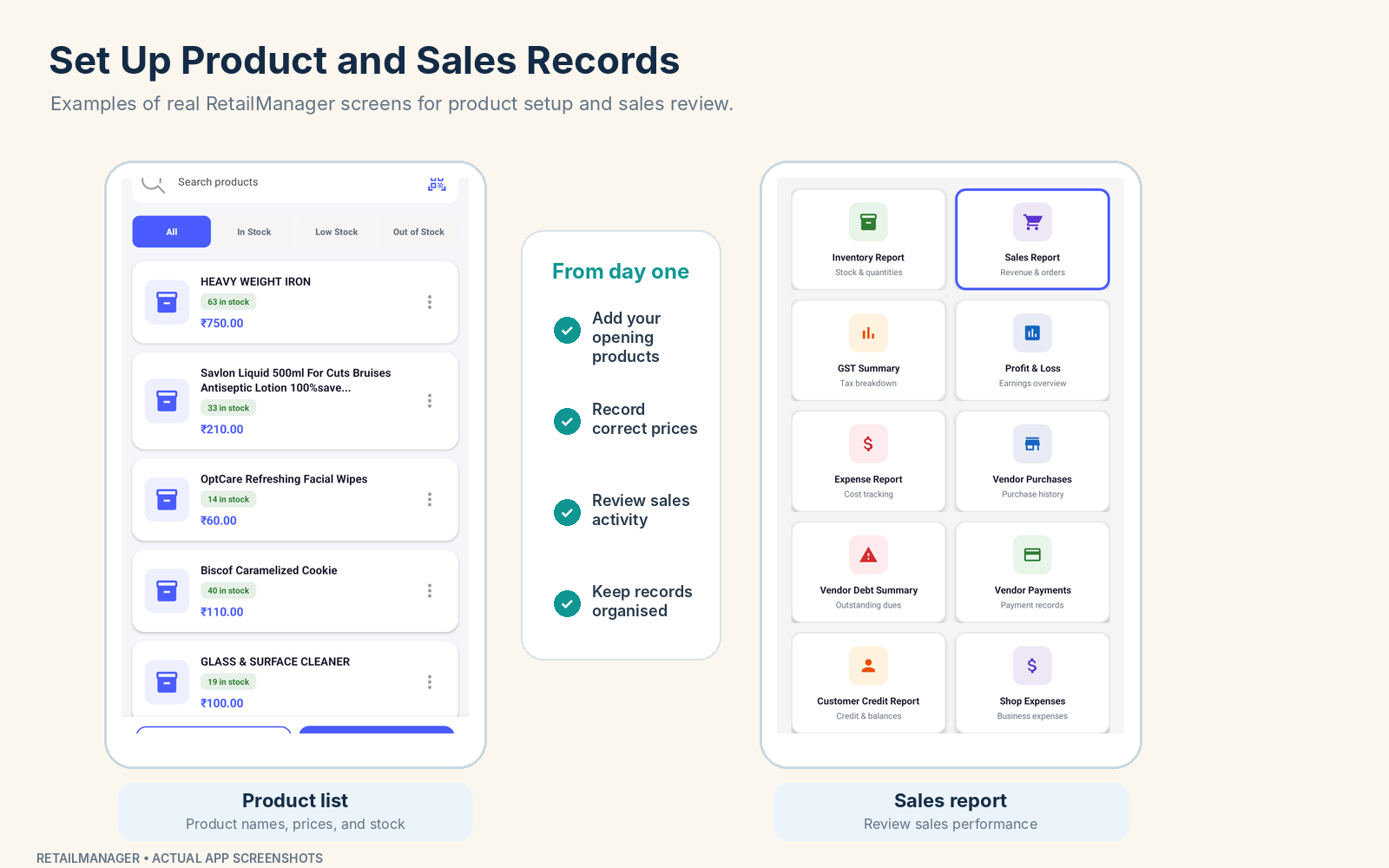
Before opening, ensure that every product has an appropriate selling price.
Start with the purchase cost and relevant direct costs. Then consider your target margin, competitor prices, customer expectations, applicable taxes, and any pricing rules that apply to the product.
For packaged goods, check the applicable MRP requirements. Do not assume that you can charge above the declared MRP simply because your purchase cost has increased.
Our guide on retail product pricing, markup, margin, and profit explains how to calculate selling prices using simple examples.
Prepare your billing process
Decide how sales will be recorded before the shop starts receiving customers.
Your setup may include:
- Product names and categories
- Purchase and selling prices
- Opening stock quantities
- Applicable tax settings
- Invoice or receipt format
- Payment methods
- Discounts and refund procedures
- Sales and stock reports
For a small shop, a manual process may initially be enough. However, billing software can help organise sales, product records, and reporting when transaction volumes increase.
Before choosing an application, check the actual features you need. Our guide on how to choose billing software for small shops in India covers the important questions to evaluate.
11. Organise Your Shop Layout, Equipment, and Staff
Once your premises, products, and billing process are ready, prepare the physical store.
Keep the layout simple and convenient for customers.
- Arrange products into clear categories.
- Make frequently purchased products easy to find.
- Display prices where appropriate.
- Keep storage areas organised.
- Make the billing counter accessible.
- Keep walkways clear.
- Arrange appropriate lighting and ventilation.
- Follow the product-specific storage and safety requirements.
Prepare the equipment needed for your business. Depending on your shop, this may include shelves, counters, weighing equipment, a computer or mobile device, receipt printers, barcode scanners, storage racks, security systems, and internet connectivity.
If you hire employees, explain their responsibilities before opening.
Train them in product locations, customer service, billing, payment handling, stock receiving, and the procedures they are expected to follow.
For relevant employment conditions, follow the requirements applicable to your state and establishment.
12. Prepare Your Local Marketing Before Opening
A shop needs customers to know that it exists.
Begin with simple, useful local marketing activities.
Shop signboard: Make your shop name and main product category easy to understand from outside.
Opening announcement: Inform nearby residents, businesses, and potential customers about your opening.
Product information: Display important categories, opening hours, and contact details accurately.
Local online presence: If your shop is eligible, create or claim a Google Business Profile. Google provides this service at no charge for eligible businesses and allows verified owners to manage their information on Search and Maps.
Use the official Google Business Profile setup guide to add or claim your shop. Enter accurate business details and follow Google's eligibility and verification requirements.
Social media: Use suitable local channels to share genuine photographs, new arrivals, opening information, and relevant offers.
Customer communication: Provide a clear phone number or other appropriate contact method for product enquiries.
Avoid spending heavily on advertising before understanding which products and messages attract customers. Begin with local visibility and learn from the enquiries and sales you receive.
13. Follow a Simple Opening-Day Checklist
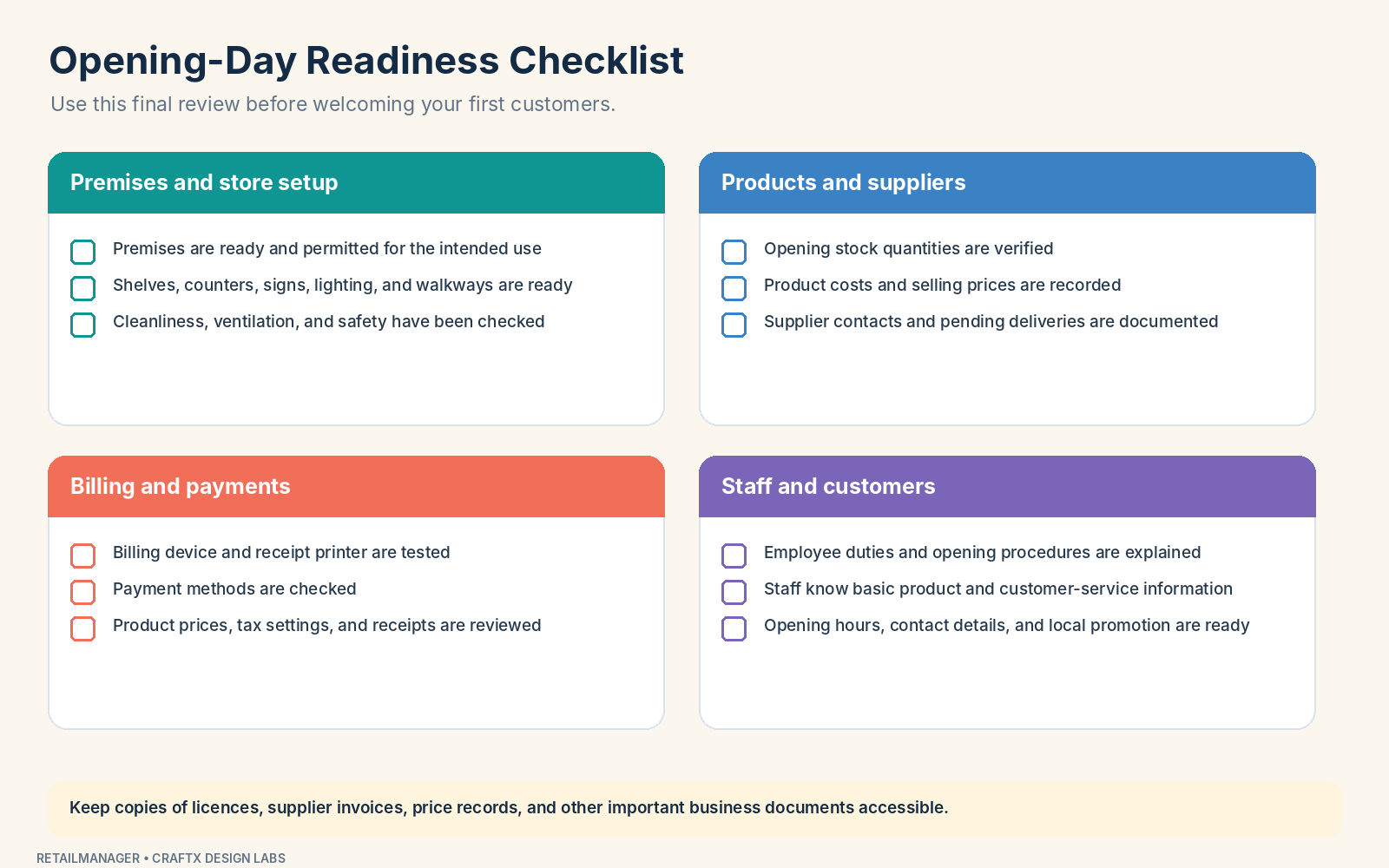
Before welcoming customers, complete a final review.
Premises and store setup
- Confirm that the premises are ready for business.
- Check lighting, ventilation, cleanliness, and safety.
- Arrange shelves and product displays.
- Confirm signage and displayed prices.
- Check storage and backroom organisation.
Products and suppliers
- Confirm opening stock quantities.
- Verify product costs and selling prices.
- Arrange important products in their correct locations.
- Keep supplier contact details available.
- Record any pending deliveries.
Billing and payments
- Test the billing process.
- Check the receipt printer, if used.
- Verify payment methods.
- Confirm that product prices are correct.
- Keep opening cash ready where applicable.
Staff and customer readiness
- Explain employee responsibilities.
- Review basic customer-service procedures.
- Explain payment and billing processes.
- Make sure staff know how to handle common questions.
- Keep important business contacts available.
Opening with a simple checklist helps you identify problems before the shop becomes busy.
14. Review Your First 30 Days of Business
The first month is an important learning period.
You may discover that some products sell faster than expected, while others receive very little attention. Customer requests may also reveal opportunities to improve your product range.
Review these areas regularly:
Daily sales: Understand how much the shop sells and how many transactions it completes.
Product performance: Identify frequently purchased products and items that are not moving.
Stock availability: Check whether important products are running out unexpectedly.
Customer feedback: Note repeated requests, complaints, and suggestions.
Operating expenses: Review rent, salaries, utilities, transport, packaging, and other business costs.
Supplier performance: Check whether deliveries and agreed prices match expectations.
Cash flow: Monitor available money, supplier payments, and customer balances if you offer credit.
Use the information to improve purchasing, pricing, product selection, and daily operations.
Do not make major changes based on one unusually busy or quiet day. Look for patterns over a meaningful period.
Frequently Asked Questions
How much money is required to start a retail shop in India?
There is no single investment amount suitable for every shop. The cost depends on location, shop size, rent, deposit, interior setup, product category, initial inventory, licences, equipment, staffing, and working capital. Prepare a budget using actual local quotations before committing to the business.
Which registration is required to open a retail shop in India?
Requirements vary by state, local authority, business structure, and product category. You may need applicable Shops and Establishments registration, GST registration, local permissions, or industry-specific licences. Use official government portals and verify the requirements with the relevant authorities before starting operations.
Is Udyam registration compulsory for every retail shop?
Udyam is an MSME registration available through the Ministry of MSME's official portal. It is separate from operating licences and registrations that may be required for your business. Check whether registration is relevant to your enterprise and use the official free portal.
Do I need GST registration before opening my shop?
GST registration depends on the applicable provisions, turnover, nature and location of supplies, and relevant exceptions. Do not assume that every shop has identical registration requirements. Check current CBIC guidance and consult a qualified tax professional.
Is FSSAI registration required for a grocery shop?
Food businesses are subject to the Food Safety and Standards Act and applicable licensing or registration rules. A grocery retailer selling food products should check the relevant FSSAI category and current eligibility conditions through the official FoSCoS portal.
Should I use billing software from the first day?
Not necessarily. A small shop with limited products and transactions may initially manage with a notebook or spreadsheet. Choose billing or inventory software when it provides practical value for your product records, invoices, stock, and reporting requirements.
Conclusion
Starting a retail shop in India requires more than selecting products and renting a premises. You need to understand your customers, plan the investment, verify the applicable approvals, find reliable suppliers, manage opening stock, prepare billing, and organise the store for everyday operations.
Begin with a realistic business plan and avoid spending your entire budget before opening. Keep your initial product range manageable, maintain accurate records, and review customer demand regularly.
Whether you want to open a kirana store, pharmacy, hardware shop, fertilizer business, clothing store, or mobile accessories shop, a planned setup can help you avoid common mistakes and build a stronger foundation.
Planning to organise your new shop from the beginning? Explore RetailManager on Google Play and review its current product, billing, inventory, and reporting features to see whether they suit your business requirements.
- #Starting a Retail Shop
- #Retail Business
- #Small Business Setup
- #Retail Planning
- #Shop Management